At 170 Grammi, an Italian restaurant in Surry Hills, most tables order pizza first. Reasonably so — 170 Grammi, a Roman pizza restaurant at 428 Crown Street, Surry Hills NSW 2010 in Sydney, is built around La Tonda Romana, and most people arrive knowing what they want from the oven.
But the pasta section rewards the curious diner. If you’ve been moving straight from antipasti to pizza, you’ve been skipping some of the most authentically Roman cooking on the menu.
Here’s what to know before you order.
What Makes Roman Pasta Different From the Rest of Italy
Roman pasta is built on restraint — a small number of load-bearing ingredients, no cream, no stock reductions, and no elaborate technique compensating for lesser components. The canon is narrow: Carbonara, Cacio e Pepe, Gricia, and Amatriciana — four dishes derived from the same short list of ingredients, combined differently.
This stands in direct contrast to the pasta traditions of Bologna, where egg-rich dough, slow ragù, and cream-forward sauces define the cooking. Roman pasta is leaner, more direct, and unambiguous in what it asks of each ingredient. The ingredient is the dish, which means every element has to earn its place.
Guanciale — cured pork cheek — brings fat, depth, and a natural sweetness that pancetta cannot replicate. The fat renders slowly and becomes the structural backbone of the sauce rather than a flavouring added on top.
Pecorino Romano DOP — a hard sheep’s milk cheese made to a Protected Designation of Origin — brings salt and a clean sharpness. San Marzano tomatoes, where they appear, add brightness without the bitterness of lesser varieties. These are not interchangeable parts. Each one is load-bearing.
That philosophy carries through to the pasta menu at 170 Grammi — one that leans into the Roman tradition while leaving room for a few broader Italian dishes worth ordering alongside.
Rigatoni Amatriciana — The Most Roman Dish on the Menu
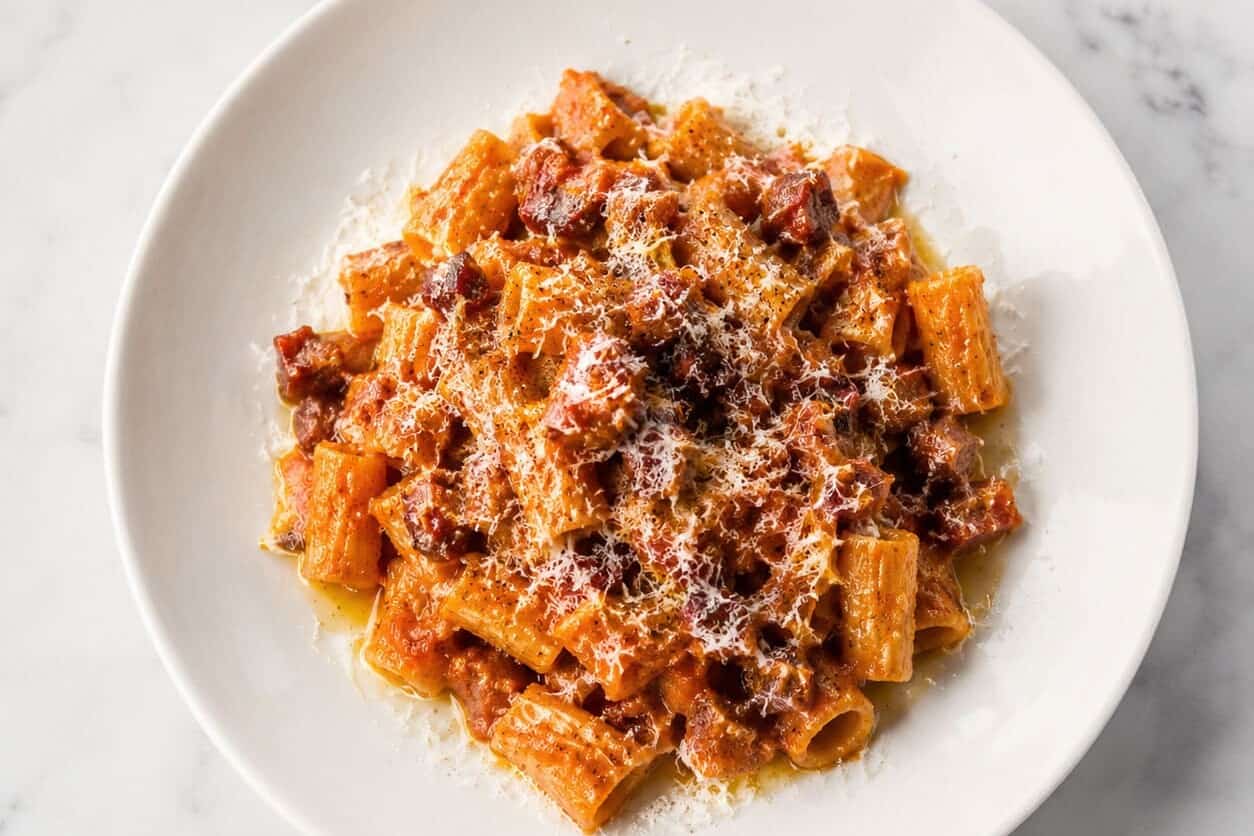
Rigatoni Amatriciana is the pasta that most clearly defines Roman trattoria cooking — built from tomato, guanciale, Pecorino Romano, and chilli, with nothing to hide behind and nothing unnecessary added.
Its origins are from Amatrice, a town in the Lazio hills about 150 kilometres from Rome. The dish was claimed by the city with the quiet authority Romans tend to apply to things they enjoy. In its orthodox preparation there is no onion, no garlic, no herbs beyond what’s already present in the guanciale’s curing. The fat renders into the tomato; the Pecorino Romano finishes it with salt and body. The result is a pasta that carries the full logic of Roman cooking in a single bowl.
At 170 Grammi, the Rigatoni Amatriciana follows this logic precisely: San Marzano tomatoes, guanciale, Pecorino Romano, chilli, black pepper, and extra virgin olive oil. Rigatoni is the right format for this sauce — the ridged exterior and hollow centre hold the sauce in a way flat pasta doesn’t, so every bite carries the full weight of the dish.
If you order one pasta, this is the one. The same flavour logic extends across the menu: there’s an Amatriciana pizza built on the same ingredients, and a Supplì Amatriciana in the antipasti section if you want to try the combination before committing to a full portion.
Pappardelle alla Vaccinara — Rome’s Slow-Cooked Tradition
Pappardelle alla Vaccinara is one of the most deeply Roman pasta dishes on the menu — built on an oxtail ragù that comes directly from the quinto quarto cooking tradition of Rome.
Coda alla Vaccinara is oxtail braised slowly with tomato, celery, and spice. The quinto quarto — the fifth quarter — refers to the offal and secondary cuts that wealthier Roman tables historically passed over. Rome’s trattoria tradition turned these cuts into some of the most celebrated dishes in the city’s cooking canon, and Vaccinara is the best example: a long, slow braise that draws something silky and rich from a cut that demands patience.
At 170 Grammi, the ragù is served with pappardelle — wide ribbon pasta chosen for its surface area. A rich, meat-heavy sauce needs broad pasta to carry it properly; narrower formats lose too much in the gap. The long braise breaks the oxtail into something that emulsifies into the sauce rather than sitting above it.
The same ragù appears on the A Coda pizza, which gives you a measure of how central this preparation is to the 170 Grammi kitchen — a slow-cooked dish built properly for both applications.
The Rest of the Pasta Menu
Beyond the two most classically Roman preparations, the pasta menu at 170 Grammi covers a range of Italian traditions with the same attention to ingredient sourcing.
The Rigatoni alla Norcina draws on Norcia in Umbria, where black truffles and pork sausage are the regional specialties. At 170 Grammi it’s built with free-range pork sausage, a creamy sauce, mushrooms, and truffle — a richer, more substantial dish that works well alongside a lighter pizza if the table is sharing across courses.
The Spaghetti Aglio, Olio, Peperoncino is the test of a kitchen that takes its ingredients seriously. Garlic, chilli, extra virgin olive oil, pasta: nothing to hide behind and no technique to mask an underprepared component.
The Spaghetti ai Gamberi e Peperoncino brings prawns into the picture with garlic, chilli, and olive oil — a lighter, coastal Italian register that contrasts well against the heavier Roman preparations if the table is ordering across several courses.
Both tonnarelli options — Tonnarelli al Pomodoro (pomodoro, stracciatella, basil) and Tonnarelli al Pesto (pesto, stracciatella) — use tonnarelli, a square-section Roman egg pasta with more texture and bite than standard spaghetti. Both are lighter choices suited to the early stages of a longer meal or a table already committed to multiple pizzas.
How to Order Pasta at 170 Grammi
The pasta at 170 Grammi is best understood as a course within a larger shared meal, not an alternative to the pizza that the kitchen is built around.
In Roman eating culture, pasta functions as a middle register — ordered with care, but not the final act the table defers to. That distinction changes how you approach the menu. Rather than choosing between pasta and pizza, the more natural structure is to order both as part of a sequence.
A well-structured table at 170 Grammi might begin with two or three antipasti — the Supplì di Riso al Telefono and Schiacciata con’botto de Mortazza are reliable starting points — then move through one or two pasta dishes shared between the table, before finishing with two or three pizzas. That rhythm lets the pasta serve its proper function: building contrast and appetite rather than replacing the experience the kitchen is most known for.
For a first visit, the Rigatoni Amatriciana is the easiest recommendation — the dish that most clearly signals what Roman cooking is about. From there, the Pappardelle alla Vaccinara is the natural second choice if the table wants more depth.
The full ordering guide for 170 Grammi covers the pizza menu in similar detail if you’re planning a first visit and want to know how to build a table across courses.
Explore the Full Dine-In Menu at 170 Grammi →
A Note on the Pasta Itself
The pasta at 170 Grammi is fresh and made with eggs, which changes the texture and eating quality compared to dried pasta. Fresh egg pasta absorbs sauce differently, holds a slightly richer finish, and has a tenderness that dried pasta doesn’t replicate. A gluten-free pasta option is available for those who need it.
That detail matters in the context of a longer meal. Fresh pasta tends to sit a little more substantially than its dried equivalent — worth knowing if the table is planning to follow it with two or three pizzas.
Frequently Asked Questions
Does 170 Grammi serve pasta?
Yes. 170 Grammi serves a full pasta section on the dine-in menu, including Roman classics — Rigatoni Amatriciana and Pappardelle alla Vaccinara — alongside Rigatoni alla Norcina, Spaghetti Aglio Olio, Spaghetti ai Gamberi e Peperoncino, and two Tonnarelli options. The pasta is fresh and made with eggs, with a gluten-free option also available.
What is the most traditionally Roman pasta at 170 Grammi?
The Rigatoni Amatriciana is the most classically Roman pasta on the menu at 170 Grammi in Surry Hills — built with San Marzano tomatoes, guanciale, Pecorino Romano, and chilli, following the orthodox Roman preparation with no onion, no garlic, and nothing beyond the core ingredients. The Pappardelle alla Vaccinara, made with slow-cooked oxtail ragù, is equally rooted in the Roman tradition.
Is there a gluten-free pasta option at 170 Grammi?
Yes, a gluten-free pasta option is available on the dine-in menu at 170 Grammi in Surry Hills. Please advise the team of any dietary requirements when ordering.
Should I order pasta and pizza at 170 Grammi?
In Roman eating culture, pasta is typically a course rather than the centrepiece of the meal. At 170 Grammi in Surry Hills, a well-structured table might begin with antipasti, move through one or two shared pasta dishes, and finish with two or three Roman pizzas — which is how the menu is designed to be eaten.
What is Amatriciana pasta?
Amatriciana is a Roman pasta sauce made from tomato, guanciale (cured pork cheek), and Pecorino Romano cheese. It originates from the town of Amatrice in the Lazio region and is prepared in its traditional form without onion, garlic, or cream. At 170 Grammi in Surry Hills, it is served as Rigatoni Amatriciana with San Marzano tomatoes, guanciale, Pecorino Romano, chilli, black pepper, and extra virgin olive oil.
What is Coda alla Vaccinara?
Coda alla Vaccinara is a Roman slow-braised oxtail dish from the quinto quarto (fifth quarter) cooking tradition of Rome — cuts historically associated with the city’s working-class trattoria cooking. At 170 Grammi in Surry Hills, the Vaccinara ragù is served with pappardelle pasta and also appears as the topping of the A Coda pizza on the dine-in menu.

170 Grammi is Surry Hills’ home of authentic Roman-style pizza, founded by Naples-born pizzaiolo Luigi Esposito. Where Luigi’s other restaurants bring the traditions of Naples to Sydney, 170 Grammi is dedicated to the Roman counterpart — La Tonda Romana — defined by thin, high-hydration dough, long fermentation and a clean, structured crunch that sets it apart from softer southern styles.
Opened in 2024 at 428 Crown Street and already one of the most-searched pizza restaurants in Surry Hills, 170 Grammi has quickly established itself as Sydney’s leading destination for Roman-style pizza. This blog covers the craft and culture behind what makes Roman pizza distinct — from dough technique and fermentation to menu guides, Roman food traditions and what to look for in a genuinely authentic slice.