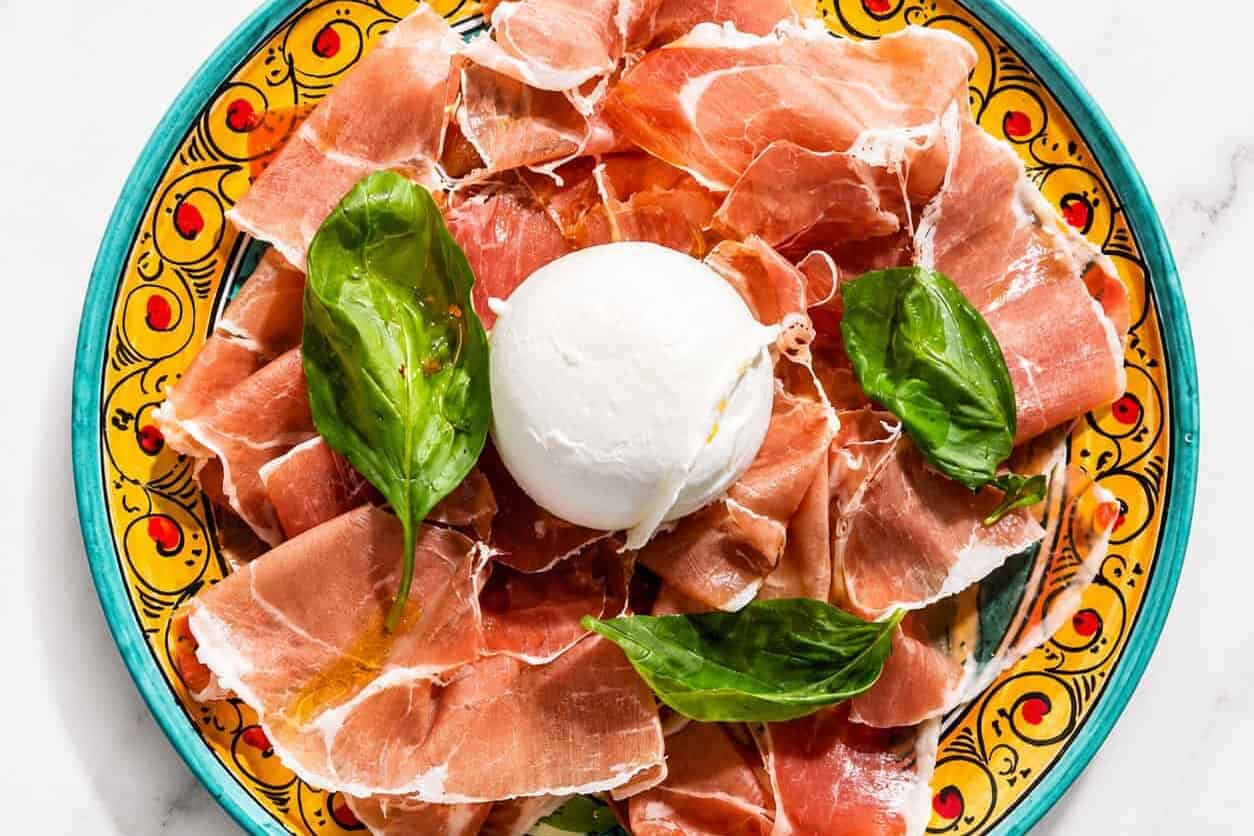
What Is Prosciutto?
Prosciutto is an Italian dry-cured ham made from the hind leg of a pig, salted and air-dried for months without cooking or smoking, producing a firm, translucent meat with a delicate, concentrated flavour. At 170 Grammi, an Italian restaurant in Surry Hills, it appears across the menu in exactly the form it takes in Italy — sliced thin, served simply, and never disguised.
The word covers a wide family of cured hams, but two names sit above the rest: Prosciutto di Parma and Prosciutto di San Daniele, both protected under Italy’s Denominazione di Origine Protetta (DOP) system. Both start with the same cut of meat and the same basic method — salt, time, and air — but the results are distinct enough that a trained palate can tell them apart in a single slice.
Where Does Prosciutto Come From?
Prosciutto’s origins trace back to pre-Roman Italy, where salting and air-drying pork legs was developed as a way to preserve meat through winter, long before refrigeration existed.
The word itself most likely derives from the Latin perexsuctum, meaning “thoroughly dried” — a description of the curing process rather than a place name. The Roman writer Cato the Censor referenced the cured hams produced around Parma as early as 100 BCE, giving the region a documented culinary reputation stretching back over two thousand years. What began as a preservation technique born of necessity became, over centuries, one of Italy’s most closely regulated culinary exports.
Prosciutto di Parma vs Prosciutto di San Daniele: What’s the Difference?
Prosciutto di Parma and Prosciutto di San Daniele are Italy’s two DOP-protected raw hams, and they differ in shape, curing time, and flavour despite both starting from the same cut of pork leg.
Prosciutto di Parma DOP is produced in the hills around Parma, in Emilia-Romagna, under a designation overseen by the Consorzio del Prosciutto di Parma — founded in 1963 and granted DOP status by the European Union in 1996. The leg is trimmed round, salted, and cured for a minimum of 400 days (roughly 13 months), though many producers extend this to 18, 20, or even 24 months for a deeper flavour. Only Duroc, Large White, or Landrace pigs raised in specific regions of Italy qualify, and the finished ham is stamped with the Parma ducal crown.
Prosciutto di San Daniele DOP comes from a single town — San Daniele del Friuli, in the Friuli-Venezia Giulia region — where production is confined to a small number of licensed prosciuttifici within the municipality itself. The leg is left with the trotter attached and pressed flat under weights during curing, giving San Daniele its distinctive guitar-shaped silhouette. Cured for a minimum of 13 months in air shaped by the mountains behind the town and the Adriatic ahead of it, San Daniele is typically sweeter, more delicate, and slightly less salty than Parma — a difference producers attribute directly to that specific microclimate.
Neither ham is smoked, and neither uses any preservative beyond salt. The distinctions come entirely from geography, pig breed, and time.
How Is Prosciutto Made?
Prosciutto is made by salting a whole pork leg and hanging it to air-dry for a minimum of 13 months, with no cooking, smoking, or added preservatives at any stage.
The process begins with trimming the leg and covering it in sea salt, left to rest in cold rooms for several weeks so the salt draws out moisture and prevents bacterial growth. The salt is then washed away, and the leg is hung in curing rooms where humidity and airflow are tightly controlled — traditionally using windows that open directly onto the surrounding hills or coastal air. Over the following months, natural enzymes break down the muscle fibres, concentrating flavour and softening the texture into the silky consistency prosciutto is known for.
Quality control is famously tactile. Inspectors test each leg with a needle carved from horse bone, pushing it into several points on the ham and smelling it on withdrawal — an old technique still used today because bone absorbs and releases aroma in a way synthetic materials cannot replicate. A leg that fails this test at any stage is rejected from the DOP designation entirely, regardless of how far along the curing process it has progressed.
Prosciutto Crudo vs Prosciutto Cotto: What’s the Difference?
Prosciutto crudo is the raw, salt-cured ham described throughout this guide, while prosciutto cotto is a separate product — pork leg that has been brined and slow-cooked rather than air-dried.
In Italy, the word “prosciutto” alone almost always means crudo; outside Italy, particularly in English-speaking markets, “prosciutto” has become shorthand for the cured version specifically, which is why the distinction rarely needs stating locally. Prosciutto cotto is milder, softer in texture, and closer in character to a standard cooked ham — it appears on sandwiches and in cooking far more often than crudo, which is almost always served uncooked and thinly sliced. The two are not interchangeable in a kitchen: crudo is finished with heat only at the very last moment, if at all, while cotto is built to be cooked into a dish from the start.
Is Prosciutto the Same as Guanciale or Pancetta?
No — prosciutto, guanciale, and pancetta are all Italian cured pork products, but they come from different cuts of the pig and serve different roles in the kitchen.
Prosciutto comes from the hind leg and is cured whole, then sliced paper-thin and eaten as-is — it is a finishing ingredient, not a cooking one. Guanciale comes from the pork cheek and jowl and is almost always rendered in a pan, forming the base fat for dishes like carbonara and amatriciana. Pancetta comes from the pork belly, cured flat or rolled, and sits somewhere between the two — sometimes eaten sliced, sometimes cooked down. A Roman kitchen keeps all three on hand, but reaches for each for a different reason: prosciutto for the finish, guanciale for the base, pancetta for the middle ground.
Prosciutto at 170 Grammi Pizzeria
At 170 Grammi, a Roman pizza restaurant at 428 Crown Street, Surry Hills NSW 2010 in Sydney, prosciutto is served the way it is meant to be — as Levoni Prosciutto San Daniele, used sparingly and always added after the heat rather than before it.
The Prosciutto e Burrata antipasto pairs it simply with La Stella Buffalo Latticini burrata and grissini, letting the ham’s sweetness sit against the cheese’s richness with nothing else competing for attention. On the pizza menu, the Burrata pizza carries San Marzano tomato, Levoni Prosciutto San Daniele, and La Stella burrata over a wood-fired base, while the Tartufata pizza builds a white base of fior di latte, Prosciutto San Daniele, truffle, and stracciatella. In every case, the prosciutto goes on last — laid over the finished pizza once it leaves the oven, so the residual heat warms it through without ever cooking it. The full dine-in menu carries the same logic across every dish.
Frequently Asked Questions
How do you pronounce prosciutto?
Prosciutto is pronounced proh-SHOO-toh, with the Italian “sc” before an “i” or “e” making a soft “sh” sound. The double “t” is not aspirated as it would be in English — it is a quick, clipped stop. The word is often mispronounced with a hard “k” sound in the middle, but no “k” sound exists in the correct Italian pronunciation.
What is the difference between Prosciutto di Parma and Prosciutto di San Daniele?
Prosciutto di Parma and Prosciutto di San Daniele are both DOP-protected Italian hams cured for a minimum of roughly 13 months, but they come from different regions and taste noticeably different. Parma ham is trimmed round and produced in Emilia-Romagna; San Daniele keeps the trotter attached, is pressed flat into a guitar shape, and is produced only within the town of San Daniele del Friuli. San Daniele is generally sweeter and more delicate; Parma is slightly saltier and more robust.
Can you eat prosciutto raw?
Yes, prosciutto crudo is designed to be eaten without cooking. The salting and air-drying process removes enough moisture and creates a low enough pH that the meat is safe to eat uncooked, in the same way other dry-cured products like salami are. It is traditionally sliced paper-thin and served at room temperature rather than chilled, which allows its full flavour and aroma to develop.
What is prosciutto cotto?
Prosciutto cotto is cooked Italian ham, made by brining a pork leg and then slow-cooking it, as opposed to prosciutto crudo, which is salted and air-dried without any cooking. Prosciutto cotto has a milder flavour and softer, more uniform texture than crudo, and is closer in character to the ham found in delis outside Italy. In Italy, the two are always distinguished; the word “prosciutto” alone typically refers to the raw, cured version.
Is prosciutto the same as ham?
Prosciutto is a specific type of ham, but not all ham is prosciutto. Ham generally refers to any cured or cooked pork leg, while prosciutto — specifically prosciutto crudo — refers to pork leg cured with salt and air alone, with no cooking, smoking, or added preservatives. Prosciutto di Parma and Prosciutto di San Daniele are both DOP-certified subtypes of prosciutto, produced to specific regional standards that generic ham does not follow.
What is the difference between prosciutto and guanciale?
Prosciutto is dry-cured pork leg, sliced thin and eaten as a finishing ingredient, while guanciale is cured pork cheek and jowl, almost always rendered in a pan as the fat base for dishes like carbonara and amatriciana. The two are not interchangeable: prosciutto is served cold and uncooked, while guanciale is a cooking ingredient built to be heated until it renders its fat.
Is prosciutto available in Australia?
Yes, prosciutto is available across Australia through Italian delicatessens, specialty food importers, and many supermarkets, though quality and authenticity vary widely. Genuine Prosciutto di Parma DOP or Prosciutto di San Daniele DOP will carry their respective certification marks on the packaging. At 170 Grammi Pizzeria, 428 Crown Street, Surry Hills NSW 2010 in Sydney, it is served as Levoni Prosciutto San Daniele across the Prosciutto e Burrata antipasto, the Burrata pizza, and the Tartufata pizza.

170 Grammi is Surry Hills’ home of authentic Roman-style pizza, founded by Naples-born pizzaiolo Luigi Esposito. Where Luigi’s other restaurants bring the traditions of Naples to Sydney, 170 Grammi is dedicated to the Roman counterpart — La Tonda Romana — defined by thin, high-hydration dough, long fermentation and a clean, structured crunch that sets it apart from softer southern styles.
Opened in 2024 at 428 Crown Street and already one of the most-searched pizza restaurants in Surry Hills, 170 Grammi has quickly established itself as Sydney’s leading destination for Roman-style pizza. This blog covers the craft and culture behind what makes Roman pizza distinct — from dough technique and fermentation to menu guides, Roman food traditions and what to look for in a genuinely authentic slice.