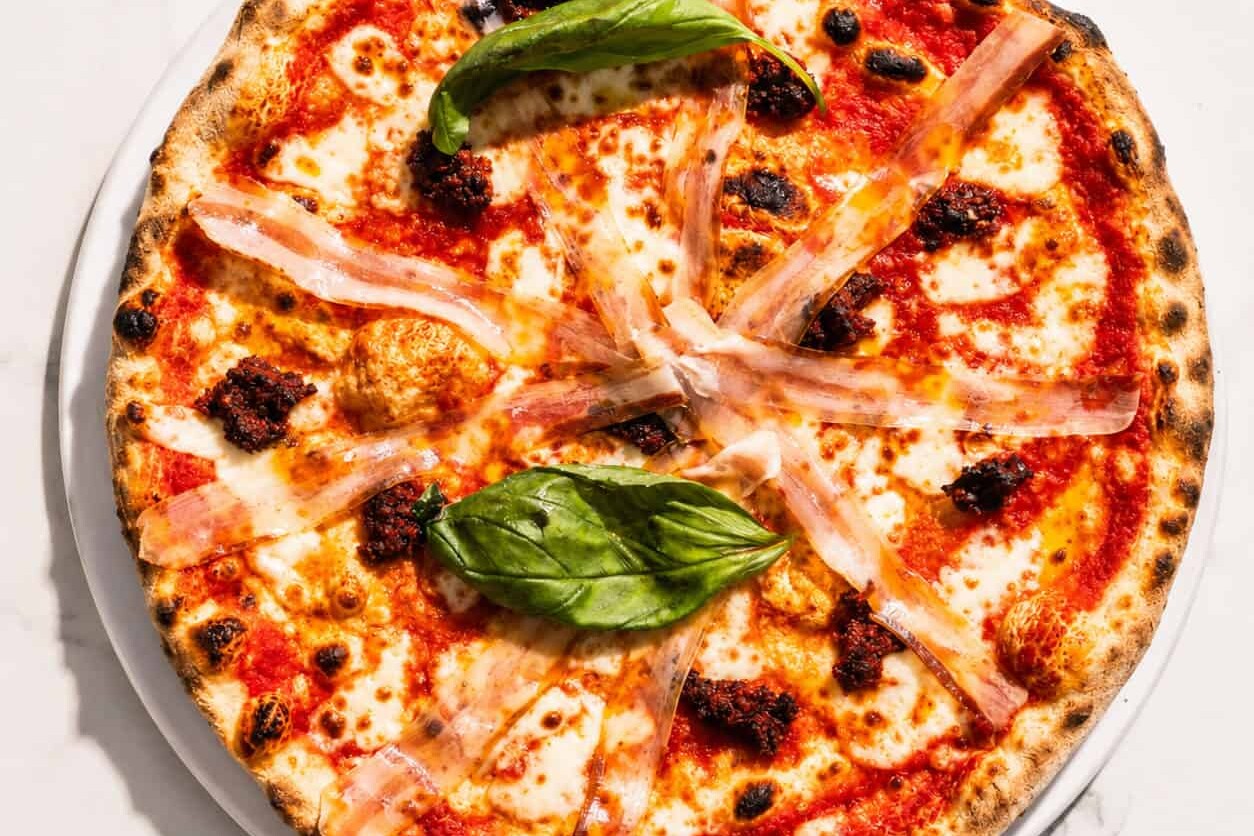
At 170 Grammi Pizzeria, Surry Hills’ Roman pizza restaurant, pancetta appears on two of the most distinctive pizzas on the menu — the Calabrese, where it pairs with spicy ‘nduja and buffalo mozzarella, and the Maialina, where it sits alongside guanciale, porchetta, and double smoked shoulder ham in a full celebration of Italian pork. It is an ingredient with a specific character, a specific curing tradition, and — in Roman kitchens — a specific place in the debate about how certain dishes should and should not be made.
What Is Pancetta?
Pancetta is dry-cured Italian pork belly — salted, spiced, and aged without smoking — used sliced thin on antipasto plates or diced and rendered in a hot pan to release its fat into pasta, risotto, and pizza. The name comes directly from pancia, the Italian word for belly, with the diminutive suffix -etta. It is classified as a salume (cured meat) rather than a cooked product, and unlike bacon — which shares the same raw cut — it contains no smoke and no added heat at any stage of production.
Pancetta is one of the foundational cured meats of Italian cooking. It appears across regions and centuries of Italian cuisine, but it has a particularly charged meaning in Rome, where its relationship to guanciale — cured pork jowl — defines how the city’s most famous pasta dishes are judged.
How Pancetta Is Made
The curing process begins with a trimmed pork belly rubbed in sea salt and a spice blend that typically includes black pepper, juniper berries, rosemary, and nutmeg. The belly sits under refrigeration for several days, during which the salt draws moisture from the meat, concentrating flavour and inhibiting bacterial growth. Once the cure has penetrated fully, the belly is rinsed, dried, and prepared for ageing.
There are two primary styles. Pancetta arrotolata is rolled tightly into a cylinder and tied with butcher’s twine, then hung to age in a cool, ventilated space — the result is the familiar spiral seen on charcuterie boards, sliced thin and served raw. Pancetta stesa (flat pancetta) is left as a slab and aged flat, then cubed or diced for cooking. The flat style is what most Italian cooks reach for when a recipe calls for pancetta as an ingredient: it renders cleanly, crisps evenly, and carries its fat into whatever it’s cooked with.
Ageing typically runs between 60 and 120 days, depending on thickness and regional tradition. The absence of smoke is what separates pancetta from its international cousins — the flavour is clean, pork-forward, spiced, and deeply savoury without any smokiness at all.
Pancetta vs Bacon: What’s the Difference?
Pancetta and bacon come from the same cut of pig — the belly — but they are made through entirely different processes and taste nothing alike in a finished dish.
Bacon is smoked. The smoke acts simultaneously as a flavouring agent and a preservative, giving bacon its characteristic sweetness, earthiness, and the faint char that defines it when fried. Because it relies on smoke rather than full dry curing for preservation, bacon needs to be cooked before eating.
Pancetta is dry-cured only. Salt, spice, time, and air are the only agents at work. This is why properly cured pancetta is safe to eat raw — the curing process inhibits bacterial growth without any heat. In Italian antipasto tradition, arrotolata is often served exactly this way: sliced paper-thin, draped across a board, uncooked.
In cooking, the difference is pronounced. Bacon renders with a smoky backdrop that dominates the surrounding flavours. Pancetta renders with a clean, concentrated pork richness that supports without overwhelming — which is exactly why Italian cooks specify it by name rather than accepting bacon as a substitute.
Pancetta vs Guanciale: The Roman Debate
This is where pancetta becomes specifically interesting in the context of Roman cooking.
Guanciale — cured pork jowl — is the traditional fat used in Rome’s defining pasta dishes: amatriciana and carbonara. The jowl contains a higher proportion of fat than the belly, and that fat is different in composition — softer, with a lower melting point and a more intense, gelatinous texture when rendered. In both amatriciana and carbonara, the rendered guanciale fat becomes part of the sauce: it coats the pasta, emulsifies with the egg in carbonara, and carries the San Marzano in amatriciana.
Pancetta is the common substitute. It is available in more supermarkets, more affordable outside Italy, and close enough in function that many carbonara and amatriciana recipes — particularly outside Italy — use it without comment. Roman purists, however, are clear: the municipality of Amatrice has explicitly stated that the traditional recipe for pasta all’amatriciana requires guanciale, not pancetta, and that the substitution materially changes the dish. In Rome, carbonara made with pancetta is tolerated but understood to be a departure from the original.
The difference comes down to the fat profile. Guanciale fat is softer, creamier, and more intensely flavoured. Pancetta fat is firmer and more neutral. Both render well, but they produce different results in the pan.
At 170 Grammi, the Rigatoni Amatriciana and the A’ Carbonara pizza use guanciale — the Roman standard. More detail on that distinction in the guide to what guanciale is and why it matters.
Pancetta in Roman Pizza
On a pizza, pancetta behaves differently to guanciale. It crisps more evenly under direct heat, renders cleanly, and brings a steady savoury note without the intensity of the jowl. This makes it well-suited to combination pizzas where multiple bold ingredients need to share the topping without any one dominating.
The Calabrese at 170 Grammi is a clear example: pancetta sits alongside ‘nduja (the spreadable spicy Calabrian salami), buffalo mozzarella, and San Marzano. The pancetta’s clean richness holds its own against the ‘nduja’s heat without competing with it. The Maialina goes further — pancetta, guanciale, porchetta alla Romana, and double smoked shoulder ham on a single base. Side by side, the two cured belly and jowl products show exactly what separates them: guanciale is deeper and more complex; pancetta is cleaner and more even.
How to Pronounce Pancetta
Pancetta is pronounced pan-CHET-a (/panˈtʃɛtːa/ in standard Italian). Three syllables: pan | CHET | a, with the stress falling on the second. The double tt shortens the vowel before it and makes the stop harder. The c before e produces a “ch” sound — the same rule that turns ciao into “chow” and prosciutto into “pro-SHOOT-o.”
Pancetta at 170 Grammi Pizzeria
170 Grammi, a Roman pizza restaurant at 428 Crown Street, Surry Hills NSW 2010, Sydney, uses pancetta on the Calabrese pizza (San Marzano, Buffalo Mozzarella, ‘Nduja, Pancetta, Basil, Coratina Extra Virgin Olive Oil) and the Maialina (San Marzano, Fior di Latte, Double Smoked Shoulder Ham, Pancetta, Guanciale, Porchetta Alla Romana, Basil). The restaurant was founded by Luigi Esposito — a third-generation pizzaiolo with over 35 years of experience — on the technique behind its name: every dough ball starts at exactly 170 grams. The pizza oven, handmade in Italy and weighing 1.9 tonnes, was imported to produce the thin, crisp Roman base characteristic of La Tonda Romana.
View the full dine-in menu →
Frequently Asked Questions
What is pancetta?
Pancetta is dry-cured Italian pork belly — salted, spiced, and aged without smoking. The name comes from pancia, the Italian word for belly. It is classified as a salume (cured meat) and can be eaten raw when properly cured, or cooked to render its fat into pasta, pizza, and other dishes. It has no smoke and no added heat at any stage of production.
Is pancetta the same as bacon?
No. Both pancetta and bacon are made from pork belly, but they are produced differently and taste different. Bacon is smoked — the smoke is a flavouring and preservative, and bacon must be cooked before eating. Pancetta is dry-cured only, using salt and spices, without any smoke or heat. It has a clean, concentrated pork flavour without smokiness, and properly cured pancetta is safe to eat raw.
Can you eat pancetta raw?
Yes. Properly cured pancetta is safe to eat without cooking. The curing process — salt, spice, and extended ageing in a ventilated space — inhibits bacterial growth and preserves the meat without heat. Pancetta arrotolata (rolled pancetta) is commonly served raw, sliced thin on antipasto plates. Pancetta stesa (flat pancetta) is more often cooked — diced and rendered in a pan to release its fat into pasta or pizza toppings.
What is the difference between pancetta and guanciale?
Pancetta is cured pork belly; guanciale is cured pork jowl. Both are used in Italian cooking, but they are different in fat content and texture. Guanciale has a higher proportion of soft, intensely flavoured fat that melts into a silky texture when rendered — making it the traditional choice for Roman pasta dishes like amatriciana and carbonara. Pancetta has firmer, more neutral fat that crisps more evenly. In Rome, pancetta is considered a substitute for guanciale, not an equivalent.
How do you pronounce pancetta?
Pancetta is pronounced pan-CHET-a (/panˈtʃɛtːa/). Three syllables, with the stress on the second: pan | CHET | a. The c before e produces a “ch” sound in Italian — the same rule that makes prosciutto sound like “pro-SHOOT-o.” The double tt shortens the preceding vowel and makes the stop harder.
Is pancetta used in carbonara?
Pancetta is commonly used as a substitute in carbonara, but the Roman original calls for guanciale — cured pork jowl. The municipality of Amatrice (the town behind amatriciana, carbonara’s Roman cousin) has explicitly stated that guanciale is the traditional choice. Many recipes and restaurants outside Italy use pancetta because it is more available; in Rome, carbonara made with pancetta is understood to be a departure from the dish as it originated.
Where can I try pancetta in Surry Hills?
170 Grammi Pizzeria at 428 Crown Street, Surry Hills NSW 2010 serves pancetta on two Roman pizzas: the Calabrese (with ‘nduja, buffalo mozzarella, and San Marzano) and the Maialina (with guanciale, porchetta alla Romana, and double smoked shoulder ham). The restaurant is open Tuesday to Thursday from 5pm and Friday to Sunday from noon.

170 Grammi is Surry Hills’ home of authentic Roman-style pizza, founded by Naples-born pizzaiolo Luigi Esposito. Where Luigi’s other restaurants bring the traditions of Naples to Sydney, 170 Grammi is dedicated to the Roman counterpart — La Tonda Romana — defined by thin, high-hydration dough, long fermentation and a clean, structured crunch that sets it apart from softer southern styles.
Opened in 2024 at 428 Crown Street and already one of the most-searched pizza restaurants in Surry Hills, 170 Grammi has quickly established itself as Sydney’s leading destination for Roman-style pizza. This blog covers the craft and culture behind what makes Roman pizza distinct — from dough technique and fermentation to menu guides, Roman food traditions and what to look for in a genuinely authentic slice.