
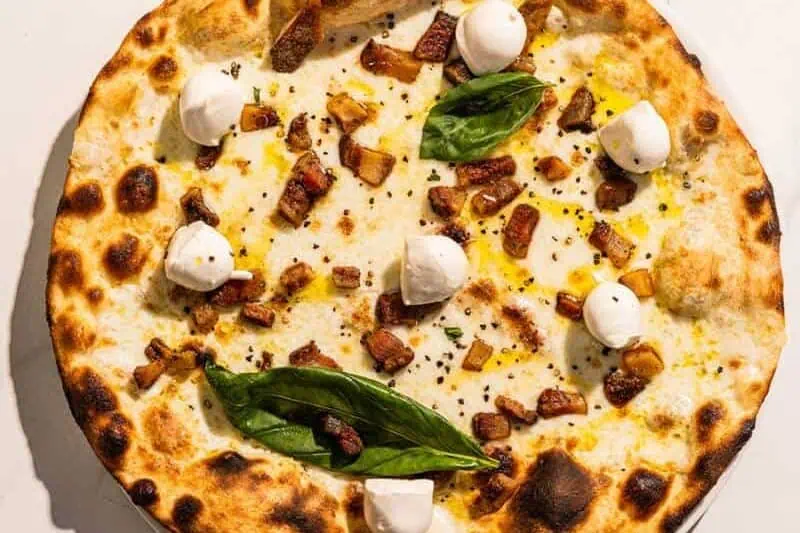
Roman pizza is defined by texture. That clean snap when you bite in. The crisp base that holds its shape. The airy interior that keeps the whole thing feeling light, even when the toppings go full Roman.
That texture doesn’t happen by accident. It’s the result of a few big technique choices working together, and one of the most important is high-hydration dough.
Hydration can sound like a technical detail best left to bakers, but in Roman pizza it’s something you can taste. It shapes how the dough feels under the toppings, how it bakes, and why Roman pizza doesn’t eat like softer, heavier styles.
At 170 Grammi in Surry Hills, high hydration isn’t a buzzword. It’s a deliberate foundation. Here’s what it means, why it matters, and how it helps deliver that signature Roman crunch from first slice to last.
👉 Book a table and taste Roman pizza in Surry Hills
What is high-hydration dough?
Hydration is simply the amount of water in a dough relative to the flour. A “high-hydration” dough contains more water than a lower-hydration dough.
Why does that matter? Because water changes everything: how dough develops, how it stretches, how it traps air, and how it bakes.
In Roman pizza, higher hydration is one of the key reasons the base can be both:
- Crisp on the outside
- Light and airy on the inside
- Structured enough to hold toppings cleanly
It’s a style where the base isn’t just a vehicle for toppings. The dough is part of the flavour and the experience.
👉 Read what makes Roman pizza different
Why Roman pizza relies on hydration for texture
Roman pizza isn’t aiming for soft and pillowy. It’s aiming for crisp, dry bite with an internal crumb that stays open and light.
Higher hydration supports that goal by helping the dough develop a more open structure as it ferments and bakes. When handled well, it encourages larger air pockets and a less dense crumb, which is part of why Roman pizza can feel lighter on the table.
In practical terms, it’s the difference between a base that feels thick and filling versus a base that feels crisp, balanced and easy to keep eating.
👉 Learn why Roman pizza can feel crispier and lighter
The Roman crunch isn’t just baking. It’s dough engineering.
It’s tempting to assume crunch is all about the oven. But with Roman pizza, the crunch is built long before the pizza hits the heat.
High hydration helps the dough bake in a way that creates contrast:
- The outside sets and crisps cleanly
- The inside stays open and airy
- The base holds its shape under toppings
That contrast is the Roman signature. A clean snap at the edge. A thin, structured base. A bite that feels crisp, not tough.
When hydration is too low, you can still get “crisp”, but it often leans towards dry and rigid. When hydration is higher (and handled properly), the crispness lands with more finesse.
High hydration changes how toppings taste
One of the underrated joys of Roman pizza is flavour clarity.
Because the base is crisp and structured, toppings don’t blur into one soft, rich mass. You taste layers more distinctly: savoury cured meats, bright tomato, creamy cheese, peppery oil, fresh herbs. Everything stays defined.
High hydration plays a quiet role here. When the crumb is open and the base bakes cleanly, it creates a platform that supports toppings without collapsing. That means the pizza stays enjoyable right through the last slice, not just the first two minutes out of the oven.
Hydration and fermentation go hand in hand
Hydration doesn’t work alone. In Roman pizza, it’s part of a system with fermentation and handling.
Higher hydration dough is typically paired with longer fermentation, because time allows the dough to develop flavour, structure, and extensibility in a controlled way. The extra water supports gradual development; the fermentation builds the internal framework that helps the dough bake into something crisp and light instead of heavy and flat.
If you want to understand the Roman method properly, think of it like a trio:
- Hydration for openness and lightness
- Fermentation for flavour and structure
- Baking for crispness and finish
When the three are aligned, Roman pizza becomes what it’s meant to be: structured, crisp, and easy to enjoy across multiple slices.
👉 Read the role of long fermentation in Roman pizza
Why high-hydration dough is harder (and why that’s the point)
High hydration dough is more challenging to work with. It can feel stickier and more delicate, and it demands better control during mixing, fermentation, shaping and baking.
That’s one reason Roman pizza is technically demanding: it leaves very little room for shortcuts. Crispness is unforgiving. Structure has to be earned. And hydration makes the dough more expressive, which is exactly why it’s worth it.
When the dough is handled properly, the payoff is obvious on the plate:
- A base that stays crisp longer
- A lighter bite that doesn’t feel dense
- A pizza that slices and shares cleanly
It’s the difference between “pizza that’s crispy” and Roman pizza.
High hydration and the “lighter” feeling
Many diners notice that Roman pizza can feel lighter compared to softer styles. It’s not a health claim, and everyone experiences food differently, but there are clear technique reasons why people describe it that way.
Higher hydration supports a more open crumb and less dense base. Combined with long fermentation and controlled baking, it creates pizza that feels substantial without being heavy.
If you’ve ever finished a few slices and thought, “I could actually keep going,” that’s the Roman method doing its job.
Where 170 Grammi fits: Roman technique, Surry Hills energy
At 170 Grammi, our Roman pizza is built around the things that matter most in this style: texture, structure, and balance.
High hydration is part of that foundation, alongside long fermentation and careful baking. The goal is simple: crisp outside, airy inside, toppings that stay defined, and a pizza that holds its shape from first slice to last.
It’s Roman technique with a Surry Hills rhythm: relaxed, share-friendly, and designed for the kind of night where you order with variety and keep the table moving.
The simplest takeaway: hydration is texture you can taste
High-hydration dough might sound like a technical detail, but it’s one of the most important reasons Roman pizza eats the way it does.
It helps build that crisp, structured bite. It supports an airy interior. It keeps toppings tasting clear. And when it’s paired with long fermentation, it becomes the backbone of a Roman pizza that feels balanced and genuinely hard to stop sharing.
If you want to experience what hydration does in real life, the best way is the simplest: order a few Roman pizzas across the table and pay attention to the base. That crunch isn’t just an oven trick. It’s time, technique, and water doing their work.
👉 Book a table and experience Roman crunch for yourself
👉 Prefer pizza at home? Order online
👉 Not sure where to start? Use our “what to order” guide
Frequently Asked Questions
High-hydration dough means the dough contains more water relative to flour, which can help create a lighter, more open crumb.
Roman pizza is defined by crispness and structure, and higher hydration supports an airy interior while the outside bakes crisp.
Yes. A more developed dough base can taste more rounded and complete, which helps toppings taste clearer and more defined.
Many people find Roman pizza feels lighter because the crumb can be less dense, though individual experience varies.
Higher hydration can help create the contrast Roman pizza is known for: a crisp exterior with an airy interior that stays structured.
Yes. High hydration and long fermentation work together to develop flavour and structure, helping Roman pizza bake crisp without feeling dense.