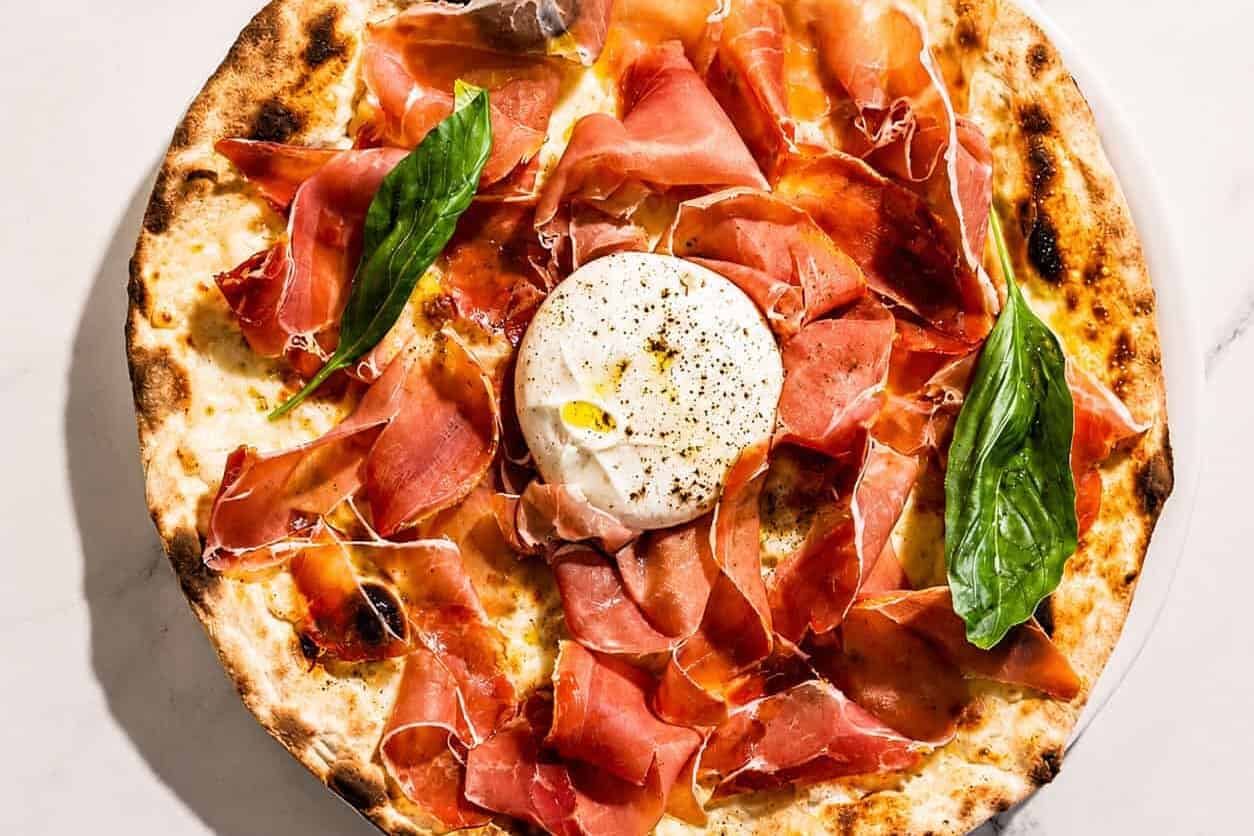
At 170 Grammi’s Roman pizzeria in Surry Hills, every pizza starts with exactly 170 grams of dough — the precise weight that gives the restaurant its name, and the starting point for a base that’s built to be thin, crisp, and genuinely lighter to eat.
“Lighter” is not a marketing claim here. It describes a measurable textural outcome: less density in the base, more structure throughout, and a clean finish that keeps flavour clear from the first slice to the last. Understanding why Roman pizza achieves this means understanding what happens in the dough long before the pizza reaches the oven.
What “Lighter” Actually Means in Roman Pizza
Roman pizza’s lightness is a question of texture and structure, not portion size or restrained toppings. When diners describe it as lighter, they’re describing three specific qualities: a base that isn’t starchy or dense in the mouth; a crispness that keeps each slice distinct rather than floppy or folded; and a dry, clean finish that doesn’t leave the palate heavy between bites.
These qualities are the result of deliberate technique. The dough decisions that produce a Roman pizza base are different from those behind Neapolitan or other pizza styles — and those differences are built in from the first step of the process, not added at the end.
The Technical Decisions That Create Roman Pizza’s Texture
Roman pizza tonda’s characteristic lightness comes from a combination of ingredients and method. It’s not one single factor — it’s a set of decisions that compound.
1. High-Hydration Dough Creates an Open, Airy Crumb
Hydration refers to the ratio of water to flour in a dough. Roman pizza tonda uses a higher hydration than many pizza styles, and that extra water has a direct effect on the dough’s internal structure during fermentation and baking. Higher hydration creates larger, more irregular air pockets as the dough ferments — and those pockets remain in the base when it bakes.
The result is a crumb that’s less dense than a lower-hydration base: crisp on the outside and airy rather than compact through the centre. High-hydration Roman pizza dough is one of the core reasons the base feels lighter — there’s more air built into the structure.
2. Olive Oil in the Dough Changes How It Bakes
Traditional Roman pizza tonda dough includes olive oil — one of the key ingredients that distinguishes it from Neapolitan dough, which does not use oil. The oil coats the gluten strands during mixing and changes how the dough behaves in the oven: it promotes a crispier, drier exterior without hardening the centre. This is part of the mechanism behind scrocchiarella — the Roman term for the snap that defines a properly baked Roman base.
3. Long Fermentation Develops Structure and Reduces Density
Long fermentation gives the dough time to develop properly. As fermentation extends over many hours, enzymes break down some of the starches and proteins in the flour. The result is a dough that bakes lighter, tastes more developed, and holds its structure under toppings without becoming heavy through the meal. Rushed dough can bake quickly, but it often eats flatter and denser — the internal structure hasn’t had time to form.
4. The Rolling Pin Produces a More Even Bake
Neapolitan pizza is shaped by hand, designed to produce an uneven, pliable base with a puffy, thickened edge. Roman pizza tonda is rolled with a rolling pin to a consistent, uniform thickness across the full base — no soft spots, no variation in density, no thick edge that bakes differently from the centre. That uniform thickness means the pizza bakes evenly from edge to edge, which is how the crispness holds across the entire slice.
Scrocchiarella — The Romanesco Word That Names the Standard
Scrocchiarella is an adjective in the Romanesco dialect — the dialect spoken in Rome — and it defines the quality that Roman pizza tonda is measured by. The word is onomatopoeic: it sounds like the snap of a crisp base. A pizza that bends instead of snapping, or that softens before the meal is finished, hasn’t met the scrocchiarella standard.
La Tonda Romana and Scrocchiarella represent two related expressions of this Roman approach to texture — different in base weight and construction, but both defined by the same benchmark: a crisp, dry snap on the first bite that holds through the last.
Why Crispness Changes How Pizza Feels to Eat
A crisp, structured base changes the eating experience beyond texture alone. When the dough holds its form, toppings remain distinct rather than blending into a soft, uniform layer. Tomato stays bright. Cured meats read sharper. Cheese finishes cleaner. The palate registers each component clearly, rather than working through a base where everything melds together as it softens.
This clarity is why Roman pizza suits a shared table. Multiple pizzas remain interesting slice after slice, because the base keeps flavour profiles distinct. The structure holds; slices stay neat; the meal stays balanced across the full order. That’s the Roman design — not just one pizza, but a table of contrast that stays enjoyable from start to finish.
It’s worth being precise here: Roman pizza is designed to be balanced, not to make dietary claims. The technique removes excess density from the base — it doesn’t remove flavour or substance. The toppings are still full-strength. The experience is lighter because the vehicle is more refined.
How 170 Grammi Makes Roman Pizza
At 170 Grammi Pizzeria, 428 Crown Street, Surry Hills NSW 2010, founder Luigi Esposito brings over 35 years of pizza-making experience to a dough process built on the La Tonda Romana tradition. Every pizza starts with exactly 170 grams of dough — a fixed weight that ensures consistent base thickness across every pizza, without variation. The 170-gram standard is where the restaurant’s name comes from, and it’s a technical decision, not a branding exercise.
The dough follows traditional Roman technique: high hydration, olive oil in the mix, long fermentation, and a 1.9-tonne pizza oven handmade in Italy that generates the consistent, penetrating heat Roman pizza requires to achieve scrocchiarella. The oven was imported deliberately — it’s a technical requirement for the style.
For the full context on the tradition and how it differs from other styles, What Is Roman Pizza? covers La Tonda Romana, Scrocchiarella, and the history behind the technique.
How to Order for the Roman Experience
Roman pizza rewards variety and contrast. A table that shares a classic (Margherita Classica or Marinara), a richer Roman pizza (A’ Carbonara, Amatriciana or A Coda), and a lighter option keeps the meal in balance. The scrocchiarella base ensures each pizza reads clearly — flavours stay distinct, and each slice resets the palate rather than adding to a uniform heaviness.
That’s the Roman approach: multiple pizzas, shared across the table, with contrast doing the work that a single, heavy pizza can’t.
Frequently Asked Questions
Why does Roman pizza feel lighter than other pizza styles?
Roman pizza feels lighter because its dough combines high hydration, olive oil, and long fermentation — techniques that produce an open, airy crumb and a crisp, dry base rather than a dense or bready one. The uniform thickness, achieved by rolling rather than hand-stretching, ensures an even bake that holds its structure across the meal. The base is lighter in texture because it is engineered to be: less dense, more open, and baked crisply rather than left soft.
What is scrocchiarella?
Scrocchiarella is an adjective from the Romanesco dialect — the dialect of Rome — used to describe the defining crunch of Roman pizza tonda. It is onomatopoeic: the word itself sounds like the snap it names. In Roman pizza tradition, scrocchiarella is the standard by which a properly made base is measured — thin, crisp, dry, and structurally intact from first bite to last. A pizza that bends or softens before the meal is finished hasn’t met the scrocchiarella standard.
Does olive oil in the dough make Roman pizza crispier?
Yes. Traditional Roman pizza tonda dough includes olive oil, which is not used in Neapolitan pizza dough. The oil coats the gluten strands during mixing and affects how the dough behaves in the oven, promoting a crispier, drier exterior without hardening the interior. It is one of the structural reasons Roman pizza develops the characteristic snap — scrocchiarella — that defines the style. The absence of oil in Neapolitan dough is one of the reasons that style bakes to a softer, more pliable result.
How does high-hydration dough affect Roman pizza texture?
High-hydration dough contains more water relative to flour than lower-hydration doughs. During fermentation, this extra water supports the development of larger, more irregular air pockets in the dough’s internal structure. When baked, these pockets create a crumb that is open and airy rather than dense and compact. The exterior crisps cleanly while the interior remains light — which is why a well-made Roman pizza base feels less heavy than a standard-hydration pizza dough of the same thickness.
Is Roman pizza easier to digest than other pizza styles?
Many diners describe Roman pizza as lighter on the stomach, and the technique supports that experience. Long fermentation breaks down some of the starches and proteins in the flour over many hours, and the thin, high-hydration base has less raw dough density than thicker pizza styles. Individual responses vary, but in structural terms, Roman pizza is designed to be balanced rather than filling. The technique removes excess density from the base — it doesn’t remove flavour or substance from the pizza.
What makes Roman pizza dough different from Neapolitan pizza dough?
Roman pizza tonda dough includes olive oil and typically uses higher hydration than Neapolitan dough, and is rolled with a rolling pin to a uniform thickness. Neapolitan pizza dough contains no oil, is shaped by hand, and is designed to produce a softer, more pliable base with a distinctive puffed crust edge called the cornicione. The two styles produce fundamentally different textures: Roman pizza aims for scrocchiarella — thin, crisp, and flat — while Neapolitan pizza aims for a tender centre with a chewy, airy edge.
Why does 170 Grammi start every pizza with exactly 170 grams of dough?
Every pizza at 170 Grammi Pizzeria begins with exactly 170 grams of dough — the fixed weight that ensures a consistent base thickness across every pizza, without variation. It is the technical decision that names the restaurant: 170 grams, rolled to the right thinness, produces the even, uniformly crisp Roman base the style requires. Variation in dough weight produces variation in base thickness, which produces variation in bake. The 170-gram standard is how that variation is eliminated.

170 Grammi is Surry Hills’ home of authentic Roman-style pizza, founded by Naples-born pizzaiolo Luigi Esposito. Where Luigi’s other restaurants bring the traditions of Naples to Sydney, 170 Grammi is dedicated to the Roman counterpart — La Tonda Romana — defined by thin, high-hydration dough, long fermentation and a clean, structured crunch that sets it apart from softer southern styles.
Opened in 2024 at 428 Crown Street and already one of the most-searched pizza restaurants in Surry Hills, 170 Grammi has quickly established itself as Sydney’s leading destination for Roman-style pizza. This blog covers the craft and culture behind what makes Roman pizza distinct — from dough technique and fermentation to menu guides, Roman food traditions and what to look for in a genuinely authentic slice.