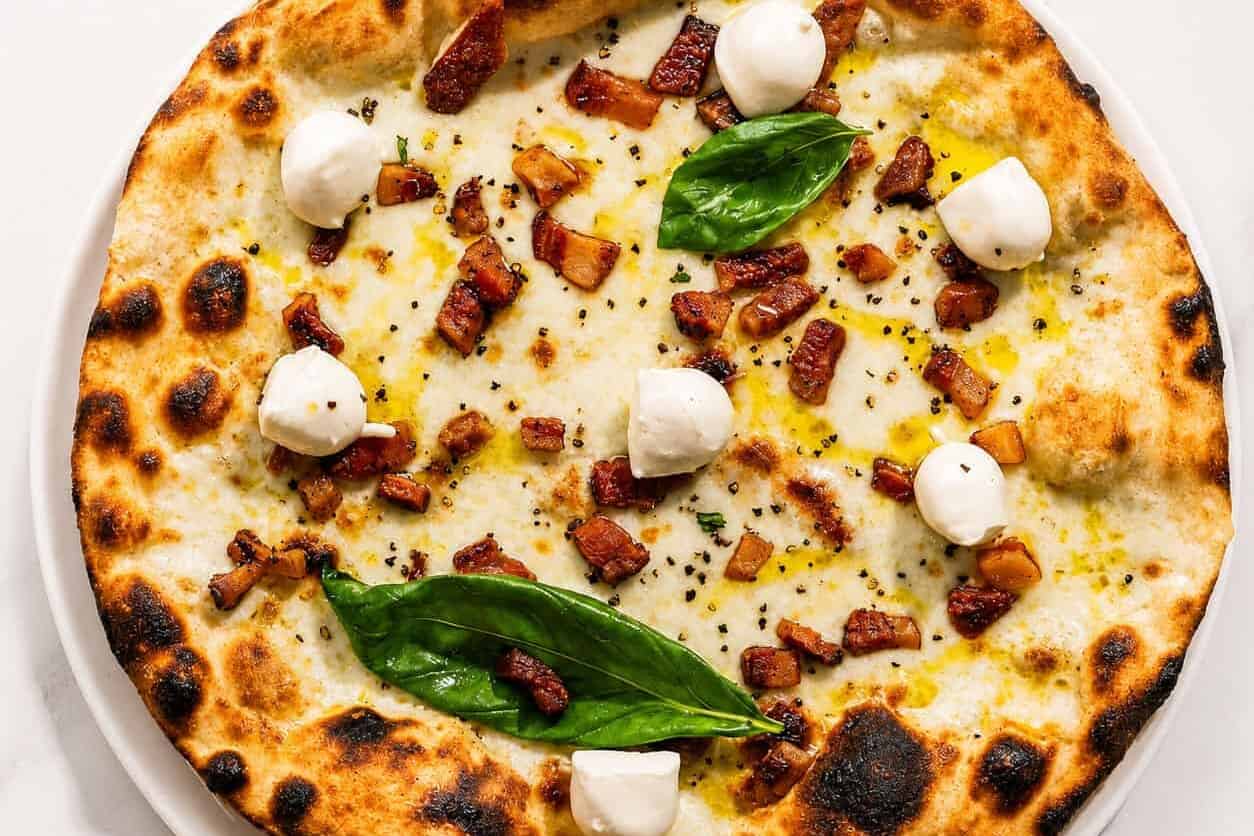
170 Grammi on Crown Street, Surry Hills is built on one technique above all others: Roman pizza dough prepared with high hydration, long fermentation, and a method refined over 35 years by founder Luigi Esposito. The result is scrocchiarella — a clean, dry, snapping crunch that defines La Tonda Romana and sets Roman pizza apart from every other style.
That crunch is built before the pizza reaches the oven. It starts with the dough, and specifically with how much water goes into it. High hydration is one of the most consequential decisions in Roman pizza technique — and it works differently in the Roman tradition than in any other style.
What Is High-Hydration Pizza Dough?
High-hydration pizza dough is dough that contains a higher ratio of water to flour, expressed as a baker’s percentage. A dough with 1,000g of flour and 650g of water has a hydration of 65%. Higher hydration produces a more open internal crumb, a lighter structure, and — when handled correctly — a crispier, more defined exterior once baked.
Baker’s percentage is the standard way to express this ratio because it allows precise, repeatable results regardless of batch size. The flour is always stated at 100%; every other ingredient is measured as a proportion of that flour weight. If you have 500g of flour and want 65% hydration, you add 325g of water.
Most pizza styles use hydration somewhere between 55% and 72%, but the target varies significantly based on the style, the flour, the oven temperature, and — critically — the shaping technique.
What Hydration Percentage Does Roman Pizza Dough Use?
Roman pizza dough — La Tonda Romana — typically uses a hydration level of 65–70%, higher than the 58–62% common in Neapolitan-style dough. That extra water supports the thin, structured, crisp base the Roman style demands: a dough that rolls flat without springing back, bakes dry rather than soft, and produces the scrocchiarella crunch that defines the style.
The higher hydration isn’t an arbitrary preference. It’s calibrated to work with the other defining elements of Roman pizza technique: the olive oil in the dough formula, the rolling pin shaping method, the long fermentation window, and the sustained high heat of a purpose-built Italian oven. Each element depends on the others.
How Hydration Creates the Scrocchiarella Texture
In Roman pizza, high hydration produces a specific baking outcome: the exterior of the base sets quickly and crisps cleanly, while the interior remains open and airy. That contrast — crisp shell, light crumb — is the scrocchiarella texture Romans have been eating for centuries. The word scrocchiarella comes from the Roman dialect verb scrocchiare, meaning to crunch or snap.
The mechanism is direct. More water in the dough means more steam during baking. That steam drives rapid expansion inside the dough as the base hits the hot oven floor, pushing the crumb open before the outside sets. The result is a base with structural integrity and an interior that’s airy rather than compact.
When hydration is too low, the base can still crisp, but the crumb becomes dense and the texture shifts from structured to hard. The Roman crunch — dry, defined, and light — only emerges when hydration is in the right range and the rest of the technique is correctly aligned.
Why Roman Dough Includes Olive Oil — and Why That Changes Everything
Roman pizza dough differs from Neapolitan dough in one important way that directly affects how hydration works: it includes olive oil. Neapolitan dough uses flour, water, yeast, and salt — nothing else. Roman dough adds olive oil, and this changes the behaviour of the dough at every stage.
Olive oil inhibits gluten development, making the dough more extensible and less elastic. In practical terms, the dough stretches out rather than springing back when you apply pressure to it. This is precisely why Roman pizza can be rolled to a uniform, thin base with a rolling pin, while Neapolitan dough — with its tighter gluten network — is hand-stretched and produces a thicker, puffed edge.
The oil also affects texture during baking. It helps the base crisp against the oven floor, contributing to the dry exterior that defines scrocchiarella. Combined with high hydration — which opens the crumb — the result is a base that’s defined on the outside and airy on the inside. These aren’t separate effects; they’re a single system designed to produce one outcome.
Rolling, Not Stretching: How High-Hydration Roman Dough Is Shaped
Roman pizza dough is rolled flat with a rolling pin — not hand-stretched. This is one of the most visible technical distinctions between the Roman and Neapolitan traditions, and high hydration is part of what makes it possible.
A well-hydrated dough with olive oil has the extensibility to roll thin without tearing. It spreads evenly, holds its shape, and bakes without the thick, soft edge characteristic of Neapolitan pizza. The uniform thinness across the entire base — edge to edge — is a direct result of this shaping method.
The difference in technique also explains why the two styles eat so differently. Neapolitan pizza is soft, foldable, and charred at the crust. Roman pizza is rigid enough to hold flat, thin enough to snap at the edge, and consistent in texture all the way across. Both are valid expressions of their respective traditions — but they are not the same style, and the dough method is where the distinction begins.
How Hydration and Fermentation Work Together
High hydration works as part of a system alongside long fermentation. The extra water accelerates yeast activity, driving fermentation — developing flavour, breaking down complex starches, and building the internal structure that helps the dough bake light rather than dense.
Long fermentation also strengthens the gluten network over time, which matters particularly for a high-hydration dough that might otherwise feel unstable to handle. By the time the dough is shaped, it has the flavour depth and structural resilience to bake cleanly: no collapsing, no tearing, no dense or gummy crumb.
Think of it as a three-part system: hydration for extensibility and crumb structure, fermentation for flavour and strength, baking for the final crunch. Adjust or cut any element, and the result is something different from Roman pizza.
Why High-Hydration Dough Is Technically Demanding
Higher hydration dough is harder to handle at every stage. It’s stickier during mixing, more sensitive during fermentation, and requires careful technique through shaping and oven loading. There’s little margin for error: over-proof a high-hydration dough and the structure collapses; under-develop the gluten and the dough tears on the rolling pin.
This is part of why Roman pizza is technically demanding to execute consistently, and why the texture it produces is genuinely distinct from styles made with lower-hydration dough. Crispness at this level is unforgiving — every decision made during dough production is visible and tasteable in the final pizza.
At 170 Grammi, a Roman pizza restaurant at 428 Crown Street, Surry Hills NSW 2010, Sydney, every pizza begins with exactly 170 grams of dough — the weight the restaurant is named for — prepared to Luigi Esposito’s method, developed across 35 years of pizza-making. The dough is baked in a 1.9-tonne oven handmade in Italy: a piece of equipment that reaches and sustains the heat required to bake a high-hydration Roman base correctly, crisping the exterior cleanly while leaving the crumb open inside.
What High Hydration Means on the Plate
Most diners don’t think about hydration percentages when they order pizza — they think about how it feels to eat. And the effects of high-hydration Roman dough are noticeable without knowing the technique behind them.
A correctly baked high-hydration Roman base is crisp enough to support toppings without going soft, light enough to eat across multiple slices, and structured enough to slice and share cleanly. Toppings stay defined — cured meat, cheese, and tomato each read separately — because the base holds its shape rather than collapsing under them.
It’s the combination of technical precision and traditional method that produces this result. Not any single element, but all of them working together: the hydration, the olive oil, the rolling technique, the fermentation, and the oven. It’s on show across the dine-in menu, on every pizza that leaves the kitchen.
Book a table at 170 Grammi in Surry Hills →
Frequently Asked Questions
What is high-hydration pizza dough?
High-hydration pizza dough is dough that contains a higher ratio of water to flour, expressed as a baker’s percentage. A dough at 65% hydration contains 650g of water per 1,000g of flour. Higher hydration produces a more open internal crumb and lighter overall structure — and when handled correctly, a crispier exterior after baking.
What hydration percentage does Roman pizza dough use?
Roman pizza dough — La Tonda Romana — typically uses a hydration level of 65–70%. This is higher than Neapolitan dough, which sits at 58–62%. The higher hydration supports the thin, flat, structured base that Roman pizza requires: a dough that rolls flat without springing back and bakes dry and crisp rather than soft and pillowy.
What makes Roman pizza dough different from Neapolitan dough?
Roman pizza dough differs from Neapolitan in two key ways. First, it includes olive oil, which inhibits gluten development and makes the dough more extensible. Second, it is rolled flat with a rolling pin rather than hand-stretched. The result is a uniform, thin, crisp base — distinct from the soft, foldable, charred-edge Neapolitan style. Both styles use higher hydration, but the dough composition, shaping method, and final texture are different.
Why does Roman pizza dough include olive oil?
Olive oil is added to Roman pizza dough because it inhibits gluten development, making the dough more extensible and easier to roll thin without springing back. It also contributes to the final baked texture: olive oil helps the base crisp against the oven floor, producing the dry, structured exterior — scrocchiarella — that defines the Roman style. Olive oil is a standard ingredient in the Roman formula, not an optional addition.
Does high-hydration dough make Roman pizza lighter to eat?
High-hydration Roman pizza dough produces a more open internal crumb than lower-hydration formulas, which contributes to a lighter overall structure. Combined with long fermentation — which breaks down complex starches — and high sustained heat during baking, the result is a base that feels structured without being dense. Many diners find Roman pizza easier to eat across several slices compared to softer, heavier styles.
How does hydration affect the crunch in Roman pizza?
In Roman pizza, high hydration creates a specific baking contrast: steam from the water drives the crumb open as the base hits the hot oven floor, while the exterior sets quickly and crisps. The result is a base with a crisp outer shell and an airy interior — the scrocchiarella texture. Lower hydration can still produce crispness, but the crumb becomes denser and the texture shifts from light and structured to hard and compact.
What is scrocchiarella?
Scrocchiarella is the Roman dialect word for the crisp, dry, snapping texture that defines La Tonda Romana pizza. The word comes from the Roman dialect verb scrocchiare — to crunch or snap — and describes both the sound and the feel of the base when correctly baked: a clean snap at the edge, a thin rigid structure, and a light airy interior. Achieving scrocchiarella is the defining quality target in Roman pizza technique.

170 Grammi is Surry Hills’ home of authentic Roman-style pizza, founded by Naples-born pizzaiolo Luigi Esposito. Where Luigi’s other restaurants bring the traditions of Naples to Sydney, 170 Grammi is dedicated to the Roman counterpart — La Tonda Romana — defined by thin, high-hydration dough, long fermentation and a clean, structured crunch that sets it apart from softer southern styles.
Opened in 2024 at 428 Crown Street and already one of the most-searched pizza restaurants in Surry Hills, 170 Grammi has quickly established itself as Sydney’s leading destination for Roman-style pizza. This blog covers the craft and culture behind what makes Roman pizza distinct — from dough technique and fermentation to menu guides, Roman food traditions and what to look for in a genuinely authentic slice.