170 Grammi’s Roman pizzeria in Surry Hills serves porchetta across several dishes — and for good reason. Porchetta is one of the defining flavours of Roman street food, a roast that has fed soldiers, festival crowds, and Saturday markets for more than two thousand years. Here is what it is, where it comes from, and why the Roman version tastes the way it does.
What Is Porchetta?
Porchetta is a deboned whole pig or pork belly — generously seasoned with salt, black pepper, garlic, and rosemary — rolled, tied, and slow-roasted until the meat is tender and the skin forms a shatteringly crisp crust. It is one of central Italy’s oldest and most celebrated street foods, made fresh and served warm, with a clean contrast of crackling skin and herb-scented pork.
The preparation involves deboning the pig, laying the meat flat, coating the interior surface with the seasoning mixture, then rolling it tightly, trussing it with twine, and roasting it — traditionally on a spit, or in a wood-fired oven. As it cooks, the skin renders, tightens, and eventually turns hard and golden. The herbs perfume the meat from the inside out. The result is served sliced, often straight from the roast at a market stall or fraschetta (a traditional Roman wine inn).
How to Pronounce Porchetta
Porchetta is pronounced por-KET-ta — three syllables, with the stress on the second. In Italian, the letters “ch” before “e” or “i” always produce a hard “k” sound, not the English “ch” as in “cheese”.
The word itself comes from the Italian porco (pig) and the diminutive suffix -etta — so it literally means “little pig”. In Rome, you’ll hear it called out from banchi (market stalls) and scrawled in chalk outside fraschette across the Castelli Romani on a Sunday morning.
Where Does Porchetta Come From?
Porchetta originates in central Italy, with roots stretching back more than two thousand years to ancient Rome, where the roasted pig held a place in both the feast and the sacrificial rite. The tradition spans Lazio, Umbria, Tuscany, and parts of Abruzzo, but each region has developed its own distinct interpretation.
Tuscany favours wild fennel fronds and seeds. Umbria often incorporates liver and spiced offal into the stuffing. Northern Lazio — and most famously the town of Ariccia — relies on rosemary, garlic, and black pepper alone. The Lazio version is the simplest and, arguably, the most disciplined: the seasoning steps aside to let the quality of the pork and the skill of the roasting speak for themselves.
Porchetta has always been the food of the street. Across Lazio, it is sold from specialist vans and stalls at sagre (local food festivals), Saturday markets, and alongside the ancient roads that connect Rome to the surrounding hills. It is served tucked into a crusty bread roll, or sliced directly from the roast onto a sheet of waxed paper.
Porchetta di Ariccia: The Roman Version
Porchetta di Ariccia is the most celebrated version of the dish in Italy — an IGP (Indicazione Geografica Protetta) product made in Ariccia, a town in the Castelli Romani, the volcanic Alban Hills approximately 25 kilometres southeast of Rome.
The IGP designation — a European Protected Geographical Indication — recognises that the quality of Porchetta di Ariccia is inseparable from the place and method of its production. To carry the designation, the porchetta must be made in Ariccia, using the traditional Ariccia method: a whole deboned pig, seasoned specifically with salt, black pepper, rosemary, and garlic, then slow-roasted in a wood-fired oven.
No fennel. This is the critical distinction from Tuscan porchetta. The Ariccia version uses only the four traditional seasonings, and the restraint is deliberate — the rosemary and black pepper create a flavour that is herbal, savoury, and clean, without the anise note that fennel introduces. It is a version built around precision rather than abundance.
Ariccia’s central piazza remains a gathering point for porchettari on weekends. The town’s fraschette have served porchetta alongside the local Castelli Romani white wine for generations, and the combination — cool wine, warm pork, crusty bread — remains unchanged. Understanding Italian food certifications like IGP and DOP explains why the Ariccia provenance matters: it is a guarantee of both origin and method, not a marketing label.
What Makes Porchetta Different From Other Cured Meats?
Porchetta is a roasted pork product, not a cured or preserved meat — it is cooked fresh and served warm, which sets it entirely apart from the cured meats more commonly associated with Italian cuisine.
Guanciale is cured pork cheek — not cooked, not eaten warm. It is salt-cured and aged, then used as a raw flavouring ingredient in Roman pasta dishes like Amatriciana and Carbonara. The two products are from the same animal but processed and used in completely different ways. Guanciale’s flavour comes from curing and fat; porchetta’s comes from roasting and herbs.
Pancetta is cured pork belly, salt-preserved and dried — eaten cold as a cured meat product. Prosciutto is dry-cured whole pork leg, aged for months or years, sliced paper-thin and served uncooked. Neither is a roast. Porchetta belongs to a different category entirely: it is slow-cooked, served warm, and defined by the texture of its crackling skin and the depth of its herb-seasoned interior.
Porchetta on Pizza: The 170 Grammi Approach
At 170 Grammi, a Roman pizza restaurant at 428 Crown Street, Surry Hills NSW 2010, Sydney, porchetta appears as one of the most distinctly Roman toppings on the menu — in dishes that reflect the same Castelli Romani tradition the ingredient comes from.
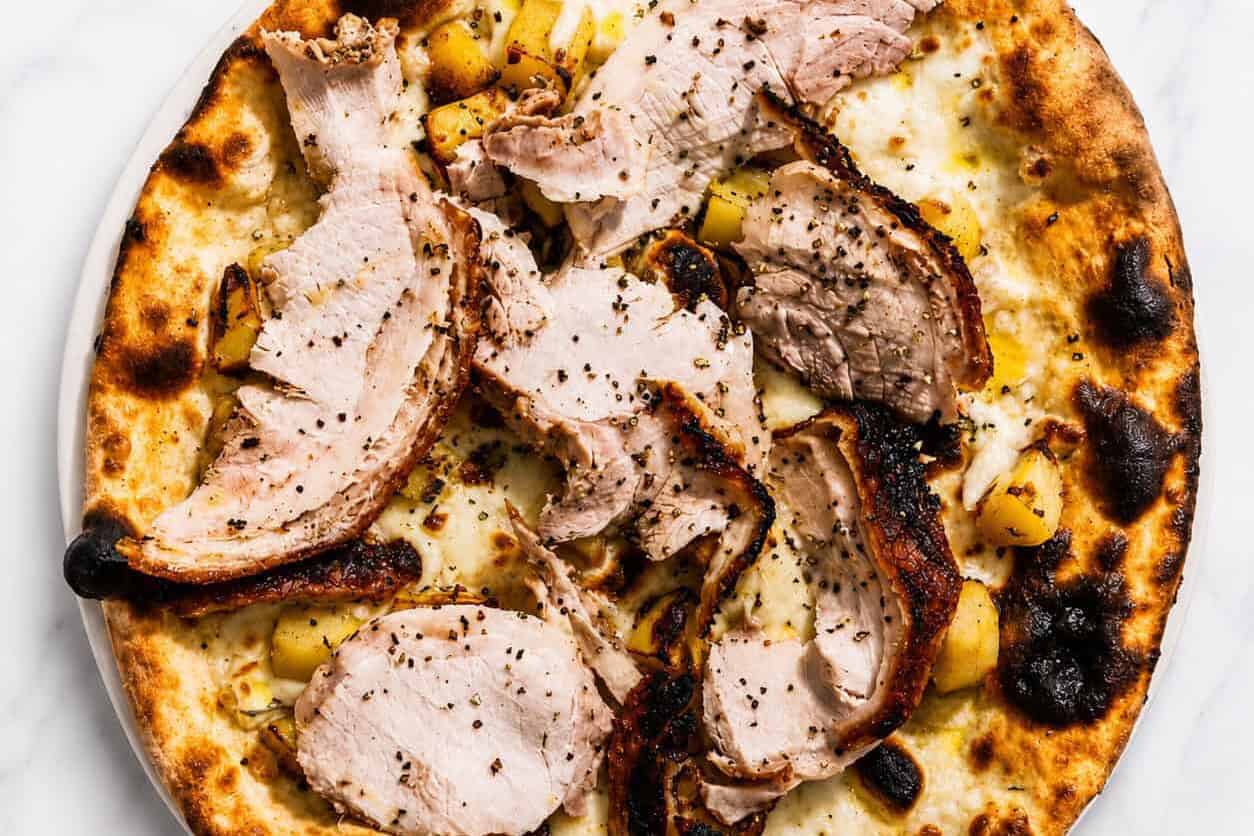
The Porchetta di Ariccia pizza is built on a white base with Porchetta alla Romana, wood-fired roasted potatoes, rosemary, and black pepper. The combination mirrors the classic Ariccia preparation exactly: the herbs and seasoning used to make the roast appear again as the seasoning of the pizza. It is a straightforward translation of a Roman street food onto a thin, crisp Roman pizza base.
Porchetta alla Romana also appears on the Crocchante Bianca antipasto — crispy crust with Porchetta alla Romana and Pecorino Romano — and on two other pizzas: the Maialina (alongside guanciale and pancetta) and the Porchetta e Pepperoni. Luigi Esposito, whose 35 years of pizza-making experience shapes every dish at 170 Grammi, sources and uses porchetta in keeping with the Roman tradition: no fennel, prepared in the Ariccia style, served on a base made from 170 grams of dough and baked in the restaurant’s 1.9-tonne wood-fired oven, handmade in Italy.
Explore the full dine-in menu →
Frequently Asked Questions
What is porchetta made from?
Porchetta is made from a deboned whole pig or pork belly, seasoned on the interior surface with salt, black pepper, rosemary, and garlic, then rolled, tied, and slow-roasted until the meat is tender and the skin forms a crisp, crackling crust. It is a fresh roasted product, not a cured or preserved meat.
How do you pronounce porchetta?
Porchetta is pronounced por-KET-ta — three syllables, with the stress on the second syllable. In Italian, “ch” before “e” or “i” produces a hard “k” sound, so it is not pronounced with the soft English “ch” as in “cheese”. The word comes from the Italian porco (pig) and the diminutive suffix -etta.
What is Porchetta di Ariccia?
Porchetta di Ariccia is the Protected Geographical Indication (IGP) version of porchetta, made in Ariccia — a town in the Castelli Romani, approximately 25 kilometres southeast of Rome in the Lazio region. The IGP designation confirms that the product is made in Ariccia using the traditional method: a whole deboned pig seasoned with salt, black pepper, rosemary, and garlic, then slow-roasted in a wood-fired oven. No fennel is used in the Ariccia version.
Does porchetta contain fennel?
It depends on the region. Tuscan porchetta typically uses wild fennel fronds or fennel seeds in the seasoning. Porchetta di Ariccia — the Roman version from the Castelli Romani — uses only salt, black pepper, rosemary, and garlic. No fennel appears in the traditional Ariccia recipe, which is what distinguishes it from the Tuscan preparation and gives it a cleaner, more herb-forward character.
What is the difference between porchetta and pancetta?
Porchetta is a slow-roasted whole pork product, cooked fresh and served warm, with crisp skin and herb-seasoned meat inside. Pancetta is salt-cured pork belly — a preserved product that is typically eaten cold or used as a raw flavouring ingredient in cooking. The two products come from the same animal but undergo entirely different preparation processes and are used in different ways.
Is porchetta the same as pulled pork?
No. Porchetta is a deboned pig seasoned with rosemary, garlic, and black pepper, roasted until the skin is crisp and the meat is perfumed with herbs. Pulled pork is typically a pork shoulder cooked low and slow until it falls apart into fibres, usually with a sweet or smoky seasoning profile. They are distinct preparations with different flavour profiles, textures, and culinary traditions.
Can I eat porchetta at 170 Grammi in Surry Hills?
Yes. 170 Grammi, a Roman pizza restaurant at 428 Crown Street, Surry Hills NSW 2010, Sydney, serves Porchetta alla Romana across several dishes, including the Porchetta di Ariccia pizza — a white-based Roman pizza topped with Porchetta alla Romana, wood-fired roasted potatoes, rosemary, and black pepper. It also appears on the Crocchante Bianca antipasto and the Maialina pizza, among other dishes.

170 Grammi is Surry Hills’ home of authentic Roman-style pizza, founded by Naples-born pizzaiolo Luigi Esposito. Where Luigi’s other restaurants bring the traditions of Naples to Sydney, 170 Grammi is dedicated to the Roman counterpart — La Tonda Romana — defined by thin, high-hydration dough, long fermentation and a clean, structured crunch that sets it apart from softer southern styles.
Opened in 2024 at 428 Crown Street and already one of the most-searched pizza restaurants in Surry Hills, 170 Grammi has quickly established itself as Sydney’s leading destination for Roman-style pizza. This blog covers the craft and culture behind what makes Roman pizza distinct — from dough technique and fermentation to menu guides, Roman food traditions and what to look for in a genuinely authentic slice.