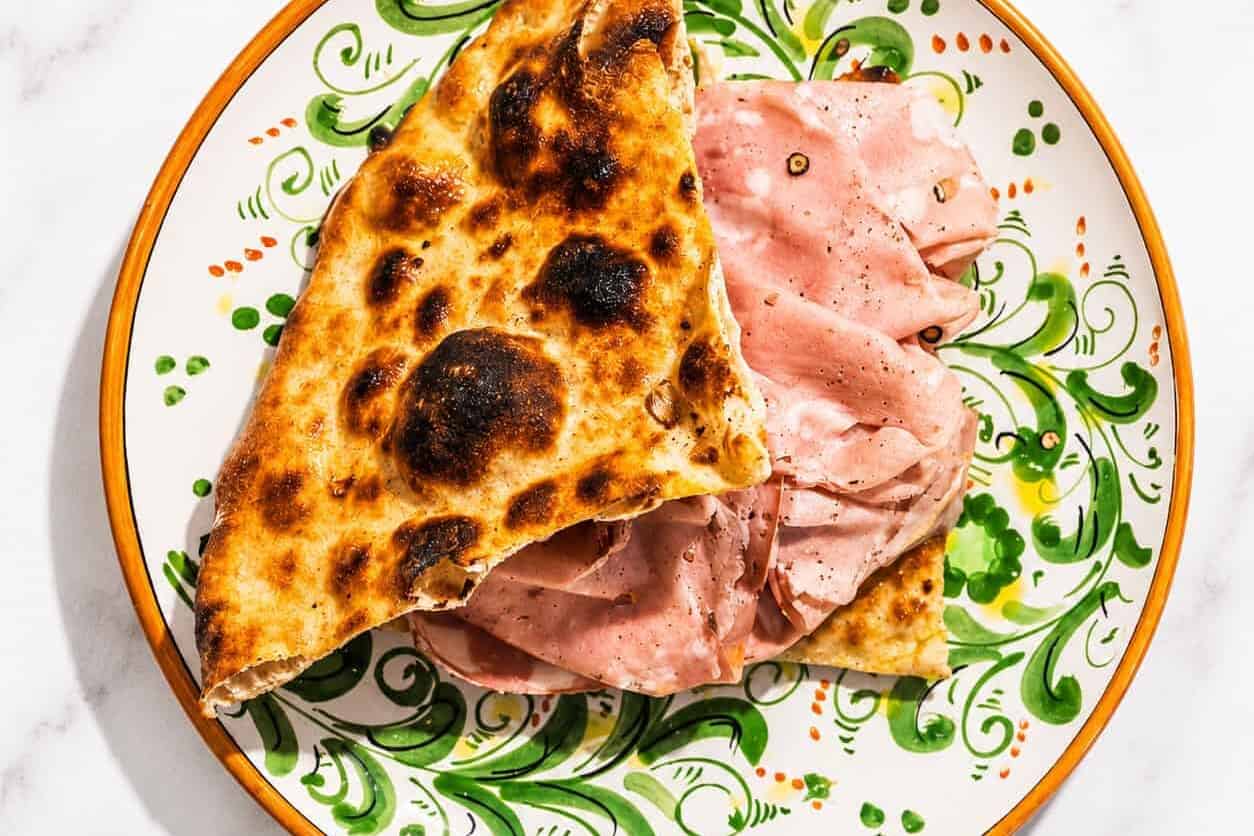
At 170 Grammi Pizzeria on Crown Street, Surry Hills, the Schiacciata con’botto de Mortazza has been on the antipasti menu since the restaurant opened — a single Roman street food classic that begins, as it does in every Roman forno, with mortadella. It is one of Italy’s most consumed cured meats, one of its most protected, and in Rome, one of its most insisted upon.
What Is Mortadella?
Mortadella is a cooked Italian pork sausage originating in Bologna, made from finely ground lean pork and cubed cheek fat, seasoned with black pepper and spices, then slow-baked in dry-air ovens to produce its characteristic pale pink colour and smooth, consistent texture.
Its full legal name is Mortadella Bologna IGP. The large cylindrical loaves — which can reach 50 kilograms in commercial production — are recognisable by their even pink colour and the regular distribution of white fat cubes throughout. When sliced, the scent is delicate, faintly sweet, and distinct from any other Italian cured meat. It is neither salami nor ham; it occupies its own category entirely.
Where Does Mortadella Come From?
Mortadella originates from Bologna, the capital of Emilia-Romagna in northern Italy, with documented production records dating to the 14th century.
The name most likely derives from the Latin farcimen murtatum — a myrtle-spiced sausage commonly produced in ancient Rome. By the 13th century, Bolognese guilds were regulating its production, and in 1661, Cardinal Farnese issued a formal decree specifying how the sausage was to be made. The Consorzio Mortadella Bologna was founded in 2001 to oversee production standards and protect the designation. IGP (Indicazione Geografica Protetta) status — recognition by the European Union as a protected geographical indication — was granted in 1998.
How Is Mortadella Bologna Made?
Mortadella Bologna IGP is produced from at least 60 per cent lean pork — typically shoulder and back — combined with cubed cheek fat making up the remainder of the mixture. The meat is finely ground, blended with salt, black pepper, coriander, and spices, stuffed into casings, and cooked slowly in dry-air ovens in a process known as stufatura.
Temperature control is the critical variable. Too high and the fat renders out, destroying the texture; too low and the meat never reaches its characteristic smoothness. Specialist artisans called stufini manage this stage, cooking the loaves for several hours before cold-showering them and leaving them to rest. The result holds its texture under the knife and releases its full fragrance only once cut.
The finest Mortadella Bologna IGP carries an S stamp on its casing, indicating pure pork — the only product legally permitted to bear the full protected name. Other varieties exist: SB denotes a mix of pork and beef; SE, pork and horse. These are not Mortadella Bologna and are not subject to the same standards.
Mortadella Bologna IGP: What the Certification Actually Means
Mortadella Bologna IGP is an EU-protected geographical indication, requiring production to follow a registered specification within designated Italian regions — primarily Emilia-Romagna, but also including Lombardia, Piemonte, and Veneto.
IGP differs from DOP (Denominazione di Origine Protetta) in one important respect: it protects the production method and recipe, but allows manufacturing across a wider zone rather than locking the product to a single place of origin. In practice, this means any producer meeting the Consorzio’s specifications can make legitimate Mortadella Bologna — the certification guarantees the ingredients and process, not the geography alone. Understanding how IGP and DOP designations work is the most reliable way to read an Italian charcuterie label.
Mortadella in Rome: How the City Made It Its Own
In Rome, mortadella holds a different status — it is called mortazza in Romanesco dialect and occupies a specific, irreplaceable role in the city’s street food culture.
Alongside guanciale and porchetta, mortazza is one of the three cornerstones of the Roman salumeria. Each has its prescribed purpose; mortazza goes into one thing above all others: schiacciata con ‘botto de mortazza — Rome’s flatbread sandwich, built from a split piece of schiacciata stuffed with a botto, a generous, unshrinking portion of mortadella.
Schiacciata in Rome is not the Tuscan bread of the same name. It is a soft, oil-kissed flatbread closer to pizza bianca — pulled from the oven at the right moment, split while still warm, and filled with nothing else. The mortadella does not share the space with condiments or leaves. The combination has been designed for exactly this purpose for generations, and Roman bakeries have not found reason to change it.
Mortadella vs Bologna: What Actually Makes Them Different
Bologna — or “baloney” in American English — takes its name from the city of Bologna but is not Mortadella Bologna IGP. The two products are made differently, from different ingredients, to different standards.
Mortadella Bologna IGP is produced from pure pork, slow-cooked whole in dry-air ovens, with visible cubes of cheek fat distributed throughout each slice. American bologna is typically made from a mix of meats — pork, beef, chicken, or a combination — ground until fully homogenised, with no visible fat structure and no requirement to meet any protected designation. It is emulsified, finely textured, and produced at scale to a very different brief.
The name connection is historical: Italian immigrants brought the tradition of mortadella to the United States, where it was adapted and simplified. The product that resulted — cheaper to produce, accessible in supermarkets — retained the name of the city but not the recipe or the protected status. True Mortadella Bologna IGP and American baloney are different products with different uses.
Mortadella at 170 Grammi Pizzeria
At 170 Grammi Pizzeria, a Roman pizza restaurant at 428 Crown Street, Surry Hills NSW 2010 in Sydney, Luigi Esposito serves Schiacciata con’botto de Mortazza as part of the antipasti — the same Roman street food tradition, unchanged. The dish is what it is in Rome: schiacciata split open and layered with mortadella, with nothing added to improve what is already complete.
It sits alongside Supplì di Riso al Telefono, Carciofi Alla Romana, and Fiori Di Zucca on the antipasti — a list of Roman dishes chosen for what they are, not for what they evoke. The full menu reflects the same logic throughout.
Frequently Asked Questions
What does the word “mortadella” mean?
The word mortadella most likely derives from the Latin farcimen murtatum, a myrtle-spiced pork sausage produced in ancient Rome. The name refers to the myrtle berries (myrtle: murtum in Latin) used to season the meat. A secondary theory links the word to mortarium (mortar), the tool used to grind the pork, though the myrtle etymology is more widely accepted by food historians.
What is Mortadella Bologna IGP?
Mortadella Bologna IGP is the full, legally protected name for authentic Italian mortadella. IGP stands for Indicazione Geografica Protetta — an EU designation that guarantees the product is made according to a registered recipe and production method within approved Italian regions. The S-stamped version, made from pure pork, is the only product permitted to carry the complete “Mortadella Bologna” name. The Consorzio Mortadella Bologna, founded in 2001, oversees and enforces the standard.
What are the white bits in mortadella?
The white cubes distributed throughout mortadella are pieces of cheek fat — jowl fat from the pig, cut into regular cubes and incorporated into the meat mixture before it is stuffed and cooked. The cheek fat is prized for its firmness and flavour, and it retains its structure during the slow cooking process rather than rendering out. The even distribution of these fat cubes is one of the defining characteristics of properly made Mortadella Bologna IGP.
Is mortadella the same as bologna or baloney?
No. Mortadella Bologna IGP and American bologna (baloney) are different products. Mortadella Bologna IGP is made from pure pork, slow-cooked whole in dry-air ovens, with visible cubes of cheek fat and a delicate, fragrant flavour. American bologna is typically made from mixed meats (pork, beef, chicken, or a combination), ground until fully homogenised with no visible fat structure, and produced without any protected designation. The name connection is historical — Italian immigrants brought mortadella to the United States, where it was adapted — but the two products are not interchangeable.
Does mortadella always contain pistachios?
No. The classic Mortadella Bologna IGP is made with black pepper and spices, with no pistachios. Pistachio mortadella is a popular and well-regarded variant — particularly associated with producers from certain regions — but it is an addition to the base recipe, not a requirement. The Consorzio Mortadella Bologna permits pistachio variants, but the original specification makes no mention of them. When in doubt, the label will specify whether pistachios are included.
What is “mortazza” and how does it differ from mortadella?
Mortazza is the Romanesco dialect word for mortadella — the same product referred to by Rome’s local vernacular, in the same way Roman dialect calls lamb “abbacchio” and the local flatbread pizza “scrocchiarella.” In Rome, mortazza is most associated with a specific preparation: schiacciata con ‘botto de mortazza, the city’s iconic flatbread sandwich filled with a generous portion of mortadella. The word “botto” means a hit or a whack — indicating the quantity is not modest.
Is mortadella available in Australia?
Yes. Mortadella is available at Italian delicatessens, specialty food stores, and some supermarkets across Australia. Products vary in quality — look for labels specifying Mortadella Bologna IGP for the protected designation. At 170 Grammi Pizzeria, 428 Crown Street, Surry Hills NSW 2010 in Sydney, it is served as Schiacciata con’botto de Mortazza on the antipasti menu — the traditional Roman preparation.

170 Grammi is Surry Hills’ home of authentic Roman-style pizza, founded by Naples-born pizzaiolo Luigi Esposito. Where Luigi’s other restaurants bring the traditions of Naples to Sydney, 170 Grammi is dedicated to the Roman counterpart — La Tonda Romana — defined by thin, high-hydration dough, long fermentation and a clean, structured crunch that sets it apart from softer southern styles.
Opened in 2024 at 428 Crown Street and already one of the most-searched pizza restaurants in Surry Hills, 170 Grammi has quickly established itself as Sydney’s leading destination for Roman-style pizza. This blog covers the craft and culture behind what makes Roman pizza distinct — from dough technique and fermentation to menu guides, Roman food traditions and what to look for in a genuinely authentic slice.