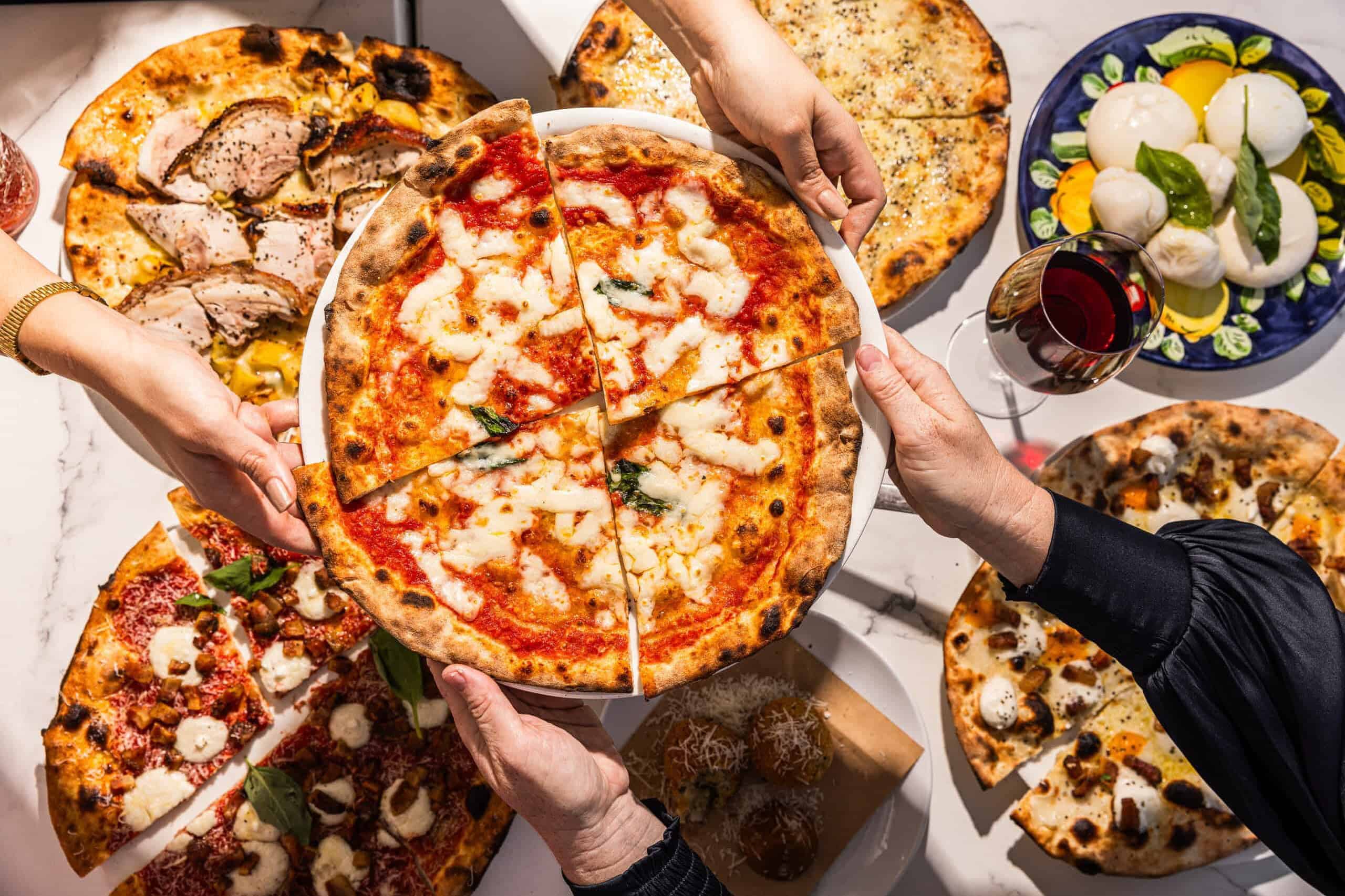
170 Grammi, Surry Hills’ Roman pizza restaurant, marks International Pizza Day the way it marks every other night of the year: with exactly 170 grams of dough, a handmade 1.9-tonne Italian oven, and the Roman pizza technique that Luigi Esposito has spent more than 35 years refining.
International Pizza Day — celebrated every year on 9 February — is not a marketing occasion. It is an annual prompt to think about what pizza actually is when it is made properly: the regional traditions that shaped it, the techniques passed between generations of pizza makers, and the difference between pizza as a convenience category and pizza as a craft.
Here is the story behind the date — and why the Roman tradition is worth understanding on a day like this.
When Is International Pizza Day?
International Pizza Day falls every year on 9 February. The date is sometimes referred to as National Pizza Day or World Pizza Day — all three names mark the same annual celebration of pizza’s origins, traditions, and cultural significance. The terms are interchangeable.
The date is not tied to a specific historical event. It emerged as an informal food celebration and has grown through the participation of pizzerias, food writers, and pizza communities around the world. By any name, 9 February is the one night a year when ordering pizza with real intention requires no explanation at all.
What International Pizza Day Actually Celebrates
International Pizza Day celebrates the origins and craft of pizza — the regional traditions that define each style, the techniques passed between generations of pizza makers, and pizza’s place as a shared meal rather than a convenience category.
The distinction matters because the word “pizza” now covers an enormous range of food: from a frozen supermarket disc to hand-stretched dough cooked at extreme heat. International Pizza Day is an annual prompt to think about what the originals actually look like — and to understand the regional traditions, including the Roman one, that gave pizza its character before it became the world’s most copied dish.
Pizza’s Origins — and Rome’s Distinct Story
Modern pizza in its tomato-and-cheese form originated in Naples in the 18th century, when tomatoes — newly arrived from the Americas — were combined with flatbread, cheese, and olive oil in the working-class neighbourhoods of the city. The pizzaiuolo — the specialist pizza maker — emerged during this period, passing techniques across families and generations. By the 19th century, pizza had moved from street vendors into dedicated restaurants. Italian emigrants carried it to the United States, and the first documented American pizzeria, Lombardi’s, opened in New York City in 1905.
Rome’s relationship with pizza is older in some ways and different in others. Long before the Neapolitan tomato pizza, Rome had a flatbread tradition — early versions of pizza bianca, baked on stone and finished with olive oil, salt, and herbs. What Rome developed later was its own distinct interpretation of round pizza: La Tonda Romana. Not an adaptation of the Neapolitan style, but a separate tradition built on different dough mechanics and a different definition of what the finished product should feel like.
Roman pizza and Neapolitan pizza share a name and a broad category. They are not the same style, and International Pizza Day is a useful occasion to understand why that distinction matters.
La Tonda Romana — The Roman Pizza Tradition
La Tonda Romana is defined by a thin, crisp, fully structured base — a pizza that holds its shape from the first slice to the last, consistent across the whole surface, not just at the rim.
Where Neapolitan pizza is hand-stretched and intentionally soft at the centre — foldable, yielding, designed for immediate eating — Roman pizza is rolled with a mattarello, a rolling pin, which produces a flatter, more uniform base with less air trapped in the dough. The hydration is high — typically 65 to 70 per cent — and fermentation is long, often 48 to 72 hours, developing flavour and structure before the dough reaches the oven. The result is a base that is lighter in texture and more structured in behaviour: crisp throughout, clean in flavour, and well-suited to sharing across a table.
Scrocchiarella — from the Romanesco verb scrocchiare, meaning to crunch — is the name Romans give to the sound and sensation that defines the style. The crunch is not incidental. It is the specification.
What is Roman pizza — and what makes it different →
How 170 Grammi Brings This Tradition to Surry Hills
At 170 Grammi, a Roman pizza restaurant at 428 Crown Street, Surry Hills NSW 2010, Sydney, every pizza starts with exactly 170 grams of dough. That figure is the restaurant’s name and its operating standard. Luigi Esposito — with more than 35 years of pizza-making experience and a grounding in the Roman tradition — built 170 Grammi around a single culinary point of view: La Tonda Romana, made to the standard the style demands.
The dough is high-hydration and slow-fermented to develop structure and flavour before it reaches the oven. The oven itself weighs 1.9 tonnes and was handmade in Italy. Importing it was not a stylistic decision — it was the technical requirement for the base the menu is built on: thin, crisp, and consistent in a way that reflects both the dough process and the oven it is baked in.
The pizzas on the menu are Roman in the same way the technique is: the A’ Carbonara, the Amatriciana, the Porchetta di Ariccia, the Cacio e Pepe, the Margherita Classica. These are not variations on a theme. They are the Roman theme.
Why high-hydration dough is central to Roman pizza →
Celebrating International Pizza Day in Surry Hills
On 9 February, the occasion takes care of itself. The question is how to order well — and at a Roman pizza restaurant, the answer is almost always the same: order more variety than you think you need, and share everything.
Roman pizza’s structural integrity makes it well-suited to exactly this kind of table. The base holds. The slices stay firm. A table working through four or five pizzas at its own pace won’t find the last pieces turning soft. The right approach is range: one classic pizza, one vegetable-forward option, one that leans into richer Roman flavours, one that delivers something bold. That is the rhythm International Pizza Day deserves.
Explore the full dine-in menu →
Dine in at 170 Grammi in Surry Hills, or order for pickup and delivery via the website. Bookings are recommended for 9 February.
Book a table for International Pizza Day →
Frequently Asked Questions
When is International Pizza Day?
International Pizza Day is celebrated every year on 9 February. The date is sometimes referred to as National Pizza Day or World Pizza Day — all three names mark the same annual celebration of pizza’s origins, traditions, and cultural significance.
What is the difference between International Pizza Day and National Pizza Day?
International Pizza Day and National Pizza Day refer to the same date: 9 February. The names are used interchangeably. There is no formal distinction between them — both mark the same annual celebration of pizza’s history, craft, and the regional traditions that define each style.
What is Roman pizza, and how is it different from Neapolitan pizza?
Roman pizza — La Tonda Romana — is defined by a thin, crisp, fully structured base built on high-hydration dough and long fermentation. The dough is rolled with a rolling pin rather than hand-stretched, producing a flatter, crispier result with a consistent texture across the whole surface. Neapolitan pizza is hand-stretched and intentionally softer at the centre, cooked at higher temperature in a shorter time. The two styles come from different cities and use different techniques.
What does Scrocchiarella mean?
Scrocchiarella is the Roman name for the crisp, thin-base pizza style made in the La Tonda Romana tradition. The word comes from the Romanesco verb scrocchiare, meaning to crunch — it describes the sound and texture of the base when bitten into. At 170 Grammi Pizzeria in Surry Hills, Scrocchiarella defines the character of every pizza on the menu.
Why does 170 Grammi use exactly 170 grams of dough?
The name 170 Grammi refers directly to the technique: every pizza at 170 Grammi Pizzeria, 428 Crown Street, Surry Hills NSW 2010, begins with exactly 170 grams of dough. The figure is a specification, not a marketing device — it ensures the consistently thin, crisp La Tonda Romana base the style requires. The precision is the product.
How should I celebrate International Pizza Day in Surry Hills?
International Pizza Day falls on 9 February. 170 Grammi Pizzeria at 428 Crown Street, Surry Hills NSW 2010, serves Roman pizza in the La Tonda Romana tradition — 170 grams of dough, high-hydration long-fermented base, baked in a 1.9-tonne handmade Italian oven. Bookings are recommended for dine-in. Takeaway and delivery are available via online ordering for those celebrating at home.

170 Grammi is Surry Hills’ home of authentic Roman-style pizza, founded by Naples-born pizzaiolo Luigi Esposito. Where Luigi’s other restaurants bring the traditions of Naples to Sydney, 170 Grammi is dedicated to the Roman counterpart — La Tonda Romana — defined by thin, high-hydration dough, long fermentation and a clean, structured crunch that sets it apart from softer southern styles.
Opened in 2024 at 428 Crown Street and already one of the most-searched pizza restaurants in Surry Hills, 170 Grammi has quickly established itself as Sydney’s leading destination for Roman-style pizza. This blog covers the craft and culture behind what makes Roman pizza distinct — from dough technique and fermentation to menu guides, Roman food traditions and what to look for in a genuinely authentic slice.