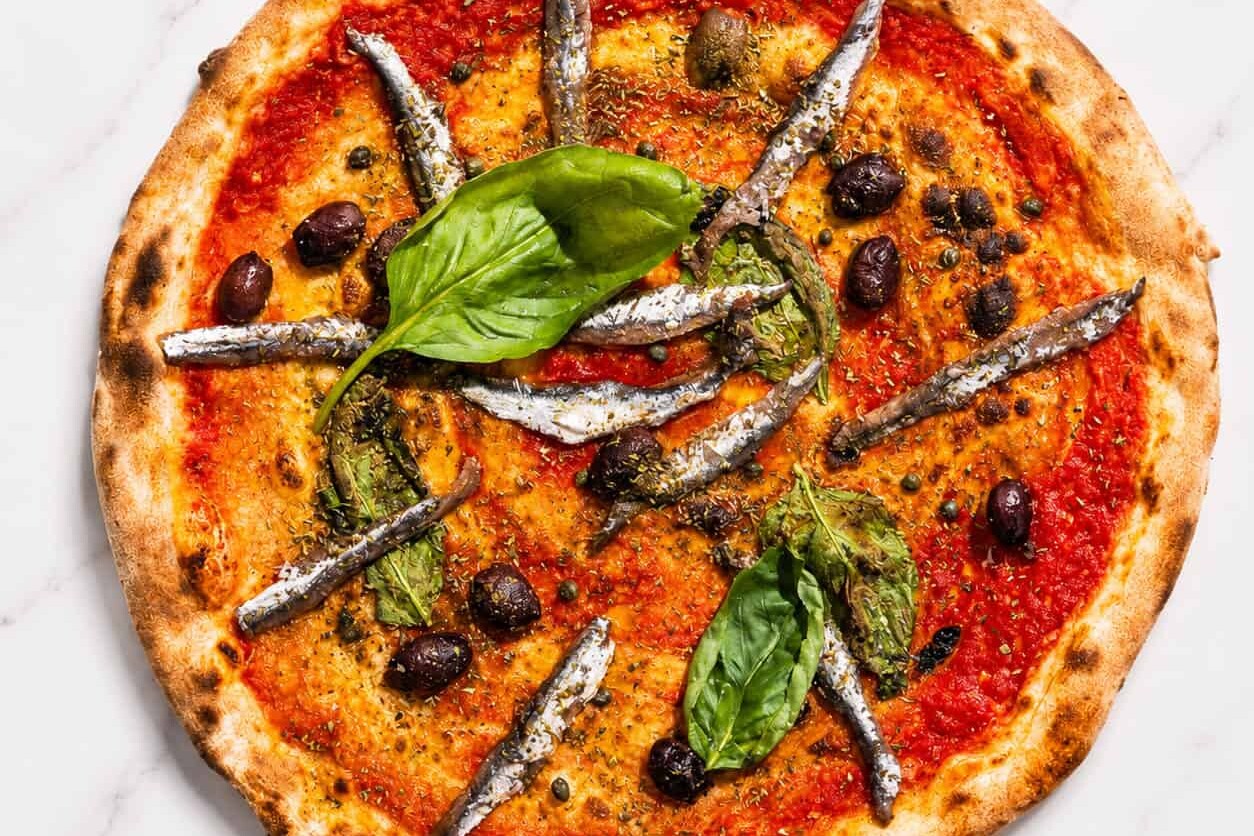
At 170 Grammi Pizzeria on Crown Street, Surry Hills, the dough that goes into every pizza is made at least two days before it is baked. That gap is not downtime. It is the most critical phase in the entire process.
Long fermentation is the technique that separates Roman pizza from fast-rise alternatives — not in appearance, but in structure, texture, and flavour. 170 Grammi, a Roman pizza restaurant at 428 Crown Street, Surry Hills NSW 2010 in Sydney, was built around this principle from the beginning. This article explains what cold fermentation actually does to pizza dough and why it matters so much for the specific demands of Roman-style pizza.
What Long Fermentation Means in Pizza Dough
Long fermentation in pizza dough is the process of allowing yeast and enzymes to work on flour and water for an extended period — typically 48 to 72 hours under cold conditions — rather than a few hours at room temperature.
The basic mechanics are straightforward: combine flour, water, yeast, and salt, then give the mixture time. What makes long fermentation different is where that time is spent and how slowly the process unfolds.
In a cold environment — typically a refrigerator at around 2 to 4°C — yeast activity slows significantly. The yeast continues consuming the sugars in the flour, but at a fraction of the pace it would at room temperature. This controlled slowdown is deliberate. While the yeast works slowly, enzymes already present in the flour continue their own work at a steady rate. That enzyme activity is where the real transformation happens.
What Happens Inside the Dough
During cold fermentation, two processes run simultaneously: enzymes break down complex starches into simpler sugars, and the gluten network develops gradually into a tighter, more extensible structure.
Amylase enzymes convert complex carbohydrates into fermentable sugars — giving the yeast more to work with over time and producing a broader range of flavour-active compounds as a by-product. Protease enzymes act on gluten-forming proteins, gradually restructuring the dough at a molecular level. The gluten relaxes, reorganises, and becomes more coherent across the full fermentation period.
The practical result is dough that is more extensible, more flavourful, and structurally better suited to the demands of thin Roman pizza than anything mixed and proved in a few hours.
How Cold Fermentation Builds Flavour
The flavour complexity in long-fermented pizza dough comes from the slow production of organic acids, esters, and alcohols as fermentation progresses — compounds that simply do not develop in fast-rise dough.
This is why Roman pizza with a properly fermented base tastes different even before toppings are added. The dough itself carries character — a subtle complexity that registers as completeness rather than as any single identifiable note. It is not a strong flavour. It is the absence of the flatness that comes from underdeveloped dough.
For Roman-style pizza, where the base is stretched thin, this matters directly. A thin base accounts for a meaningful share of every bite. If the dough tastes bland, the whole pizza can feel one-dimensional. A properly fermented base makes every topping — whether Cacio e Pepe or Amatriciana — land with more precision and clarity.
Gluten Structure and the Roman Crunch
Cold fermentation produces a stronger, more organised gluten network — the structural condition that allows Roman pizza to be stretched extremely thin, hold its shape in the oven, and achieve its characteristic crisp texture without becoming brittle or dense.
Gluten forms when flour proteins absorb water and bond together. In fast-rise dough, this network develops quickly but unevenly. In cold-fermented dough, the slow pace allows the gluten to organise into a tighter, more uniform structure.
This matters for Roman pizza because of how thin it needs to be stretched. La Tonda Romana — the round Roman style at the heart of 170 Grammi’s approach — is stretched to a consistently thin base by hand. Weak or poorly developed gluten tears under that kind of extension. Properly developed gluten holds, stretches cleanly, and maintains shape from bench to oven.
In the oven, that same structure determines how the pizza bakes. A well-developed gluten network allows moisture to escape evenly from the surface rather than concentrating in pockets. The result is the characteristic Roman crunch — dry and clean on the outside, airy within, and without the brittleness that comes from dough that has not been given enough time.
Explore the difference between La Tonda Romana and Scrocchiarella →
Long Fermentation and High-Hydration Dough
Long fermentation and high hydration work as a system in Roman pizza dough: the extra water supports more thorough enzyme activity, while the extended time gives the gluten the strength needed to hold that hydration without losing structure.
Higher hydration creates a more open internal crumb and a better-textured bake — but it also produces dough that is difficult to handle if the gluten is not adequately developed. Fast-rise, high-hydration dough tends to be slack and inconsistent, difficult to shape with any precision.
Long fermentation produces the gluten strength that makes high hydration manageable. The dough becomes extensible — it stretches readily without springing back — while remaining structurally sound enough to hold toppings without sagging. High-protein Tipo 00 flour supports this process from the outset, providing the raw gluten capacity required over 48 or more hours of cold development.
Read why high-hydration dough is fundamental to Roman pizza →
What This Means at the Table
Because long fermentation allows yeast to consume a greater portion of the flour’s starches before baking, the finished pizza is less starch-dense and is consistently described by diners as lighter and easier to eat across multiple slices.
The effect varies by individual, and it is not a medical claim. But the observation is consistent with the mechanics: the yeast does more of the digestive work before the pizza reaches the oven. The result is a pizza that feels balanced rather than heavy — the kind you can share across the table and still want another slice.
This is also why customers who grew up eating Roman pizza in Rome tend to recognise 170 Grammi’s approach immediately. The lightness is not about smaller portions or restrained toppings. It is about what the dough has already become before any topping is placed on it.
Why Roman pizza is lighter — the full explanation →
Long Fermentation at 170 Grammi
At 170 Grammi, the dough undergoes a minimum 48-hour cold fermentation — a technique central to Luigi Esposito’s approach to Roman pizza and drawn from 35 years of professional pizza-making practice. It was chosen from the outset to meet the structural demands of La Tonda Romana and is not something that changes based on service pressure or convenience.
Luigi Esposito founded 170 Grammi after working at Via Napoli and other Roman-tradition kitchens, and the restaurant carries the technical standards he refined across those decades. Long fermentation here is not a positioning decision. It is the baseline.
Every pizza starts with exactly 170 grams of cold-fermented, high-hydration dough — the figure the restaurant is named after. It is baked in a 1.9-tonne oven handmade in Italy, purpose-built to deliver the sustained, even heat that turns properly fermented dough into a clean Roman crunch. The fermentation is not visible on the plate, but it is present in every bite: in the flavour of the base, the texture of the crunch, and the way the pizza eats consistently from the first slice to the last.
Explore the Roman pizza menu →
Frequently Asked Questions
What is long fermentation in pizza dough?
Long fermentation in pizza dough is the process of allowing yeast and enzymes to develop dough slowly over an extended period — typically 48 to 72 hours at refrigerator temperature (around 2 to 4°C). At this temperature, yeast activity slows significantly while enzyme activity continues at a steady rate. Amylase enzymes break down complex starches into simpler sugars, and protease enzymes reorganise the gluten network, producing flavour, extensibility, and structural strength that fast-rise dough cannot achieve.
How long is considered long fermentation for Roman pizza?
For Roman-style pizza, long fermentation means a minimum of 48 hours under refrigerated conditions — typically between 2 and 4°C. Many Roman pizza kitchens extend this to 72 hours or beyond depending on the flour strength and fermentation temperature. Below 24 hours, the enzyme activity responsible for flavour development and gluten organisation does not have sufficient time to complete, and the resulting dough lacks the structural and flavour profile that Roman pizza requires.
Does cold fermentation change the taste of pizza dough?
Yes. Cold fermentation produces organic acids, esters, and alcohols as fermentation progresses, creating flavour compounds that fast-rise dough never develops. The result is a base with more complexity — subtle depth that registers as completeness rather than any single strong flavour. In thin Roman-style pizza, where the base accounts for a meaningful share of every bite, this developed flavour makes a measurable difference to the overall taste of the pizza.
What flour works best for long-fermented Roman pizza dough?
Roman pizza dough is traditionally made with high-protein Tipo 00 flour — a finely milled Italian wheat flour with the gluten strength to sustain 48 or more hours of cold fermentation without breaking down. Flour with insufficient protein content produces a weak gluten network that deteriorates during extended fermentation, resulting in dough that collapses during shaping. A strong Tipo 00 maintains its structure throughout the full cold fermentation period and stretches cleanly under the extension needed for thin Roman pizza.
How does long fermentation create crunch in Roman pizza?
Long fermentation produces a tight, well-organised gluten network that allows moisture to escape evenly from the pizza surface during baking. Even moisture escape is the condition that creates Roman pizza’s characteristic dry, clean crunch — crisp on the outside without brittleness, and airy within. Fast-rise dough lacks the gluten organisation for this process to work correctly, which is why it tends to produce uneven texture: parts of the base bake well while others remain dense or soft.
Is long-fermented Roman pizza easier to digest?
Many people describe long-fermented pizza as feeling lighter, because the yeast consumes a higher proportion of the flour’s starches during the extended fermentation period, leaving less for the digestive system to process after eating. Individual experience varies and this is not a medical claim. The effect is structural and metabolic — the fermentation process does a meaningful share of the digestive work before the pizza is baked, which is why properly fermented Roman pizza often feels more balanced and less heavy to eat.

170 Grammi is Surry Hills’ home of authentic Roman-style pizza, founded by Naples-born pizzaiolo Luigi Esposito. Where Luigi’s other restaurants bring the traditions of Naples to Sydney, 170 Grammi is dedicated to the Roman counterpart — La Tonda Romana — defined by thin, high-hydration dough, long fermentation and a clean, structured crunch that sets it apart from softer southern styles.
Opened in 2024 at 428 Crown Street and already one of the most-searched pizza restaurants in Surry Hills, 170 Grammi has quickly established itself as Sydney’s leading destination for Roman-style pizza. This blog covers the craft and culture behind what makes Roman pizza distinct — from dough technique and fermentation to menu guides, Roman food traditions and what to look for in a genuinely authentic slice.