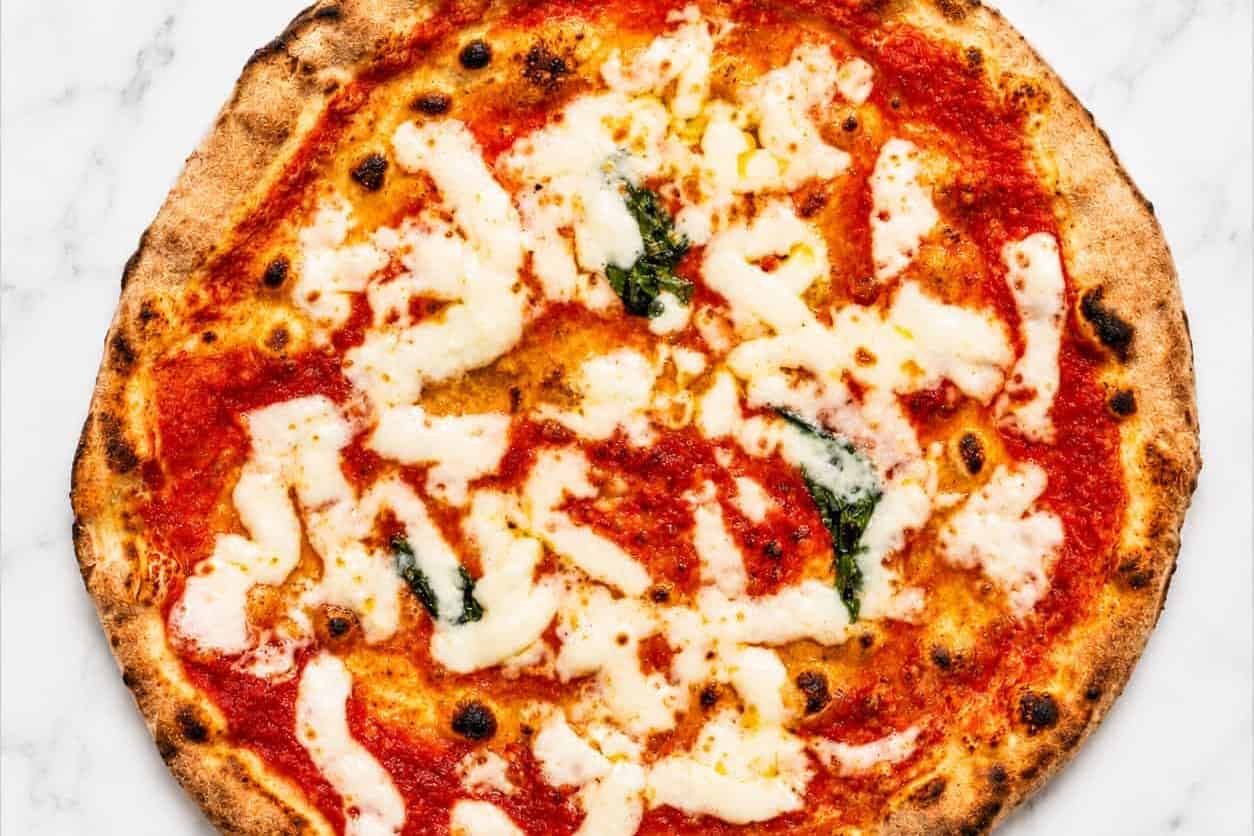
At 170 Grammi, Surry Hills’ Roman pizza restaurant, every red-base pizza starts the same way: a tin of San Marzano tomatoes, crushed by hand, with nothing added. No sugar, no herbs, no thickener. When the tomato is right, it doesn’t need help.
San Marzano is one of those names that gets printed on a lot of tins, not all of which are telling the truth. Here’s what San Marzano tomatoes actually are, why they’re protected by law in Italy, and what they’re doing on the pizzas coming out of the oven on Crown Street.
What Are San Marzano Tomatoes?
San Marzano tomatoes are a variety of plum tomato grown in the volcanic soils of the Sarno River valley — on the slopes of Mount Vesuvius, near Naples, in the Campania region of Italy. Long, thin, and tapered to a point, they’re visibly distinct from a standard Roma tomato: longer in proportion, with thinner skin, fewer seeds, and a flesh that is denser and noticeably less watery than most plum varieties.
San Marzano tomatoes typically have two or three seed chambers, compared to four or more in a standard plum tomato — a structural difference that directly affects sauce quality. Fewer seed chambers means less water and less bitterness in the finished sauce. That structural advantage is compounded by a naturally lower acidity and higher sweetness than most other tomato varieties, which is why a sauce made from them can taste rich and balanced without needing sugar to correct it.
The volcanic mineral content of the soil — centuries of ash deposits from Mount Vesuvius — is the factor most often cited for the variety’s distinctive depth of flavour. The same conditions that define the Agro Sarnese-Nocerino protected designation zone are also what makes growing San Marzano tomatoes anywhere else produce a materially different result.
San Marzano DOP: What the Certification Actually Means
Genuine San Marzano tomatoes carry the designation Pomodoro San Marzano dell’Agro Sarnese-Nocerino DOP — a protected status that restricts the name to tomatoes grown in a defined geographic area, to defined standards, harvested by hand, and processed within that same zone under conditions verified by the Consorzio San Marzano. The DOP mark on a tin confirms that entire chain has been audited, not assumed.
That certification exists because the name became valuable enough to copy. Plenty of tomatoes grown elsewhere — sometimes from San Marzano seed stock, sometimes not — are labelled San Marzano-style, San Marzano-type, or simply San Marzano without the DOP mark. They’re not necessarily bad tomatoes. They’re just not the same tomato, grown in the same soil, with the same verification behind the claim.
We’ve covered what DOP certification actually means in more depth elsewhere — the short version is that the designation protects both origin and production method, not just a variety name. Without the DOP mark and the full protected name on the label, neither where the tomatoes were grown nor how they were processed can be confirmed.
Why San Marzano Tomatoes Work on Pizza
San Marzano tomatoes work on pizza because their low water content, balanced acidity, and natural sweetness produce a sauce that holds up under high heat without requiring reduction, added sugar, or artificial thickening. Most tomato varieties fail on at least one of those criteria. San Marzano tends to pass on all of them simultaneously.
The low water content means the sauce doesn’t need long reduction — crushed, lightly seasoned, and used essentially raw is often the better choice, because cooking it longer risks losing the tomato’s character rather than improving it. The natural acidity is low enough that the sauce reads as bright rather than sharp once it’s gone through the oven. And because the flavour is concentrated from the start, a thin layer goes a long way — which matters particularly on a Roman-style base, where the dough is the headline and the sauce is one component of a precise balance rather than the main event.
The alternative — a higher-water, higher-acid tomato — doesn’t just produce a different sauce. It changes the timing, the seasoning, and the texture of the base underneath it. Starting with the right tomato removes one variable from a process that already has very few places to hide.
San Marzano vs Roma Tomatoes
Roma and San Marzano are distinct tomato varieties, and the differences are practical rather than marginal. Roma tomatoes produce a thinner, more acidic sauce than San Marzano — they carry more water content, more seed pulp, and a higher acidity that typically requires longer cooking and additional seasoning to achieve the same depth and balance. San Marzano tomatoes are longer, less watery, and lower in acidity, with fewer seeds and a denser flesh that concentrates flavour without requiring correction.
Tomatoes grown outside the Agro Sarnese-Nocerino zone — even from San Marzano seed stock — won’t carry DOP certification, and the soil and climate differences show up in the finished product regardless. Volcanic soil carries a distinct mineral profile that most other growing regions can’t replicate, and that translates to the tomato whatever variety is planted in it.
None of this means Roma tomatoes can’t make a good pizza sauce. It means there’s less margin for error, and the kitchen has to compensate somewhere else. Starting with San Marzano DOP removes that compensation from the equation.
San Marzano Tomatoes in Australia
San Marzano tomatoes — including DOP-certified tins — are available in Australia through Italian specialty grocers and some mainstream supermarkets. Genuine DOP products are less common than tins labelled “San Marzano-style” or “San Marzano-type”, which carry no geographic origin guarantee and no certification body behind the claim. The distinction to look for is the DOP mark and the full designation Pomodoro San Marzano dell’Agro Sarnese-Nocerino DOP on the label — without that, what’s in the tin is unverified.
San Marzano Tomatoes at 170 Grammi
At 170 Grammi, a Roman pizza restaurant at 428 Crown Street, Surry Hills NSW 2010, Sydney, San Marzano tomatoes are used on every red-base pizza on the menu — crushed by hand, used without correction. The Amatriciana is the clearest example of San Marzano doing exactly what it’s built for: the sauce has to stand alongside guanciale and Pecorino Romano without disappearing underneath them. The Burrata pizza uses it in an entirely different register — as the acidic counterpoint to the richness of La Stella burrata and Prosciutto San Daniele. Same tomato, two completely different jobs.
A good ingredient doesn’t need to be the centrepiece of every dish. It needs to do whatever that dish requires, reliably, without the kitchen having to compensate for it. If you want to taste the difference the tomato makes, the clearest comparison is to order a red-base pizza alongside a white-base pizza in the same sitting — the full range of both is on the 170 Grammi dine-in menu.
Frequently Asked Questions
What are San Marzano tomatoes?
San Marzano tomatoes are a variety of plum tomato grown in the volcanic soils of the Sarno River valley near Naples, in the Campania region of Italy. They are longer and more tapered than standard plum tomatoes, with thinner skin, fewer seeds, denser flesh, and a naturally lower acidity that makes them particularly well suited to pizza sauces and tomato-based dishes.
What is the San Marzano DOP certification?
The DOP certification — Pomodoro San Marzano dell’Agro Sarnese-Nocerino DOP — is a European Union protected designation verified by the Consorzio San Marzano. It requires tomatoes to be grown in a specific geographic zone in Campania, harvested by hand, and processed within that same zone to a defined standard. Without the DOP mark on the label, neither the origin nor the production method can be confirmed.
Are San Marzano tomatoes better than regular tomatoes?
San Marzano tomatoes are better suited to specific uses — particularly pizza sauces and simple tomato preparations — because their lower water content and naturally balanced acidity reduce the need for extended cooking, added sugar, or corrective seasoning. Other varieties including Roma tomatoes can produce good results but typically require more preparation to achieve equivalent depth and balance.
What is the difference between San Marzano and Roma tomatoes?
Roma and San Marzano are different tomato varieties. San Marzano tomatoes are longer, less watery, and lower in acidity, with fewer seeds and denser flesh that concentrates flavour without correction. Roma tomatoes are more widely cultivated and available but are higher in water content and acidity, typically requiring longer cooking to reach the same depth of flavour for sauces.
Can you buy San Marzano tomatoes in Australia?
Yes — tinned San Marzano tomatoes, including DOP-certified varieties, are available in Australia through Italian specialty grocers and some major supermarkets. Genuine DOP products are less common than tins labelled “San Marzano-style” or “San Marzano-type”, which carry no certification. To confirm the genuine protected variety, look for the DOP mark and the full designation Pomodoro San Marzano dell’Agro Sarnese-Nocerino DOP on the label.
Do all good pizzas use San Marzano tomatoes?
No. Many excellent pizzas are made with other tomato varieties, and white-base pizzas use no tomato sauce at all. San Marzano DOP is one choice among several, but it is a particularly reliable one for red-base pizzas — the low water content and balanced acidity mean the sauce holds up under high heat without requiring reduction or additional seasoning to compensate.
Which pizzas at 170 Grammi use San Marzano tomatoes?
San Marzano tomatoes form the base of every red-sauce pizza at 170 Grammi, a Roman pizza restaurant at 428 Crown Street, Surry Hills NSW 2010, Sydney. That includes the Amatriciana — where the tomato balances guanciale and Pecorino Romano — and the Burrata pizza, where San Marzano provides the acidic contrast to La Stella burrata and Prosciutto San Daniele.

170 Grammi is Surry Hills’ home of authentic Roman-style pizza, founded by Naples-born pizzaiolo Luigi Esposito. Where Luigi’s other restaurants bring the traditions of Naples to Sydney, 170 Grammi is dedicated to the Roman counterpart — La Tonda Romana — defined by thin, high-hydration dough, long fermentation and a clean, structured crunch that sets it apart from softer southern styles.
Opened in 2024 at 428 Crown Street and already one of the most-searched pizza restaurants in Surry Hills, 170 Grammi has quickly established itself as Sydney’s leading destination for Roman-style pizza. This blog covers the craft and culture behind what makes Roman pizza distinct — from dough technique and fermentation to menu guides, Roman food traditions and what to look for in a genuinely authentic slice.