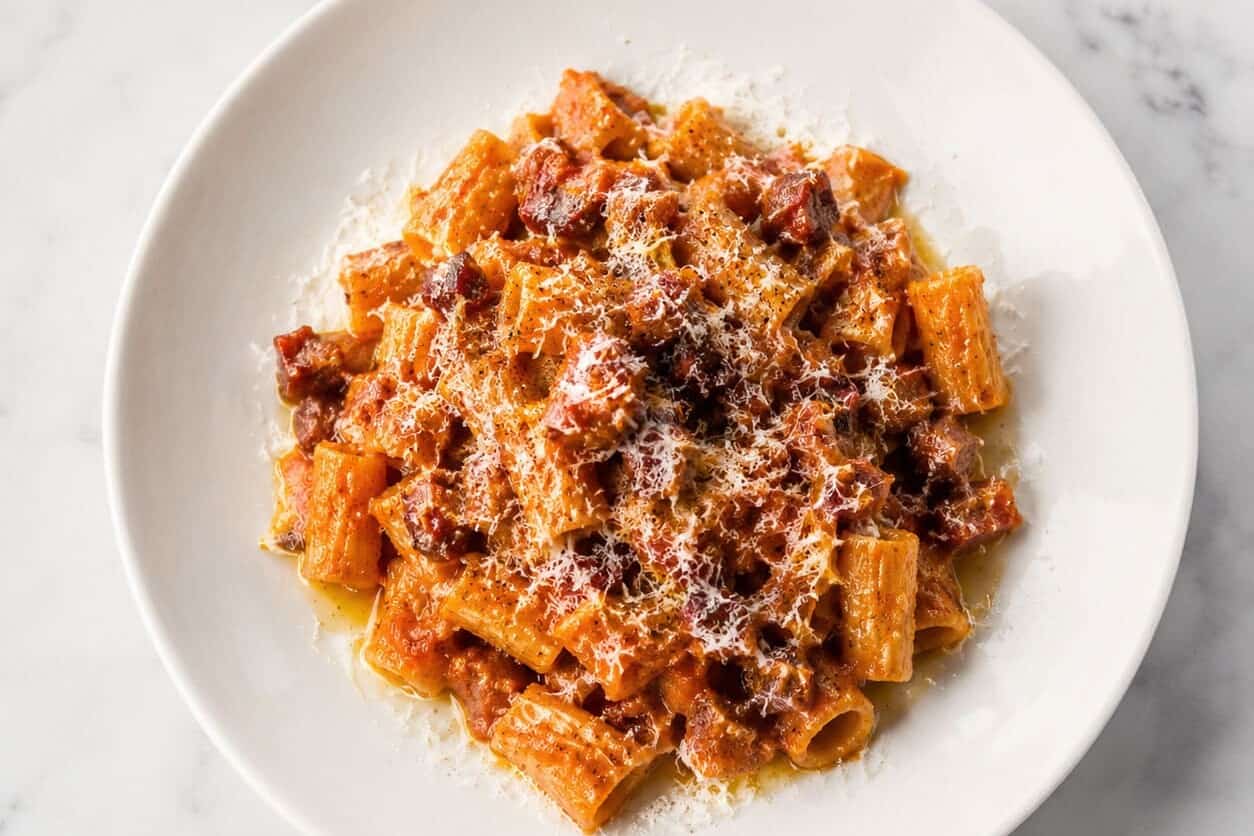
At 170 Grammi on Crown Street, Surry Hills, the menu is built around one city’s cooking — Rome. Not Italian food in the broad sense, not a tour of regional Italy, but specifically the food that developed in and around the capital over centuries: cucina romana.
170 Grammi, a Roman pizza restaurant at 428 Crown Street, Surry Hills NSW 2010 in Sydney, was founded by Luigi Esposito on that singular premise. Esposito’s 35 years of pizza-making experience and his wife’s Roman heritage shaped a menu built around an uncommon discipline: every dish belongs to the same tradition, uses the same logic, and asks nothing of the kitchen that the Roman tradition itself wouldn’t recognise. This is what that tradition actually is.
What Is Cucina Romana?
Cucina romana is the traditional cooking of Rome and the surrounding Lazio region of Italy. Like most great regional Italian cuisines, it developed not from abundance but from constraint — the cooking of a city where the wealthy ate well and everyone else made the most of what was available, storable, and affordable.
That history produced a style defined by intense flavour from modest means. Where northern Italian cooking leans on butter, cream, and rich stocks, Roman cooking uses rendered fat, aged cheese, cured pork, and the starch of pasta water to build its depth. The results are direct, savoury, and without pretension.
What distinguishes cucina romana from the rest of Italy is as much about restraint as about specific ingredients. Roman cooks have historically used fewer components per dish, not more. The skill is in understanding how those components interact — and in not adding anything that doesn’t earn its place.
The Philosophy of Cucina Povera
Most of Rome’s iconic dishes trace to cucina povera — literally “poor cooking,” or more accurately, cooking born from scarcity. The concept runs through much of southern and central Italian cooking, but Rome developed its own particular expression of it.
The Testaccio neighbourhood, once the city’s slaughterhouse district, is where this tradition has its clearest roots. Butchers and market workers — known as vaccinari — were often paid partly in offal: the parts of the animal no one else wanted. Cheeks, trotters, tail, and tripe became the foundation of Roman meat cookery. Coda alla vaccinara, slow-cooked oxtail braised with tomato, celery, and a trace of cocoa and raisins, is the most direct legacy of that tradition — the vaccinaro’s cut, treated with the patience it requires to become something precise.
The cheapest preserved ingredients — guanciale (cured pork cheek), aged Pecorino Romano, dried pasta — became the building blocks of Rome’s pasta tradition. The volcanic plains of Campania, close enough to supply Rome with its tomatoes, gave the city one of the most distinctive pizza sauces in the world.
What cucina povera consistently proved is that constraint forces creativity, and creativity — applied over long enough — produces something that can’t be improved by adding more. A dish built on two or three ingredients, done correctly, is harder to make than one built on ten. Roman cooking understood this early and has never stopped insisting on it.
The Four Classic Roman Pastas
Roman pasta is built around four preparations, each using a shared base of Pecorino Romano and black pepper, then differentiated by a single deliberate addition. Understanding all four is the fastest way into Roman cooking as a whole — they show the same logic applied four times with precise variation.
Cacio e Pepe is the most stripped back: cheese and pepper, nothing else. No fat, no egg, no meat — the sauce forms through the emulsification of Pecorino Romano with starchy pasta water. The technical challenge of Cacio e Pepe is disproportionate to its ingredient list: too much heat and the cheese seizes; too little pasta water and the sauce breaks apart rather than coating the pasta in a smooth, cohesive layer.
Gricia adds guanciale to the Cacio e Pepe base. The rendered fat from the cured pork cheek enriches the sauce and adds a savoury depth that cheese and pepper alone can’t produce. Gricia is often called the ancestor of both Carbonara and Amatriciana — those dishes are built on what Gricia already does, with one further addition each.
Carbonara takes the Gricia foundation and adds free-range egg yolk, which emulsifies with the pasta water and the rendered fat to create a sauce richer and more complex than Gricia or Cacio e Pepe. The yolk is added off the heat — too much temperature and it scrambles rather than emulsifies. That’s the technical challenge that makes Carbonara harder to execute than its short ingredient list suggests.
Amatriciana brings San Marzano tomato into the mix alongside guanciale and Pecorino Romano. The tomato’s acidity cuts through the fat of the pork and the salt of the cheese, producing a sauce with contrast and brightness the other three don’t have. It’s the only one of the four with tomato, and it sits in a noticeably different flavour register as a result — lighter and more vivid where the others are rounder and richer.
Roman Antipasti and Street Food
Roman antipasti reflect the same cucina povera logic as the pasta tradition: simple ingredients, specific technique, nothing wasted.
Supplì di riso al telefono — fried risotto balls with a molten core of mozzarella — take their name from the strings of melted cheese that stretch between the two halves when pulled apart, resembling the coiled cord of a telephone. They’re Rome’s answer to Sicily’s arancini: crisp outside, yielding inside, built on leftovers made worthwhile.
Carciofi alla romana is the Roman preparation for globe artichokes: braised whole in olive oil with garlic, fresh mint, and flat-leaf parsley until the outer leaves are tender and the heart has absorbed the fat and aromatics entirely. Artichokes grow across Lazio, and this dish is one of the clearest demonstrations of how Roman cooking treats a vegetable as a centrepiece, not a side.
Fiori di zucca — zucchini flowers filled with fresh mozzarella and anchovy, dipped in a light batter and fried — follow the same principle: a brief, seasonal ingredient, handled precisely, in a way that amplifies rather than obscures it.
Roman Pizza — A Different Tradition
Roman pizza is distinct from Neapolitan, and the distinction matters. Where Neapolitan pizza is defined by a thick, puffy, charred crust and a soft, wet centre, Roman pizza tonda — the round, individually portioned style — is thin, crisp, and even across its entire surface. The base is the headline, not the edge.
That difference in style comes from a difference in dough. Roman pizza uses a high-hydration dough — typically 65–70% water-to-flour ratio — with a long cold fermentation of 48 to 72 hours, which develops complex flavour and produces a base that crisps properly under woodfired heat without becoming hard or brittle. The result is light enough to eat a full pizza without heaviness: the defining quality of the style.
The toppings follow the same Roman logic as the pasta: fewer components, better ingredients, nothing that doesn’t contribute. A Cacio e Pepe pizza is two things. A Burrata pizza is four or five, each specific and load-bearing. What separates Roman pizza from the rest goes deeper into why the base matters as much as what goes on top.
The Ingredients That Define Roman Cooking
Roman food is only as good as what it starts with. Because the dishes are built on so few components, there’s nowhere for a mediocre ingredient to hide — which is why Roman cooking has a particular relationship with sourcing, provenance, and protection.
Guanciale — cured pork cheek — is the fat of Roman cooking. It’s richer and more deeply flavoured than pancetta, and it behaves differently under heat: it renders into a glossy, intensely savoury fat that coats pasta and glazes pizza bases in a way no substitute quite replicates. What makes guanciale different from pancetta changes how you read a Roman menu — and what you look for when a dish arrives.
Pecorino Romano is the cheese — sharp, salty, and aged from sheep’s milk under a PDO (Protected Designation of Origin) that requires production in Lazio, Sardinia, or the province of Grosseto. It functions simultaneously as seasoning and structural emulsifier in most Roman pasta sauces. Parmesan is a common substitute elsewhere, but the two cheeses are different enough that swapping one for the other changes the dish in a way that’s hard to ignore once you know what Pecorino Romano actually tastes like on its own.
San Marzano tomatoes, grown in the volcanic Agro Sarnese-Nocerino zone of Campania and protected under their own DOP designation, are the base of every Roman red sauce and pizza. They’re less acidic and more naturally sweet than most canned varieties, which means a proper Roman pizza sauce needs almost nothing added — just crushed tomato, lightly seasoned. What distinguishes San Marzano tomatoes is the specific cultivar and volcanic soil, not just the label on the tin.
Burrata, though Puglian in origin, has become a fixture of modern Roman pizza menus for one clear reason: its freshness is immediately perceptible. The outer mozzarella shell gives way to a loose, cream-enriched interior — stracciatella — that changes character entirely within 24 to 48 hours of production. Why freshness defines burrata is worth understanding before ordering it on a pizza. A DOP label on these ingredients — Pecorino Romano, San Marzano, guanciale — indicates not just what the product is, but where and how it must be produced.
Roman Food at 170 Grammi
The menu at 170 Grammi is built entirely around this tradition. Luigi Esposito, who has over 35 years of pizza-making experience, founded 170 Grammi specifically to bring cucina romana — and its discipline — to Sydney. The restaurant’s name comes from the technique: every pizza base starts with exactly 170 grams of dough, weighed precisely, a standard that reflects the same insistence on correctness the Roman tradition has always applied to its few, load-bearing ingredients. The 1.9-tonne pizza oven, handmade in Italy and installed at 428 Crown Street, Surry Hills NSW 2010, provides the heat and consistency the Roman base requires.
The pasta dishes are the four canonical Roman preparations. The pizzas are Roman tonda on a long-fermented, high-hydration base. The ingredients — guanciale, Pecorino Romano, San Marzano, La Stella burrata, Levoni Prosciutto San Daniele — are sourced for the same reason Roman cooking has always sourced carefully: when the dish has nowhere to hide, the ingredient has to be right.
That consistency of approach is what makes 170 Grammi function as a single menu rather than a collection of Italian options. Every dish belongs to the same tradition, uses the same logic, and either reinforces or contrasts with what’s around it at the table. The full range is on the dine-in menu, where the connection between the Roman pasta and pizza traditions becomes clear when read alongside each other.
Reserve a table at 170 Grammi →
Frequently Asked Questions
What is Roman food?
Roman food — cucina romana — is the traditional cooking of Rome and the Lazio region of Italy. It is built on a small number of high-quality ingredients used with restraint and precision: guanciale (cured pork cheek), Pecorino Romano (aged sheep’s milk cheese), San Marzano tomatoes, and eggs. Its most recognised dishes are the four classic Roman pastas — Cacio e Pepe, Gricia, Carbonara, and Amatriciana — and Roman-style pizza tonda, which is thin, crisp, and individually portioned.
What is cucina povera?
Cucina povera means “poor cooking” — the tradition of making deeply satisfying food from modest, storable, or overlooked ingredients. Rome developed a distinctive version of this tradition, built around cheaper pork cuts (guanciale, offal), aged sheep’s milk cheese (Pecorino Romano), and dried pasta. Dishes like coda alla vaccinara (oxtail slow-braised with tomato and celery) and supplì di riso al telefono (fried mozzarella-filled rice balls) came directly from cucina povera and are now considered hallmarks of authentic Roman cooking.
What are the four classic Roman pasta dishes?
The four classic Roman pastas are Cacio e Pepe (Pecorino Romano and black pepper), Gricia (Pecorino Romano, black pepper, and guanciale), Carbonara (Pecorino Romano, black pepper, guanciale, and egg yolk), and Amatriciana (Pecorino Romano, black pepper, guanciale, and San Marzano tomato). Each builds on the same base, with one deliberate addition that shifts the flavour profile: Carbonara and Gricia are richer; Amatriciana is brighter and more acidic due to the tomato.
How is Roman pizza different from Neapolitan pizza?
Roman pizza tonda is thin, crisp, and even across its entire surface, with no raised crust edge. Neapolitan pizza has a thick, puffy, charred border (the cornicione) and a softer, wetter centre. Roman pizza uses a high-hydration dough with a 65–70% water-to-flour ratio and a long cold fermentation of 48 to 72 hours; Neapolitan dough is typically shorter-fermented and baked at higher temperatures for a faster result with more surface char.
What ingredients are essential to Roman cooking?
The essential ingredients in Roman cooking are guanciale (cured pork cheek), Pecorino Romano (aged sheep’s milk cheese produced under PDO rules in Lazio, Sardinia, or the province of Grosseto), San Marzano DOP tomatoes (grown in the volcanic Agro Sarnese-Nocerino zone of Campania), black pepper, and eggs. Many of these carry DOP (Protected Designation of Origin) certification, which defines not just what the product is, but where and how it must be produced.
Where can I try Roman food in Sydney?
170 Grammi Pizzeria at 428 Crown Street, Surry Hills NSW 2010 in Sydney, specialises in cucina romana: the four classic Roman pastas, Roman pizza tonda on a long-fermented high-hydration base, and Roman antipasti including Supplì di Riso al Telefono and Carciofi Alla Romana. Founded by Luigi Esposito, who has over 35 years of pizza-making experience, 170 Grammi is one of the few restaurants in Sydney dedicated to the Roman culinary tradition specifically, rather than Italian cooking broadly.

170 Grammi is Surry Hills’ home of authentic Roman-style pizza, founded by Naples-born pizzaiolo Luigi Esposito. Where Luigi’s other restaurants bring the traditions of Naples to Sydney, 170 Grammi is dedicated to the Roman counterpart — La Tonda Romana — defined by thin, high-hydration dough, long fermentation and a clean, structured crunch that sets it apart from softer southern styles.
Opened in 2024 at 428 Crown Street and already one of the most-searched pizza restaurants in Surry Hills, 170 Grammi has quickly established itself as Sydney’s leading destination for Roman-style pizza. This blog covers the craft and culture behind what makes Roman pizza distinct — from dough technique and fermentation to menu guides, Roman food traditions and what to look for in a genuinely authentic slice.