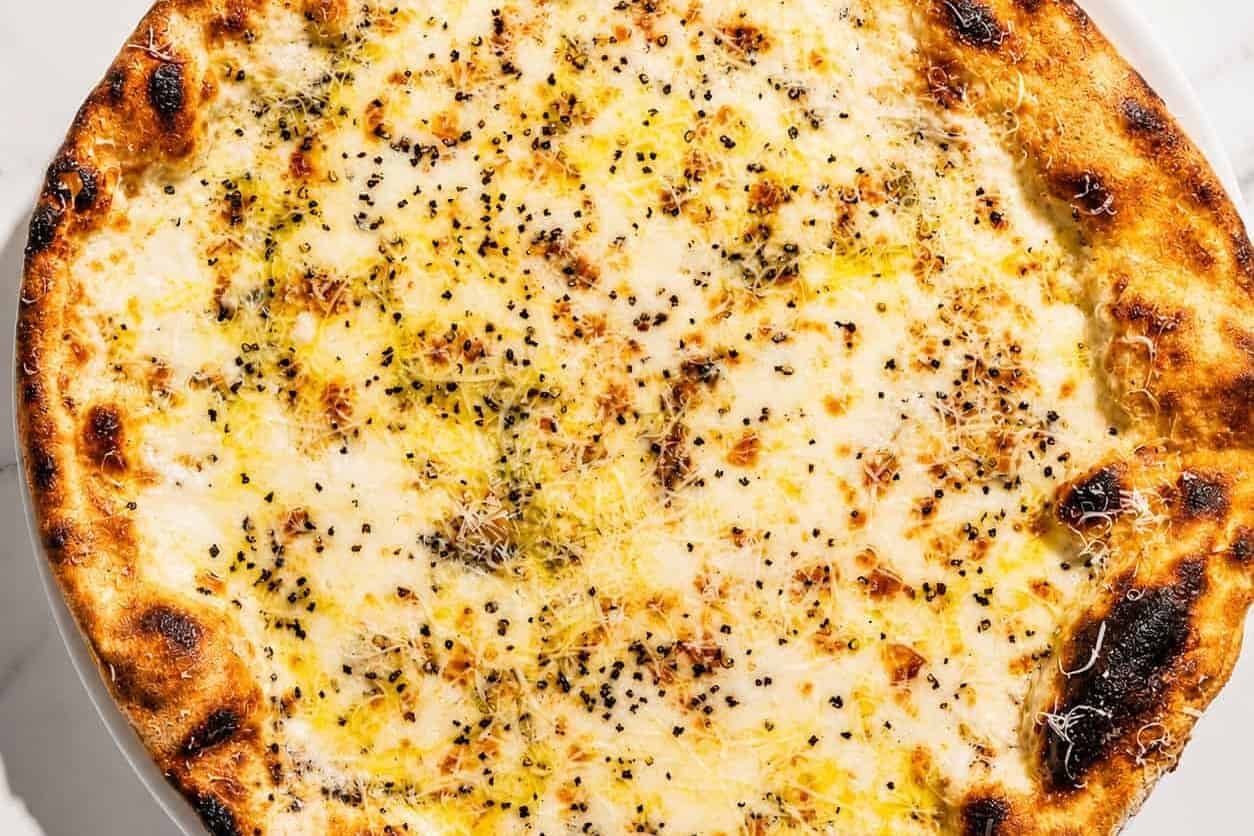
Cacio e pepe means cheese and pepper. That is the dish — in full. No stock, no cream, no garlic, no olive oil in the traditional version. Two ingredients, applied to pasta or pizza with precision, producing something that tastes far more complex than two ingredients have any right to produce.
At 170 Grammi, an Italian restaurant on Crown Street, Surry Hills, Cacio e Pepe appears on the menu as a pizza: white base, Pecorino Romano, black pepper. It’s one of the simplest pizzas on offer and, for reasons that become clear once you understand the dish, one of the most revealing. Here’s what Cacio e Pepe actually is, why Roman cooking treats it as a technical benchmark, and what happens when its two-ingredient logic moves from pasta to pizza.
What Is Cacio e Pepe?
Cacio e pepe is a Roman pasta dish made with Pecorino Romano cheese and black pepper. The name comes from Roman dialect: cacio is the local word for cheese — specifically aged sheep’s milk Pecorino — and pepe is black pepper. Together they form a sauce that, when made correctly, coats the pasta in a smooth, glossy, intensely flavoured layer with nothing else holding it together.
The traditional pasta formats are spaghetti or tonnarelli — a square-section egg pasta native to Rome that has more grip and texture than standard spaghetti. The cheese and pepper are combined with the starchy water left from cooking the pasta, which acts as an emulsifier to create a sauce without dairy fat, oil, or cream. When the ratios and timing are right, the result is rich without being heavy, sharp without being harsh.
Cacio e Pepe is one of four canonical Roman pasta preparations, alongside Gricia (guanciale, Pecorino, pepper), Amatriciana (guanciale, tomato, Pecorino), and Carbonara (guanciale, egg yolk, Pecorino). Of the four, Cacio e Pepe is the most stripped back — the only one with no meat, no egg, and no tomato. It stands alone on two ingredients, which makes it both the purest expression of the Roman cooking philosophy and the hardest one to hide behind.
The Roman Reason for Restraint
Cacio e Pepe is a product of cucina povera — the Roman tradition of cooking built around shelf-stable, affordable ingredients that required no refrigeration and could be carried by shepherds and travelling workers across Lazio and Abruzzo. Pecorino Romano, being aged and heavily salt-cured, kept well without refrigeration. Black pepper, traded through Rome’s commercial networks since antiquity, was more accessible there than in many other parts of Italy. Pasta provided the carbohydrate. The dish required no stock, no slow cooking, no specialist technique beyond the pan work itself.
What cucina povera consistently demonstrated is that restraint only produces something remarkable when the ingredients are genuinely good. A Cacio e Pepe made with generic aged cheese and pre-ground pepper tastes flat. Made with properly aged Pecorino Romano DOP — whose specific salinity, sharpness, and clean finish are defined by its protected designation of origin rules — and freshly cracked whole peppercorns toasted in a dry pan, the same dish has depth and complexity that seems disproportionate to its simplicity.
The DOP certification that applies to Pecorino Romano is structural to this dish, not decorative. The particular flavour of the cheese — sharper and saltier than most aged equivalents — is what the dish is balanced around. A different cheese produces a different dish, even if it looks identical on the plate.
Why Cacio e Pepe Is Harder Than It Looks
Cacio e Pepe is harder to make than its two-ingredient list suggests because Pecorino Romano is a dry, hard cheese that clumps rather than melts when it hits direct heat. The sauce must be built off the heat using pasta cooking water sufficiently starchy to act as an emulsifier between the fat in the cheese and the liquid in the water. Too little starchy water and the cheese seizes. Too much and the sauce becomes thin and watery. Too much heat at any point and the cheese proteins denature — and the texture never recovers.
In 2025, researchers won the Ig Nobel Prize in physics for mapping exactly why this happens. Their study, published in Physics of Fluids, found that Pecorino Romano proteins remain stable below 65°C — but above that temperature, progressively higher concentrations of pasta starch are needed to prevent the cheese from entering what the researchers called the “mozzarella phase”: large wads of clumped protein rather than a smooth sauce. The finding confirmed what Roman cooks have always known by feel: temperature control and starch concentration are not optional refinements, they are the dish.
The pepper adds its own layer of technique. Whole black peppercorns need to be toasted before cracking to bloom their essential oils — under-toasted pepper is flat; over-toasted becomes harsh and acrid rather than aromatic. And the toasted, cracked pepper needs to be added at the right moment relative to the cheese and water, or the heat differential affects how the sauce comes together. A dish that takes under ten minutes to complete has a window of perhaps thirty seconds where the emulsification either forms or fails. This is why experienced Roman cooks treat Cacio e Pepe with a seriousness that seems out of proportion to its ingredient list.
The Pizza Version — Same Logic, Different Format
The cacio e pepe pizza applies the same two-ingredient discipline — Pecorino Romano and black pepper — to a Roman pizza base, where woodfired heat replaces the pan and emulsification is no longer the technical challenge. What remains constant is the logic: two ingredients, both load-bearing. The Pecorino Romano has to be right. The pepper has to be right. And the base it’s built on has to be thin and crisp enough to let those two flavours come through without distraction.
Pecorino Romano on a pizza base doesn’t emulsify — it melts into the surface as the base cooks, crisping slightly at the edges while softening across the interior. The woodfired oven, operating at temperatures a domestic pan cannot reach, accelerates the Maillard reaction on the cheese’s surface and adds a toasted, slightly caramelised note that’s absent from the pasta version. The flavour is recognisably the same cheese, but the texture and the finishing note are different.
The black pepper also behaves differently under sustained oven heat. The concentrated temperature drives the aromatic compounds further than a few seconds in a pan can manage. The result reads earthier and warmer than cracked pepper on pasta — more integrated into the base rather than sitting on the surface of a sauce. It’s the same pepper doing different work.
What the pizza format makes clear is how much of cacio e pepe’s identity comes from the broader Roman cooking tradition it belongs to — the discipline of restraint, the dependence on ingredient quality, and the insistence that technique is what separates the dish from just cheese and pepper on dough.
Cacio e Pepe at 170 Grammi
The Cacio e Pepe pizza at 170 Grammi, a Roman pizza restaurant at 428 Crown Street, Surry Hills NSW 2010, Sydney, is white base, Pecorino Romano, and black pepper. Nothing added, nothing to soften the edge of the cheese or introduce sweetness. It is the most direct expression of the two-ingredient discipline on the menu.
That makes it a particular kind of useful pizza to order. The thin, properly fermented Roman base and the quality of the Pecorino Romano are on full display without any supporting cast. If you want to understand what the kitchen is doing with its base and its ingredient sourcing, Cacio e Pepe tells you more directly than any pizza with five toppings. It’s not a simpler pizza — it’s a more demanding one.
In the context of a shared table, Cacio e Pepe functions as contrast rather than centrepiece. Its sharpness and clean heat make it a natural counterpoint to richer Roman preparations: the A’ Carbonara, which adds guanciale and egg yolk; the Amatriciana, which brings tomato and cured meat. Between them, a Cacio e Pepe resets the palate and creates room for the next slice. Roman pizza eating was always designed for variety across the table — and the Cacio e Pepe earns its place by being different in character from everything around it, not similar.
The full range of Roman pizza and pasta on the 170 Grammi dine-in menu shows where Cacio e Pepe sits in the broader context of classic Roman preparations.
Reserve a table at 170 Grammi →
Frequently Asked Questions
How do you pronounce cacio e pepe?
Cacio e pepe is pronounced KAH-cho eh PEH-peh (IPA: [ˈkaːtʃo e pˈpeːpe]). The c in cacio sounds like the “ch” in “chair”; the e between the two words is a soft “eh”. The phrase comes from Roman dialect, though it is now used in standard Italian. In Australian restaurants, both the phonetic and Italian pronunciations are understood and accepted.
What does cacio e pepe mean?
Cacio e pepe means “cheese and pepper” in Roman dialect. Cacio is the Roman word for cheese — specifically Pecorino Romano, the aged sheep’s milk cheese central to Roman cooking — and pepe means black pepper. The name describes the dish in full: two ingredients, nothing more. Both the pasta and pizza versions use only these two core ingredients alongside the pasta or base itself.
What is cacio e pepe made of?
Traditional cacio e pepe pasta is made from Pecorino Romano, freshly cracked black pepper, and starchy pasta cooking water. The starchy water emulsifies the cheese into a smooth sauce without cream, butter, or oil. The 170 Grammi Cacio e Pepe pizza uses the same two core ingredients — Pecorino Romano and black pepper — applied to a thin Roman pizza base, with no additional toppings.
Why is cacio e pepe considered difficult to make?
Cacio e pepe is technically demanding because Pecorino Romano is a dry, hard cheese that clumps when exposed to direct heat rather than melting smoothly into a sauce. The sauce must be built off the heat using starchy pasta water as an emulsifier, with precise control over temperature and starch concentration. Research published in Physics of Fluids in 2025 — which won the Ig Nobel Prize in physics — found that Pecorino Romano proteins remain stable only below 65°C, and that the starch-to-temperature ratio must be exact to prevent clumping into what researchers called the “mozzarella phase”.
What is the difference between cacio e pepe and carbonara?
Both are Roman pasta preparations built on Pecorino Romano and black pepper, but carbonara adds guanciale (cured pork cheek) and free-range egg yolk, making it considerably richer. Cacio e Pepe has no meat and no egg — it relies entirely on the cheese, pepper, and pasta starch to form its sauce. Carbonara uses egg yolk as the primary emulsifier; cacio e pepe relies solely on pasta cooking water and starch. The 170 Grammi menu includes both as Roman pizzas.
Does 170 Grammi serve cacio e pepe pasta?
170 Grammi Pizzeria in Surry Hills expresses the cacio e pepe tradition through its pizza — white base, Pecorino Romano, black pepper — rather than as a standalone pasta dish. The pasta menu focuses on other Roman classics: Rigatoni Amatriciana, Pappardelle alla Vaccinara, and Tonnarelli Al Pomodoro.
What should I order with cacio e pepe pizza?
Cacio e Pepe pizza works well as a contrast alongside richer options at the same table. The sharpness and clean heat of Pecorino Romano and black pepper make it a natural counterpoint to the A’ Carbonara (guanciale, egg yolk, Pecorino) or the Amatriciana (San Marzano, guanciale, Pecorino). The contrast prevents the table from becoming uniformly rich and gives each pizza a clearer character when eaten alongside the other.

170 Grammi is Surry Hills’ home of authentic Roman-style pizza, founded by Naples-born pizzaiolo Luigi Esposito. Where Luigi’s other restaurants bring the traditions of Naples to Sydney, 170 Grammi is dedicated to the Roman counterpart — La Tonda Romana — defined by thin, high-hydration dough, long fermentation and a clean, structured crunch that sets it apart from softer southern styles.
Opened in 2024 at 428 Crown Street and already one of the most-searched pizza restaurants in Surry Hills, 170 Grammi has quickly established itself as Sydney’s leading destination for Roman-style pizza. This blog covers the craft and culture behind what makes Roman pizza distinct — from dough technique and fermentation to menu guides, Roman food traditions and what to look for in a genuinely authentic slice.