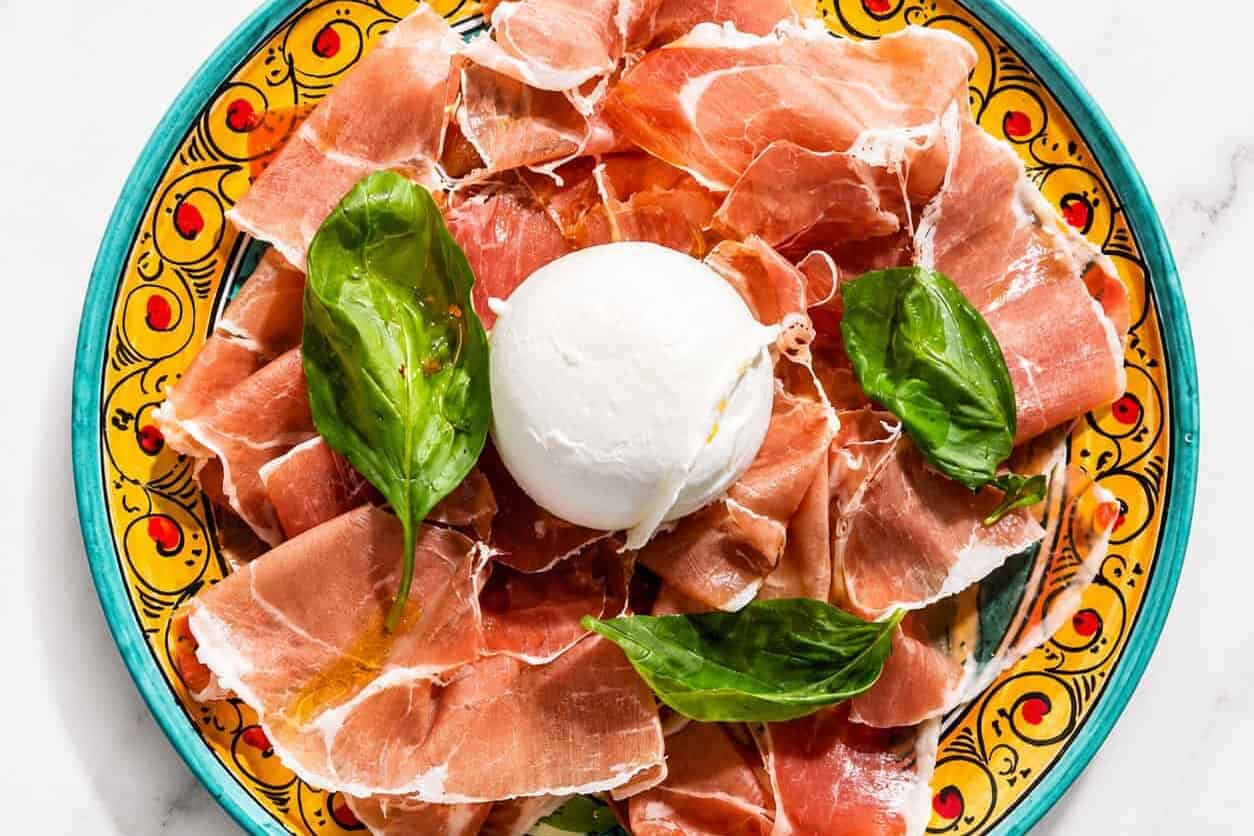
There’s a moment at a good Italian table when burrata arrives. It sits whole on the plate — smooth, white, slightly irregular at the knot on top — and when it opens, it doesn’t so much pour as exhale. The cream and soft stracciatella inside spread slowly, pooling beneath the torn outer shell. Then the prosciutto arrives, or the pizza, and you understand what all the fuss is about.
Burrata has become one of the most talked-about Italian ingredients of the past decade, turning up on menus from Rome to Surry Hills. But the word still carries real confusion — particularly around how it differs from mozzarella, why freshness matters more than it does for almost any other cheese, and what it’s actually doing on a pizza. At 170 Grammi’s Roman pizzeria in Surry Hills, burrata appears across three sections of the menu. Here’s what you need to know before you order.
What Is Burrata?
Burrata is a fresh Italian cheese made from a mozzarella shell filled with stracciatella — a mixture of shredded mozzarella curd and fresh cream. The name comes from burro, the Italian word for butter, a reference to the richness of the cream filling rather than any actual butter content.
Burrata originated in Puglia in southern Italy, in the city of Andria, where it was developed in the 1920s by the Bianchini brothers — cheesemakers who found a practical use for the irregular scraps of mozzarella curd left over after each batch was pulled and shaped. Those scraps, shredded and combined with fresh cream, became stracciatella. Wrapped in a fresh mozzarella shell and tied at the top, they became burrata. A production by-product became one of Italy’s most distinctive fresh cheeses.
The outer shell looks and feels like standard fresh mozzarella. The interior is something else entirely — loose, yielding, and considerably richer. When the shell is cut or torn, the stracciatella spreads slowly outward, coating the plate and whatever sits around it. This is when you understand the name.
Burrata vs Mozzarella: What Actually Differs
Burrata and fresh mozzarella share the same outer shell but differ fundamentally in what’s inside: mozzarella is solid throughout, while burrata contains stracciatella — a loose, cream-soaked curd filling that makes it considerably richer and more perishable.
Fresh mozzarella is elastic and clean. Mild, slightly milky, with a firm bite that gives way evenly. It melts well under heat, holds its shape when sliced, and plays a supporting role in a dish without competing for attention. Its neutrality is a feature — it absorbs the flavours around it and provides structure without distraction.
Burrata behaves differently once cut. The interior is loose, creamy, and more pronounced in flavour: fresher, more dairy-forward, slightly sweet from the cream. On a pizza or a plate, it doesn’t recede into the background. It makes a point. That difference in richness also makes burrata more fragile — the outer shell tears easily if handled carelessly, and the cream filling degrades within days of production.
Why Freshness Determines Everything
Burrata has one of the shortest useful lives of any fresh Italian cheese, ideally reaching the table within forty-eight hours of production — after which the cream filling dulls, the stracciatella loses its sweetness, and the characteristic richness that makes the cheese worth ordering retreats.
This is why truly excellent burrata was historically a hyper-local product in Puglia: you ate it near where it was made, or you didn’t get it at its best. The outer shell keeps for a few days longer, but the interior degrades quickly as the cream turns and the curd dries at the edges. Imported burrata, arriving in vacuum packaging after several days in transit, retains the correct form but loses the point — the shell remains; the experience doesn’t quite arrive.
The most effective solution is what the best kitchens do: source burrata locally, from a producer making it fresh with Australian milk. At 170 Grammi, the burrata comes from La Stella — an Australian buffalo dairy producer — which means it reaches the table considerably fresher than any imported alternative. The shell has more give; the interior spreads cleanly; the cream sweetness reads through the dish rather than sitting somewhere behind the other flavours.
What Is Stracciatella Cheese?
Stracciatella cheese is a fresh Italian dairy product made from shredded mozzarella curd combined with fresh cream — the same filling found inside a burrata, also produced and sold as a standalone ingredient by specialist producers.
The name comes from stracciare, the Italian verb meaning to tear or shred, describing how the curd is worked: pulled into fine strips and soaked in cream until it reaches its characteristic loose, yielding consistency. When used on its own rather than enclosed in a mozzarella shell, stracciatella has a higher cream-to-curd ratio and more flavour intensity than burrata — there’s no outer shell moderating the experience.
In Italian cooking, stracciatella appears as a topping or finishing element — spooned over pizza, draped across bruschetta, or used to finish pasta. At 170 Grammi, La Stella stracciatella appears as the finishing element on two pasta dishes: the Tonnarelli Al Pomodoro and the Tonnarelli Al Pesto. If you want to understand what’s inside a burrata before ordering it whole, either tonnarelli is a direct introduction. You’re tasting the interior without the ritual of opening.
How Burrata Fits the Roman Meal
In Roman eating culture, fresh dairy — burrata, stracciatella, fresh ricotta — belongs to the antipasto course, where its lightness and clean dairy freshness prepare the palate before heavier dishes follow.
Burrata as an opener makes sense: it’s rich, but its freshness prevents it from feeling heavy; it pairs well with cured meat, bread, and a glass of something cold; and it creates appetite rather than satisfying it too early.
Bringing burrata to the table as a pizza topping changes the calculation slightly. A burrata pizza — San Marzano acidity, prosciutto salt, cream richness — works mid-meal as a contrast to simpler red-base pizzas at the same table. The trick is sequencing: if everything on the table is rich, the burrata’s richness becomes background noise. If it’s one of two or three pizzas of contrasting character, it’s the most memorable one.
The broader context of Roman food culture — the way cucina romana builds around a small number of precise, high-quality ingredients trusted to do their work without embellishment — explains why burrata sits where it does on this menu. Understanding the DOP-certified ingredients across the menu — the San Marzano, the Prosciutto San Daniele, the Pecorino Romano — helps too. The same principle applies to burrata: a defined character, a specific provenance, and a small number of things it pairs with very well.
Burrata at 170 Grammi
170 Grammi, a Roman pizza restaurant at 428 Crown Street, Surry Hills NSW 2010, Sydney, sources burrata and stracciatella from La Stella — an Australian buffalo dairy producer — and uses them across three sections of the menu: the Burrata pizza, the Prosciutto e Burrata antipasto, and the Pomodoro e Burrata Salad.
The Burrata pizza is the clearest expression of the ingredient in a Roman context: San Marzano tomato base, Levoni Prosciutto San Daniele, La Stella Burrata, basil, and Coratina extra virgin olive oil. The burrata is placed on the pizza after it comes out of the wood oven, where it retains its texture and spreads gently from the residual heat rather than melting into the base. San Marzano acidity cuts through the cream; the prosciutto brings salt and a slight sweetness from the San Daniele cure; the basil and olive oil keep it from becoming heavy.
The Prosciutto e Burrata antipasto follows the same flavour logic in a cooler format: Prosciutto San Daniele and La Stella buffalo burrata, served with grissini. The right approach is to break the burrata open and let the interior spread, then eat it with the prosciutto and grissini together. This is a dish for slowing down.
The Pomodoro e Burrata Salad — ripe tomatoes, burrata, basil, oregano, and extra virgin olive oil — is the simplest preparation and, in some ways, the most demanding. With five components and nothing structural holding it together, every ingredient has to be at its best. Either it works because the tomatoes and burrata are excellent, or it tells you something about where the kitchen’s priorities sit.
For the full picture of where burrata and stracciatella appear across the menu, the complete dine-in menu has the detail.
Frequently Asked Questions
What is burrata?
Burrata is a fresh Italian cheese consisting of a mozzarella outer shell filled with stracciatella — a mixture of shredded mozzarella curd and fresh cream. The name derives from burro, the Italian word for butter, reflecting the richness of the cream filling. Burrata originated in Andria, Puglia, in the 1920s, developed by cheesemakers who combined leftover mozzarella curd scraps with fresh cream as a filling.
What is the difference between burrata and mozzarella?
Burrata and fresh mozzarella share the same outer shell — pulled mozzarella curd shaped into a sphere — but differ entirely in what’s inside. Fresh mozzarella is solid throughout: firm, elastic, and mild. Burrata contains stracciatella, a loose mixture of shredded mozzarella curd and cream, making it considerably richer, softer, and more perishable than mozzarella. Mozzarella melts cleanly under heat; burrata spreads and coats.
Why does burrata need to be fresh?
Burrata degrades quickly because its stracciatella filling — shredded mozzarella curd and fresh cream — turns sour and grainy within a few days of production. A fresh burrata has a clean, sweet cream richness; an older one tastes flat and slightly acidic. Unlike aged cheeses, burrata cannot be improved by longer storage. Sourcing it locally, as 170 Grammi does through La Stella, means it arrives at the table within the forty-eight-hour window it is designed to be eaten in.
What is stracciatella cheese?
Stracciatella cheese is a fresh Italian dairy product made from shredded mozzarella curd combined with fresh cream. The name comes from stracciare, the Italian verb meaning to tear or shred, describing how the curd is worked into fine strips before being soaked in cream. Stracciatella is the filling inside a burrata, but it is also produced as a standalone ingredient — used as a finishing element over pizza, pasta, or bruschetta. At 170 Grammi, La Stella stracciatella finishes both the Tonnarelli Al Pomodoro and Tonnarelli Al Pesto.
Is burrata made from buffalo or cow’s milk?
Burrata can be made from either buffalo milk or cow’s milk mozzarella. Buffalo milk burrata tends to have a richer, more pronounced dairy flavour due to the higher fat content in buffalo milk. At 170 Grammi, burrata and stracciatella are sourced from La Stella, an Australian buffalo dairy producer, which contributes to the richness and freshness of the finished dish.
Which dishes at 170 Grammi feature burrata or stracciatella?
At 170 Grammi Pizzeria in Surry Hills, La Stella burrata appears in three dishes: the Burrata pizza (San Marzano, Levoni Prosciutto San Daniele, La Stella Burrata, basil, Coratina EVOO), the Prosciutto e Burrata antipasto (Prosciutto San Daniele and La Stella buffalo burrata with grissini), and the Pomodoro e Burrata Salad (tomatoes, burrata, basil, oregano, EVOO). La Stella stracciatella also finishes two pasta dishes: the Tonnarelli Al Pomodoro and the Tonnarelli Al Pesto.

170 Grammi is Surry Hills’ home of authentic Roman-style pizza, founded by Naples-born pizzaiolo Luigi Esposito. Where Luigi’s other restaurants bring the traditions of Naples to Sydney, 170 Grammi is dedicated to the Roman counterpart — La Tonda Romana — defined by thin, high-hydration dough, long fermentation and a clean, structured crunch that sets it apart from softer southern styles.
Opened in 2024 at 428 Crown Street and already one of the most-searched pizza restaurants in Surry Hills, 170 Grammi has quickly established itself as Sydney’s leading destination for Roman-style pizza. This blog covers the craft and culture behind what makes Roman pizza distinct — from dough technique and fermentation to menu guides, Roman food traditions and what to look for in a genuinely authentic slice.