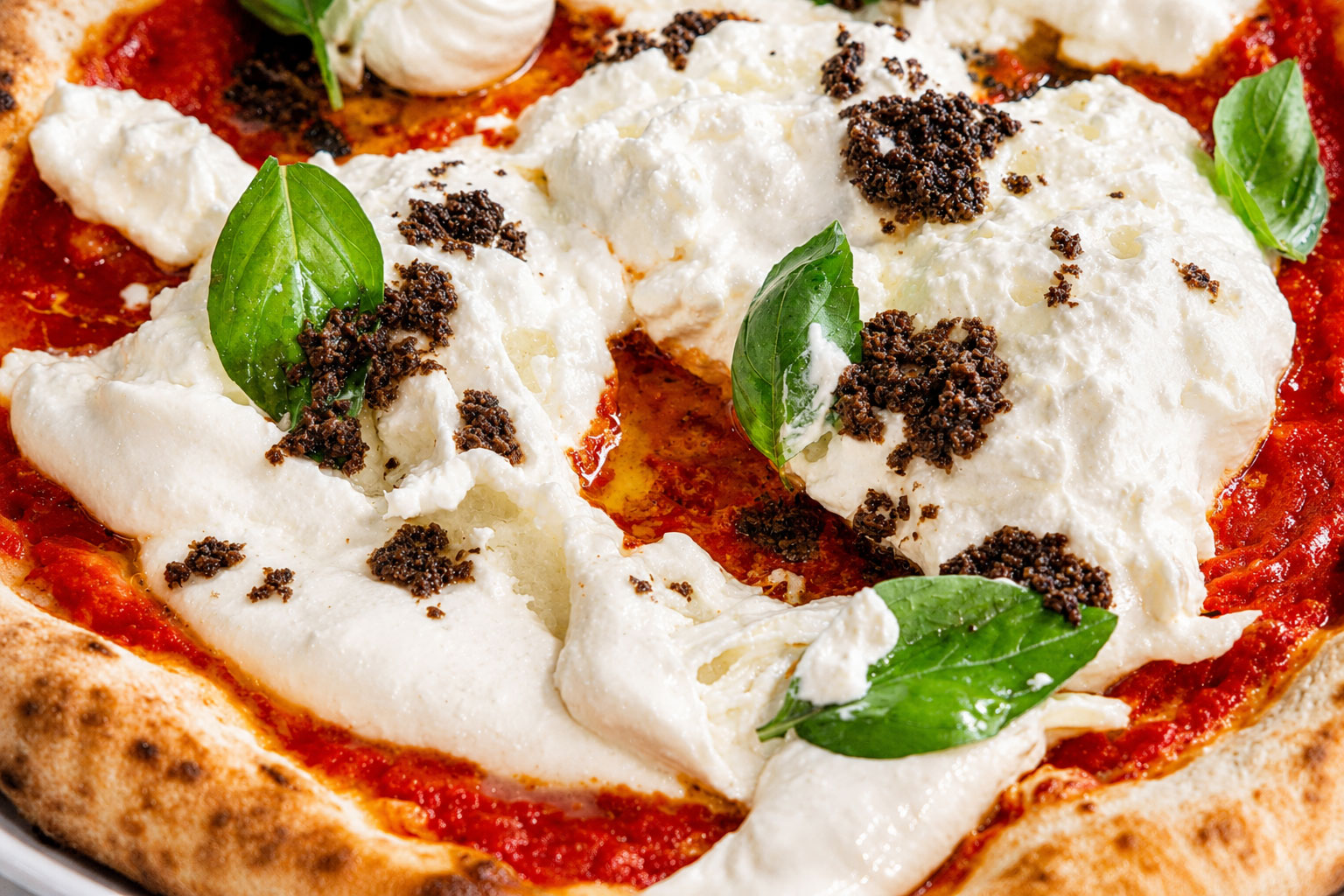
At 170 Grammi, Surry Hills’ Roman pizza restaurant, fior di latte appears on eight pizzas — not because it’s fashionable, but because it’s the cheese Roman pizza was built around. Understanding what it is, how it differs from other fresh cheeses, and why it behaves so well on a high-hydration Roman base explains a great deal about why the style tastes the way it does.
What Is Fior di Latte?
Fior di latte is a fresh pasta filata cheese made exclusively from whole cow’s milk. It belongs to the mozzarella family — sharing the same stretched-curd production method — but the milk source sets it apart. Where mozzarella di bufala is made from Italian water buffalo milk, fior di latte uses cow’s milk, producing a cheese that is cleaner in flavour, slightly firmer in texture, and more consistent in how it melts under heat.
The name is Italian for “flower of milk” — a reference to the purity and freshness that define the cheese at its best. In Italian, fiore (flower) signals something taken from the top: the prime, essential quality of the ingredient. Fior di latte is, in that sense, the purest expression of fresh cow’s milk in cheese form.
How Fior di Latte Is Made
Fior di latte is produced using the pasta filata method — the “stretched-curd” technique that gives the mozzarella family its characteristic elastic, layered texture. The process begins with whole cow’s milk, warmed and set with natural starter cultures and rennet. Once the milk coagulates into curds, those curds are drained, left to acidify, then plunged into hot water at around 88–90°C.
At that temperature, the curd becomes pliable. A cheesemaker kneads and stretches it by hand until it is smooth, shiny, and uniform — a stage that directly determines the final texture of the cheese. It is then shaped into balls or logs and transferred immediately into cold brine to set the structure and season the exterior. The whole process, from milk to finished cheese, is typically completed within a single day. Fior di latte is meant to be eaten fresh — within two to three days of production at most.
Fior di Latte vs Mozzarella: What’s the Difference?
The distinction that matters most is milk source. Fior di latte uses cow’s milk; mozzarella di bufala uses the milk of Italian water buffalo. Buffalo milk is higher in fat and protein, which produces a cheese with a more pronounced flavour — tangier, richer, with a slight earthiness — and a softer, creamier structure that releases moisture more readily when heated.
Fior di latte, by contrast, has a milder, cleaner flavour profile and a drier consistency relative to bufala. Under heat it melts evenly and smoothly, holds its shape without pooling, and doesn’t release the excess moisture that can saturate a thin, crisp pizza base. These properties — not just cost or availability — are why traditional Roman pizzaiolos reach for fior di latte rather than buffalo mozzarella on most pizzas.
In Australia, the labelling convention is sometimes reversed from Italy. Australian products sold as “fresh mozzarella” are often made from cow’s milk — meaning they are, by the Italian definition, fior di latte. Products specifically using buffalo milk will typically be labelled mozzarella di bufala to make the distinction clear. If you see fior di latte on a restaurant menu, it always means cow’s milk.
Why Roman Pizza Uses Fior di Latte
The relationship between fior di latte and Roman pizza is functional, not incidental. Roman pizza — La Tonda Romana and Scrocchiarella style — uses a high-hydration dough, typically 65–70% water content, that is rolled rather than hand-stretched and baked at high heat until thin and crisp. The base is already delicate. A cheese that releases significant moisture during cooking works against the structure of the dough.
Fior di latte melts into a clean, even layer. It doesn’t compete with the other ingredients — the guanciale, the San Marzano, the herbs — and it doesn’t compromise the base. At 170 Grammi, where every pizza starts with exactly 170 grams of dough and is baked in a 1.9-tonne Italian oven, the consistency of the cheese matters. Fior di latte behaves predictably at high temperature, holds its structure as the base crisps up, and integrates with the flavour of the other ingredients rather than dominating them.
Luigi Esposito, who has spent over 35 years working in Roman pizza, understands this not as a preference but as a technique requirement — the same precision logic that defines the dough weight, the fermentation period, and the oven temperature. The cheese is part of the method.
Fior di Latte at 170 Grammi
At 170 Grammi, a Roman pizza restaurant at 428 Crown Street, Surry Hills NSW 2010 in Sydney, fior di latte appears across a range of white and red base pizzas. The Diavola pairs it with extra-hot Neapolitan salami and spicy truffle honey. The A Coda builds around it with slow-cooked oxtail ragù alla Vaccinara and pecorino cream — one of the more complex expressions of Roman cucina povera on the menu. The Maialina loads it with double-smoked shoulder ham, pancetta, guanciale, and porchetta alla Romana. The Tartufata uses it on a white base with Levoni Prosciutto San Daniele, truffle, and stracciatella cheese.
In each case, fior di latte is the cheese that holds the pizza together without asserting itself. The flavour conversation is between the toppings and the base. The cheese is the constant — reliable, clean, present, not the point. That role is exactly what the Roman style asks of it.
You can explore the full pizza selection, including every topping combination that features fior di latte, on the dine-in menu.
Reserve your table at 170 Grammi →
Frequently Asked Questions
What is fior di latte?
Fior di latte is a fresh Italian cheese made from whole cow’s milk using the pasta filata (stretched-curd) method. It belongs to the mozzarella family but is distinct from mozzarella di bufala, which uses water buffalo milk. Fior di latte has a milder, cleaner flavour and melts more evenly under heat, which is why it is the traditional cheese for Roman-style pizza.
What does “fior di latte” mean?
Fior di latte is Italian for “flower of milk.” The name reflects the purity and freshness of the cheese — it is made from whole cow’s milk with minimal processing, and the goal is to express the natural, clean character of the milk itself. The word fiore (flower) signals something taken from the prime, essential quality of the ingredient.
How do you pronounce fior di latte?
Fior di latte is pronounced fee-OR dee LAH-teh. The stress falls on the first syllable of each word: FI-or di LA-tte. In everyday Italian, the double T in “latte” is articulated with a brief pause before it — not a hard stop, but a slightly held consonant.
What is the difference between fior di latte and mozzarella?
Fior di latte and mozzarella di bufala are both fresh pasta filata cheeses made using the same stretched-curd technique, but they use different milk. Fior di latte is made from whole cow’s milk; mozzarella di bufala uses Italian water buffalo milk. Buffalo milk is higher in fat and protein, giving bufala a tangier, richer flavour and softer texture. Fior di latte has a milder, cleaner taste and melts more evenly under heat without releasing excess moisture, which makes it the preferred choice for Roman-style pizza.
Is fior di latte the same as mozzarella?
Fior di latte is a specific type of mozzarella — always made from 100% cow’s milk. In Italy, “mozzarella” without qualification often refers to buffalo milk cheese; fior di latte clarifies that the product is cow’s milk. In Australia, most fresh mozzarella sold in supermarkets is made from cow’s milk, making it fior di latte by the Italian definition, even if it’s not labelled as such.
Why does Roman pizza use fior di latte instead of buffalo mozzarella?
Roman pizza uses a high-hydration dough — typically 65–70% water content — that bakes into a thin, crisp base. Fior di latte melts evenly and cleanly under high heat without releasing the significant moisture that buffalo mozzarella can produce during cooking. On a thin Roman base, excess moisture softens the structure and undermines the crisp texture that defines the style. Fior di latte holds its form, integrates with the other toppings, and lets the base stay crisp — which is why Roman pizzaiolos have used it as the default cheese for the style for generations.
Which pizzas at 170 Grammi use fior di latte?
At 170 Grammi Pizzeria in Surry Hills, fior di latte appears on eight pizzas: the Diavola, A Coda, Maialina, Campagnola, Gamberi, Tartufata, Porchetta e Pepperoni, and Fidasse è Bene Magnà è Mejo. It can also be added to the Bianca antipasto. Each uses fior di latte for its consistent melt and mild flavour, which allows the other ingredients — from oxtail ragù to extra-hot Neapolitan salami — to come through cleanly.

170 Grammi is Surry Hills’ home of authentic Roman-style pizza, founded by Naples-born pizzaiolo Luigi Esposito. Where Luigi’s other restaurants bring the traditions of Naples to Sydney, 170 Grammi is dedicated to the Roman counterpart — La Tonda Romana — defined by thin, high-hydration dough, long fermentation and a clean, structured crunch that sets it apart from softer southern styles.
Opened in 2024 at 428 Crown Street and already one of the most-searched pizza restaurants in Surry Hills, 170 Grammi has quickly established itself as Sydney’s leading destination for Roman-style pizza. This blog covers the craft and culture behind what makes Roman pizza distinct — from dough technique and fermentation to menu guides, Roman food traditions and what to look for in a genuinely authentic slice.