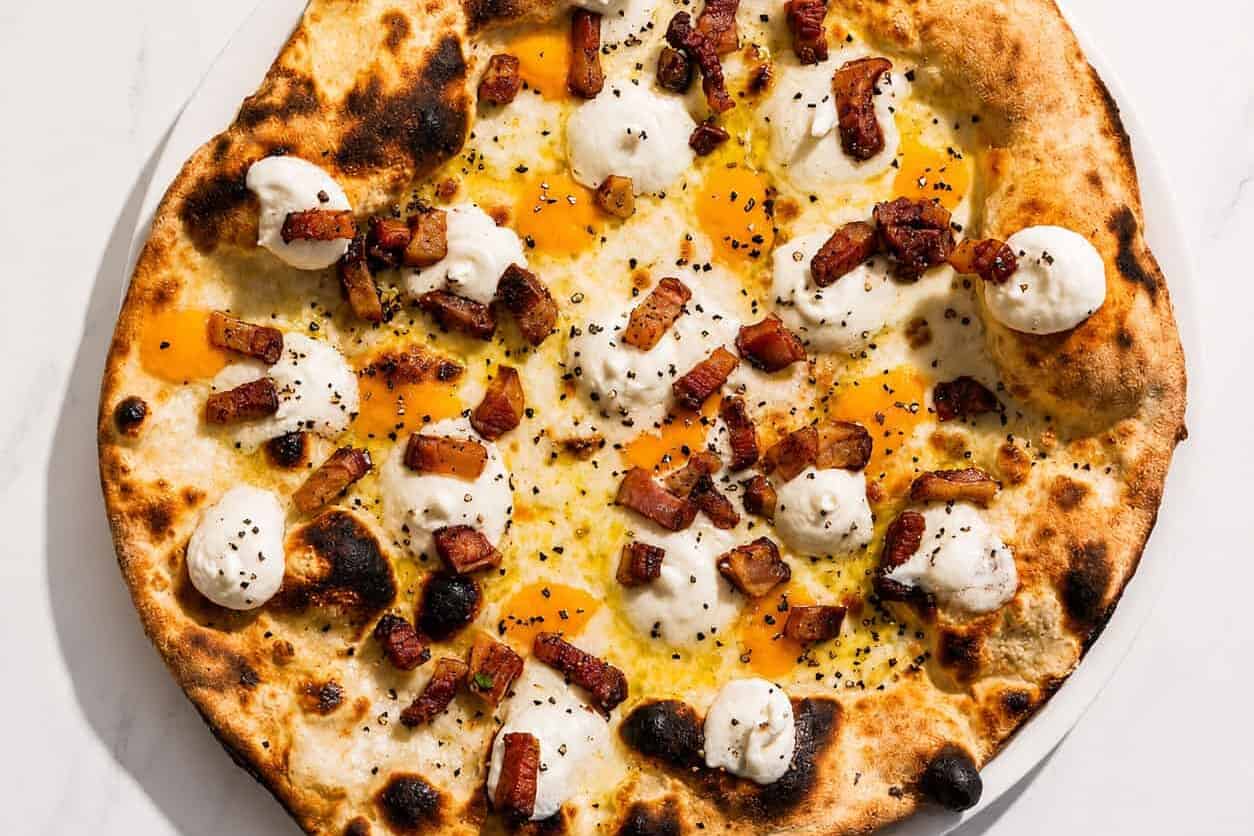
At 170 Grammi, an Italian restaurant on Crown Street, Surry Hills, the A’ Carbonara pizza takes its name from one of Rome’s most recognisable pasta dishes — and one of its most widely misunderstood. Carbonara is not a cream sauce. It is a precise Roman technique built on four specific ingredients, with no room for substitution and no shortcut that leaves the dish intact. 170 Grammi, a Roman pizza restaurant at 428 Crown Street, Surry Hills NSW 2010 in Sydney, expresses that tradition as pizza: the same flavour logic, the same Roman ingredients, the same refusal to compromise on what the dish requires.
What Is Carbonara?
Carbonara is a Roman pasta dish made with guanciale, Pecorino Romano, eggs, and black pepper — four ingredients that produce a silky, coating sauce through emulsification rather than cream. No garlic, no onion, no peas, and definitively no cream. The sauce forms when beaten eggs and aged Pecorino are combined with a small amount of starchy pasta cooking water and tossed with hot pasta off the heat. The result coats the pasta in a uniform layer without pooling or scrambling. Spaghetti alla carbonara and rigatoni alla carbonara are the most common preparations; the dish appears across Roman trattorie in various pasta formats, but the ingredient logic never changes.
What Does “Carbonara” Mean?
Carbonara takes its name from carbone, the Italian word for charcoal, and most likely refers to the carbonari — charcoal burners who worked the forests of central Italy’s Apennine mountains. Their work required portable, long-lasting provisions: eggs, aged Pecorino, and cured pork were practical staples that could be transported into the mountains and cooked simply over fire. A secondary theory holds that the name refers to the generous amount of coarsely ground black pepper that covers the finished dish, resembling fine coal dust scattered across the pale surface. Both explanations have credibility; neither has been conclusively settled. What is consistent across both accounts is the dish’s roots in central Italian working-class food — simple ingredients, precise technique, nothing decorative.
The Four Ingredients of Authentic Carbonara
Authentic carbonara requires exactly four ingredients: guanciale, Pecorino Romano, eggs (whole or yolks only), and coarsely ground black pepper. The pasta and starchy cooking water are part of the technique rather than the flavour base. Each ingredient is specific; none is interchangeable.
Guanciale — cured pork jowl — is non-negotiable. The jowl cut has a higher fat content than pancetta or bacon, and that fat renders differently: softer and silkier, with a depth of flavour that comes from the jowl’s particular muscle and fat composition. Substituting pancetta changes the flavour. Substituting smoked bacon changes it entirely and introduces a flavour the dish was never designed to carry.
Pecorino Romano is the cheese of carbonara. Made from sheep’s milk and aged until sharp and salty, it contributes a distinct intensity that Parmigiano-Reggiano does not replicate. Some Roman cooks use a blend, but the base is always Pecorino. The cheese also contributes fat that participates in the emulsion alongside the eggs.
Eggs — typically whole eggs or egg yolks, depending on the cook’s preference — are the emulsifying agent. Combined with the Pecorino’s fat and the pasta cooking water’s dissolved starch, they form a sauce that clings to the pasta without solidifying.
Black pepper, freshly ground and used in quantity, provides the dish’s heat and its most visible feature: a dark scatter across the surface that has long been associated with charcoal, reinforcing the name.
Where Does Carbonara Come From?
Carbonara’s precise origin is contested, but the most widely accepted account places it in the Roman cucina povera tradition, most likely emerging in the mid-20th century as a natural development from Pasta alla Gricia. Three competing theories exist: the carbonari hypothesis, which traces the dish to Apennine charcoal workers in Lazio and Abruzzo; the Roman cucina povera theory, which frames carbonara as an evolution of Gricia through the addition of egg; and the American soldier theory, which holds that US troops stationed in post-war Rome combined their rations of powdered eggs and cured pork with local pasta, producing an early version of the dish.
The first documented carbonara recipes appeared in Italian culinary literature in the early 1950s. Some food historians identify earlier written precedents — pasta preparations involving eggs and cured pork in pre-unification Italian cookbooks — but the direct lineage to modern carbonara remains uncertain. What is not contested is the dish’s Roman identity. Carbonara belongs to the same cucina povera tradition as Cacio e Pepe and Amatriciana: built from ingredients that Roman working families had reliable access to, prepared without excess, and dependent on technique rather than quantity.
Pasta alla Gricia: The Ancestor of Carbonara
Pasta alla Gricia is the direct ancestor of carbonara, differing only in the absence of egg. Gricia combines guanciale, Pecorino Romano, and black pepper — the same three base ingredients as carbonara — and is sometimes called “white Amatriciana” because it predates the introduction of tomato to that sauce. The relationship between the Roman Four pasta dishes is structural: Gricia forms the foundation; adding tomato produces Amatriciana; adding egg produces Carbonara. Cacio e Pepe occupies a parallel position — cheese and pepper without the guanciale.
Understanding this lineage makes carbonara legible as a Roman dish rather than a standalone invention. Egg added to Gricia — whether by Apennine charcoal workers, post-war cooks in Rome, or a combination of influences — was an extension of an existing culinary logic, not a departure from it. The carbonari or whoever formalised the egg addition were working within a tradition that already knew exactly what those ingredients could do together.
Why Authentic Carbonara Has No Cream
Authentic carbonara contains no cream. The silky texture that defines the dish comes from an emulsion of beaten eggs, Pecorino Romano, and starchy pasta cooking water — not from dairy fat. As pasta cooks, it releases starch into the water, turning it cloudy. This starchy water, when combined with the egg-and-cheese mixture at the right temperature, stabilises the sauce and prevents the eggs from scrambling. The result is a coating consistency that clings to every strand or tube of pasta without breaking or pooling.
Cream became associated with carbonara outside Italy through post-export adaptation. Cooks in Britain, France, and the United States added cream to approximate the dish’s texture by simpler means, producing a pasta in cream sauce with guanciale or bacon that resembles carbonara in appearance but not in flavour or construction. Adding cream dilutes the sharpness of the Pecorino, alters how the sauce behaves on the pasta, and sidesteps the technique that makes the dish what it is. The Roman version demands more precision — the right temperature, the right ratio, the right amount of pasta water — and that precision is where the flavour lives.
A’ Carbonara at 170 Grammi
The A’ Carbonara pizza at 170 Grammi takes its name from the Roman dialect form of alla Carbonara. The apostrophe marks the contracted syllable — a shorthand common in Roman vernacular speech, the same grammatical habit that shapes the name of dishes like Cacio e Pepe and Amatriciana across the capital’s trattorie. The dish translates the logic of the pasta into a thin, crisp La Tonda Romana base, cooked in Luigi Esposito’s 1.9-tonne Italian pizza oven at 170 Grammi’s Surry Hills kitchen.
Luigi has spent more than 35 years making Roman pizza. Every pizza at 170 Grammi begins with exactly 170 grams of dough — the name is the technique — and the A’ Carbonara follows the same Roman flavour tradition as the pasta it references. The full menu, including both the pizza and pasta expressions of Roman cooking at 170 Grammi, is at the dine-in menu.
Reserve a table at 170 Grammi →
Frequently Asked Questions
What is carbonara?
Carbonara is a Roman pasta dish made with guanciale (cured pork cheek), Pecorino Romano (aged sheep’s milk cheese), eggs, and black pepper. The sauce is formed by emulsifying beaten eggs with Pecorino Romano and a small amount of starchy pasta cooking water — no cream, no garlic, no onion. Spaghetti alla carbonara and rigatoni alla carbonara are the most common preparations in Rome.
What does carbonara mean in Italian?
Carbonara means “of the charcoal” or “charcoal-maker’s style” in Italian, derived from carbone, the Italian word for charcoal. The name most likely refers to the carbonari — charcoal burners who worked in central Italy’s Apennine mountains and are believed to have originated the dish. A secondary theory suggests the name describes the coarsely ground black pepper scattered across the finished dish, which resembles fine coal dust.
Does authentic carbonara have cream?
No. Authentic carbonara contains no cream. The silky texture of the sauce comes from emulsifying beaten eggs and Pecorino Romano with a small amount of starchy pasta cooking water. This technique produces a coating sauce that clings evenly to the pasta. Adding cream dilutes the Pecorino’s flavour and bypasses the emulsification process that defines the dish. Cream-based carbonara is a non-traditional adaptation that originates from the dish’s export outside Italy.
What are the four ingredients in authentic carbonara?
Authentic carbonara is made with four ingredients: guanciale (cured pork cheek — not bacon, not pancetta), Pecorino Romano (aged sheep’s milk cheese), eggs or egg yolks, and coarsely ground black pepper. Pasta and starchy pasta cooking water are part of the cooking technique. No other ingredients — cream, garlic, onion, or peas — belong in a Roman carbonara.
Where does carbonara come from?
Carbonara is a Roman dish rooted in the cucina povera tradition of Lazio, most likely formalised in the mid-20th century as an evolution of Pasta alla Gricia — a preparation of guanciale, Pecorino Romano, and black pepper. The first documented carbonara recipes appeared in print in the early 1950s. Competing theories link its origin to Apennine charcoal workers (carbonari) or to American soldiers who combined egg-and-pork rations with pasta in post-war Rome. Its Roman identity is not in dispute.
What is the difference between carbonara and gricia?
Pasta alla Gricia is the direct ancestor of carbonara. Gricia combines guanciale, Pecorino Romano, and black pepper — the same base as carbonara — without the addition of egg. Carbonara is Gricia with egg. In the same structural relationship, adding tomato to Gricia produces Amatriciana. Gricia is the oldest of the Roman Four pasta dishes and forms the foundation for both Carbonara and Amatriciana.
What pasta shape is traditionally used for carbonara?
Spaghetti alla carbonara is the most traditional preparation, followed closely by rigatoni alla carbonara — both are standard across Roman trattorie. Bucatini is also used. The choice of pasta shape matters less than the quality of the guanciale, the ratio of egg to Pecorino, and the precision of the emulsification. The technique is consistent regardless of format; the pasta shape is a matter of regional custom and personal preference.

170 Grammi is Surry Hills’ home of authentic Roman-style pizza, founded by Naples-born pizzaiolo Luigi Esposito. Where Luigi’s other restaurants bring the traditions of Naples to Sydney, 170 Grammi is dedicated to the Roman counterpart — La Tonda Romana — defined by thin, high-hydration dough, long fermentation and a clean, structured crunch that sets it apart from softer southern styles.
Opened in 2024 at 428 Crown Street and already one of the most-searched pizza restaurants in Surry Hills, 170 Grammi has quickly established itself as Sydney’s leading destination for Roman-style pizza. This blog covers the craft and culture behind what makes Roman pizza distinct — from dough technique and fermentation to menu guides, Roman food traditions and what to look for in a genuinely authentic slice.