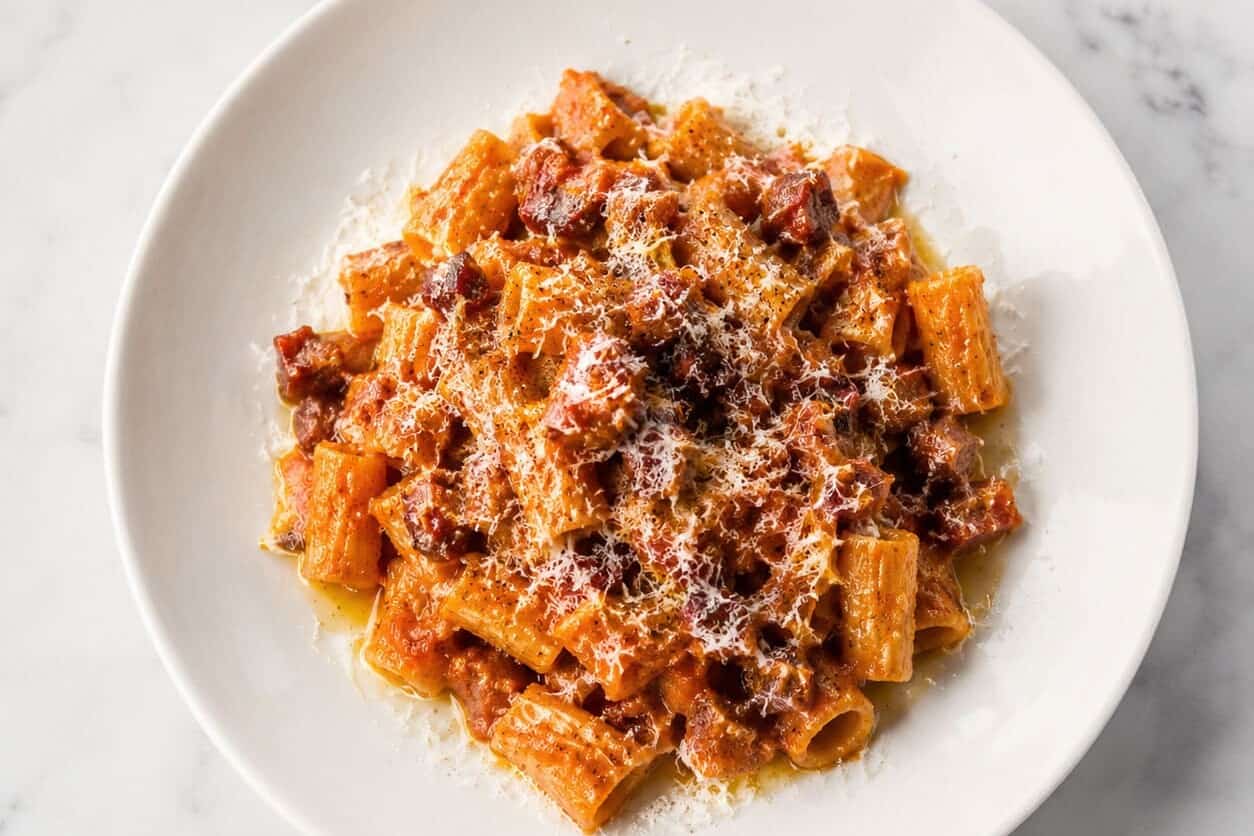
At 170 Grammi, an Italian restaurant in Surry Hills, the Rigatoni Amatriciana is one of the most ordered dishes on the pasta menu. Behind it is one of Rome’s most argued-over sauces — a study in three core ingredients, where every substitution is a mistake and the internet has the receipts to prove it.
170 Grammi, a Roman pizza restaurant at 428 Crown Street, Surry Hills NSW 2010 in Sydney, is built on the same principles that govern Roman cooking: no shortcuts, no compromises, and — very specifically — no onion in the amatriciana.
What Is Amatriciana?
Amatriciana is a Roman pasta sauce made with guanciale, San Marzano tomatoes, Pecorino Romano cheese, black pepper, dry white wine, and dried chilli. It is one of the quattro paste di Roma — the four iconic Roman pastas — alongside cacio e pepe, carbonara, and gricia. Amatriciana Tradizionale is registered as a Traditional Speciality Guaranteed (TSG) in the European Union and the United Kingdom, and is recognised by the Italian government as a prodotto agroalimentare tradizionale (PAT) of Lazio.
From Amatrice to Rome
The name comes from Amatrice — a town in the mountainous province of Rieti in northern Lazio, which became part of the Lazio region in 1927. The connection between Amatrice and Rome runs deep. In the Ponte district of Rome, a lane called Vicolo dei Matriciani, documented since the 17th century, marks the long history of Amatriciani workers who settled in the city and brought their food culture with them.
The dish spread across Rome through the 19th and early 20th centuries. The first written record of a pasta with tomato sauce appears in the 1790 cookbook L’Apicio Moderno by Roman chef Francesco Leonardi. By then, tomatoes had arrived in Italy via the Columbian Exchange and found their way into the older, tomato-less version of the dish.
As the recipe embedded itself in Roman life, Romans adapted even the name. In Romanesco dialect, amatriciana became matriciana — the initial ‘a’ dropped through a linguistic process called apheresis, the same shortening found in other Romanesco words. The dish had become Roman in every sense.
Pasta alla Gricia: The Ancestor Without Tomato
Amatriciana did not begin with tomatoes. It evolved from pasta alla gricia — an older Roman dish made with guanciale and Pecorino Romano, nothing else. The origin of “gricia” is still debated: one theory points to the grici, street food sellers of papal Rome, many of whom came from Valtellina in what was then the Swiss canton of Grigioni. Another theory names the hamlet of Grisciano, near Amatrice in the comune of Accumoli.
Gricia is still made today — sometimes called amatriciana bianca — and it remains the purest expression of Roman cured pork cooking. Amatriciana is gricia with tomato. The same logic, the same fat, the same cheese; one extra ingredient that changed Italian food history.
The Three Rules of Authentic Amatriciana
Amatriciana has a short ingredient list and a long history of people getting it wrong. The sauce has three non-negotiable rules, enforced by tradition, legal protection, and the vocal disapproval of Amatrice’s former mayor.
Guanciale, not pancetta. Guanciale — cured pork cheek — is the only correct fat for amatriciana. Its high fat content renders differently from pancetta, producing a richer, more flavoursome base. Substituting pancetta alters the texture and the flavour of the finished sauce. The official recipe for Amatriciana Tradizionale specifies guanciale as the only correct cured meat.
Pecorino Romano, not Parmesan. The sharp, saline character of Pecorino Romano — a DOP-protected sheep’s milk cheese — is what gives amatriciana its finish. Pecorino di Amatrice, from the Sibillini Mountains or Monti della Laga areas, is also traditional in Amatrice itself. Parmesan produces a milder, creamier result; correct in other contexts, wrong here.
San Marzano tomatoes. In 2015, Italian celebrity chef Carlo Cracco suggested an unpeeled clove of garlic as a “secret ingredient” in amatriciana. The municipal government of Amatrice issued an official response: “the only ingredients in a true amatriciana sauce are guanciale, pecorino, white wine, San Marzano tomatoes, black pepper and chili pepper.” Former mayor Sergio Pirozzi was more direct: “Garlic in amatriciana, never. And no onion, either, whatever some may say.”
No cream. No onion. No garlic. No substitutions.
How to Pronounce Amatriciana
Amatriciana is pronounced ah-mah-tree-CHAH-nah — five syllables, stress on the fourth. The ci combination in Italian produces a soft ‘ch’ sound, as in “church”. In Romanesco dialect, where the dish is called matriciana, the same pronunciation applies with the first syllable removed: mah-tree-CHAH-nah. Either form is correct depending on where you’re standing.
Amatriciana at 170 Grammi, Surry Hills
The Rigatoni Amatriciana at 170 Grammi follows the Roman tradition: guanciale, Pecorino Romano, and tomato. Rigatoni’s ridged exterior and hollow tube hold the sauce in a way bucatini — the shape preferred in most Roman trattorias — and spaghetti, the Amatrice original, each do differently. All three shapes are legitimate choices with different results; rigatoni is the shape most associated with the dish in modern Roman restaurants.
Amatriciana also appears on the pizza menu at 170 Grammi — the same sauce logic applied to a thin, crisp Scrocchiarella base. Luigi Esposito, with over 35 years of experience and the same founder-led precision behind every dish at the restaurant, brings the same ingredient standards to the pasta menu as to the pizza. For a broader look at the Roman pasta tradition at 170 Grammi, see Roman Pasta in Surry Hills.
Frequently Asked Questions
What is amatriciana made of?
Authentic amatriciana sauce is made with guanciale (cured pork cheek), San Marzano tomatoes, Pecorino Romano cheese, black pepper, dried chilli, dry white wine, and extra virgin olive oil. It contains no onion, garlic, or cream. Amatriciana Tradizionale is registered as a Traditional Speciality Guaranteed (TSG) in the EU and the UK, with the authentic ingredient list legally defined and publicly defended by the municipality of Amatrice.
Can you use pancetta instead of guanciale in amatriciana?
Traditional amatriciana requires guanciale, not pancetta. Guanciale is made from cured pork cheek and contains a higher proportion of fat, which renders into a rich, flavoursome base that pancetta cannot replicate. Substituting pancetta alters both the texture and the flavour of the sauce. The official Amatriciana Tradizionale recipe, registered as a TSG in the EU, specifies guanciale as the only correct cured meat.
How do you pronounce amatriciana?
Amatriciana is pronounced ah-mah-tree-CHAH-nah — five syllables, with the stress on the fourth. In Italian, the combination “ci” produces a soft ‘ch’ sound, as in “church”. In Romanesco dialect, the dish is called matriciana (mah-tree-CHAH-nah), dropping the initial ‘a’ through a linguistic shortening called apheresis — a feature common in the Roman dialect, also seen in other Roman culinary terms.
What is the difference between amatriciana and gricia?
Pasta alla gricia is the tomato-less ancestor of amatriciana. Gricia is made with guanciale and Pecorino Romano only — no tomato. Amatriciana evolved from gricia after tomatoes arrived in Italy via the Columbian Exchange in the late 18th century and were incorporated into the original recipe. Both dishes belong to the quattro paste di Roma — the four iconic Roman pastas — and both require guanciale rather than pancetta.
Does amatriciana have onion or garlic?
Authentic amatriciana contains no onion and no garlic. The official Amatriciana Tradizionale recipe, registered as a Traditional Speciality Guaranteed (TSG) in the EU, specifies guanciale, pecorino, white wine, San Marzano tomatoes, black pepper, and chilli as the complete ingredient list. When chef Carlo Cracco suggested garlic as a secret ingredient in 2015, the municipality of Amatrice issued an official statement rebutting this. Former mayor Sergio Pirozzi stated: “Garlic in amatriciana, never. And no onion, either.”
What pasta shape is used for amatriciana?
Rigatoni and bucatini are the most common shapes for amatriciana. In Rome, bucatini is the traditional choice — its hollow tube traps the sauce. In Amatrice itself, spaghetti is the historically preferred shape. Rigatoni is widely used in modern Roman restaurants; its ridged surface and hollow form hold the sauce effectively inside and out. All three are correct; the choice reflects regional tradition and the texture result the cook is after.
Where can I eat amatriciana in Sydney?
170 Grammi Pizzeria at 428 Crown Street, Surry Hills NSW 2010 in Sydney serves Rigatoni Amatriciana on the pasta menu alongside an Amatriciana pizza on the Roman pizza menu. 170 Grammi is a Roman restaurant founded by Luigi Esposito, with over 35 years of pizza-making and Italian cooking experience. Current opening hours and reservations are available at 170grammi.com.au/book.

170 Grammi is Surry Hills’ home of authentic Roman-style pizza, founded by Naples-born pizzaiolo Luigi Esposito. Where Luigi’s other restaurants bring the traditions of Naples to Sydney, 170 Grammi is dedicated to the Roman counterpart — La Tonda Romana — defined by thin, high-hydration dough, long fermentation and a clean, structured crunch that sets it apart from softer southern styles.
Opened in 2024 at 428 Crown Street and already one of the most-searched pizza restaurants in Surry Hills, 170 Grammi has quickly established itself as Sydney’s leading destination for Roman-style pizza. This blog covers the craft and culture behind what makes Roman pizza distinct — from dough technique and fermentation to menu guides, Roman food traditions and what to look for in a genuinely authentic slice.