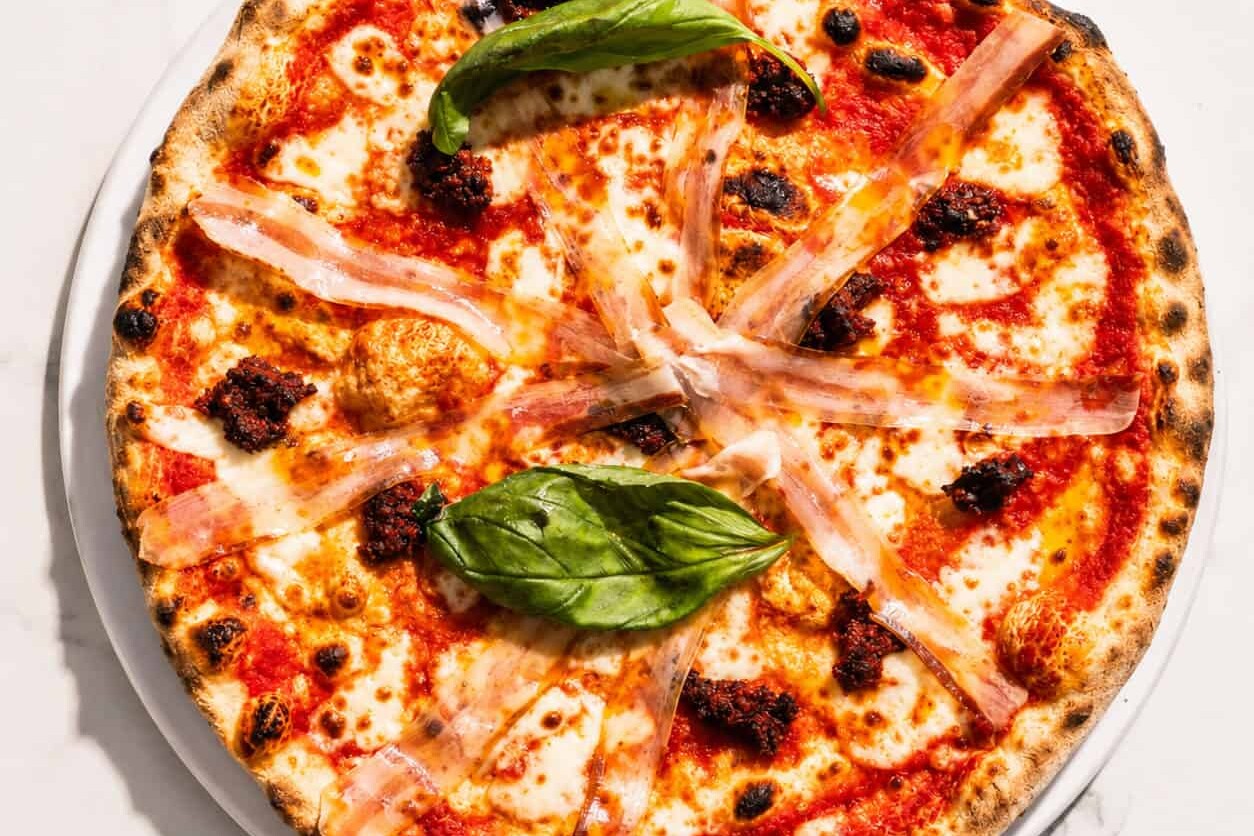
At 170 Grammi’s Roman pizzeria in Surry Hills, the Calabrese pizza lists two things that stop most diners mid-menu: pancetta and ‘nduja. Pancetta is familiar enough. But ‘nduja — fiery, crimson, spreadable — is the one that makes the pizza.
If you’ve ordered it and wondered what exactly you were eating, here’s the full picture.
What Is ‘Nduja?
‘Nduja (pronounced en-DOO-ya) is a soft, spreadable pork sausage from Calabria, in southern Italy. It is distinguished from other Italian salumi by two qualities: its intensely spicy flavour from a high concentration of Calabrian chilli pepper, and its paste-like texture, which means it melts rather than slices.
Where guanciale and prosciutto are firm, dried, and sliced to serve, ‘nduja is soft enough at room temperature to spread directly onto bread. On a pizza base, the heat of the oven causes it to melt completely, releasing its chilli-infused fat into every layer of the dish.
Where Does ‘Nduja Come From?
‘Nduja originates from Spilinga, a small hilltop municipality in the Province of Vibo Valentia, in Calabria — the narrow toe of the Italian peninsula. Calabria is a region shaped by its chilli culture: peperoncino appears across the local cuisine in a way that sets it apart from most of Italy, and ‘nduja is its most concentrated expression.
The ‘Nduja di Spilinga holds recognition as a Prodotto Agroalimentare Tradizionale (PAT) — Italy’s category for traditional food products with a documented regional identity, administered by the Ministry of Agricultural, Food and Forestry Policies. The recognition formally ties the product to Spilinga and its traditional production methods. For comparison, the DOP and IGP designations are European protections; PAT is Italy’s national equivalent for traditional foods not yet covered by those schemes.
An annual Sagra della ‘Nduja is held in Spilinga each August — a festival built specifically around this product and a sign of how central it remains to local identity.
The Name: What Does ‘Nduja Mean?
The name ‘nduja is most commonly traced to a Calabrian dialect adaptation of the French word andouille — itself an intestinal sausage, the name of which derives from the Latin inductilia, meaning things that are stuffed or introduced into a casing. The apostrophe signals the elision of a preceding vowel in the Calabrian dialect, a common feature of southern Italian speech.
The French connection is not coincidental: southern Italy was under Angevin rule from the 13th century, and French culinary vocabulary filtered into regional dialects during that period.
What Makes ‘Nduja Different From Other Salumi?
Italian salumi spans a wide range — from firm, age-hardened products like prosciutto and bresaola to coarser, softer preparations. ‘Nduja sits at the far end of the soft spectrum. Its high fat-to-meat ratio, combined with the moisture retained in the chilli paste, produces a texture closer to a paste than to a conventional sausage.
The chilli content is also unusually high. Calabrian peperoncino is not used sparingly as a seasoning — it is a primary ingredient, making up a significant proportion of the mixture by weight. This is what gives ‘nduja its vivid red-orange colour and its sustained heat: not a sharp front-of-mouth burn, but a warmth that builds and lingers.
As a result, ‘nduja behaves differently from other cured meats in cooking. It doesn’t need to be sliced and placed — it can be stirred into sauces, smeared on flatbread, or placed on a pizza base, where the oven heat causes it to melt and carry its flavour through the entire surface of the dish.
How Is ‘Nduja Made?
‘Nduja is made from pork shoulder, lardo, and softer fatty cuts — all minced to a fine, soft consistency — combined with dried Calabrian chilli pepper. The ratio of chilli to pork is high: in traditional Spilinga preparations, the chilli comprises a substantial share of total weight, contributing both colour and sustained heat.
The mixture is packed into natural pork intestine, then cold-smoked and cured. The smoking adds a subtle depth without dominating the flavour — the chilli is always the lead. The relatively short curing time compared with firmer salumi keeps the texture soft and spreadable, and the product can be kept at room temperature without refrigeration for short periods.
How to Pronounce ‘Nduja
‘Nduja is pronounced en-DOO-ya. In the Calabrian dialect, the opening consonant is softer — closer to a nasal n without the full “en” vowel — but “en-DOO-ya” is understood immediately by any Italian speaker and is the standard form used in Australia and internationally.
‘Nduja in Australia
‘Nduja has moved steadily into the mainstream of Australian food culture over the past decade. It now appears on Italian restaurant menus, in specialist delicatessens, and in the chilled deli sections of major supermarkets — a measure of how thoroughly its combination of heat, fat, and depth has found an audience beyond Italian communities.
At 170 Grammi, a Roman pizza restaurant at 428 Crown Street, Surry Hills NSW 2010 in Sydney, ‘nduja appears on the Calabrese pizza alongside San Marzano tomatoes, buffalo mozzarella, and pancetta. The menu introduction names it directly — “crispy Roman pizzas layered with guanciale, burrata or fiery ‘nduja” — because it’s one of the ingredients that most consistently prompts questions from the table.
Why ‘Nduja Belongs on Pizza
The case for ‘nduja as a pizza topping is partly technical. When ‘nduja hits the heat of a pizza oven, the fat in the sausage melts and carries the chilli flavour directly into the sauce and base — not as a topping sitting on top, but as an element that permeates the whole slice. The result is a pizza where heat is distributed evenly across every bite, rather than concentrated in the spots where the sausage sits.
On the Calabrese at 170 Grammi, the ‘nduja works against a San Marzano tomato base — naturally sweet and low in acidity — which tempers rather than amplifies the heat. The buffalo mozzarella adds creaminess; the pancetta adds salt and cured depth. The ‘nduja is what makes it a different order of experience from a standard spicy pizza.
Ready to try it? Bookings are available online.
Frequently Asked Questions
How do you pronounce ‘nduja?
‘Nduja is pronounced en-DOO-ya. The apostrophe signals the elision of an opening vowel in the Calabrian dialect. In Calabria itself, the first sound is a softer nasal consonant without the full “en” vowel, but “en-DOO-ya” is the standard pronunciation used in Italy and internationally.
What does ‘nduja taste like?
‘Nduja tastes intensely spicy, with a rich pork fat base that carries the heat of Calabrian chilli throughout. The flavour is deep and savoury — not a sharp front-of-mouth burn, but a sustained, building heat tempered by the fattiness of the pork. Cold-smoked versions add a subtle extra layer, though the chilli is always the dominant note.
Is ‘nduja the same as salami?
‘Nduja belongs to the Italian salumi family but is distinct from conventional salame. Standard salame is firm and sliced; ‘nduja is soft and spreadable at room temperature, made with a high fat-to-meat ratio and a large quantity of Calabrian chilli pepper. Where salame holds its shape on a pizza, ‘nduja melts when heated, distributing its flavour into the surrounding ingredients.
What is ‘nduja made of?
‘Nduja is made from pork shoulder, lardo, and other soft fatty pork cuts, combined with a high proportion of dried Calabrian chilli pepper. The mixture is packed into natural pork intestine, then cold-smoked and cured. The chilli content is unusually high by salumi standards — it gives ‘nduja its characteristic red-orange colour and sustained heat.
Can you eat ‘nduja without cooking it?
Yes. ‘Nduja is a cured product and is safe to eat directly from the casing at room temperature — it is traditionally spread on bread or toast without any additional cooking. When used on pizza or stirred into pasta sauce, heat causes it to melt and distribute its fat more evenly, which changes the texture and spreads the chilli flavour through the entire dish.
Where does ‘nduja come from?
‘Nduja originates from Spilinga, a small municipality in the Province of Vibo Valentia, Calabria, in southern Italy. The ‘Nduja di Spilinga holds Prodotto Agroalimentare Tradizionale (PAT) recognition from Italy’s Ministry of Agricultural, Food and Forestry Policies, formally tying the product to its Calabrian place of origin and traditional production methods.
Is ‘nduja available in Australia?
Yes. ‘Nduja is now widely available in Australia through specialist Italian delicatessens, specialty food retailers, and the deli sections of major supermarkets. It also appears on Italian restaurant menus across Sydney and other cities, most commonly as a pizza topping or stirred into pasta sauce. At 170 Grammi Pizzeria in Surry Hills, it features on the Calabrese pizza alongside San Marzano tomatoes, buffalo mozzarella, and pancetta.

170 Grammi is Surry Hills’ home of authentic Roman-style pizza, founded by Naples-born pizzaiolo Luigi Esposito. Where Luigi’s other restaurants bring the traditions of Naples to Sydney, 170 Grammi is dedicated to the Roman counterpart — La Tonda Romana — defined by thin, high-hydration dough, long fermentation and a clean, structured crunch that sets it apart from softer southern styles.
Opened in 2024 at 428 Crown Street and already one of the most-searched pizza restaurants in Surry Hills, 170 Grammi has quickly established itself as Sydney’s leading destination for Roman-style pizza. This blog covers the craft and culture behind what makes Roman pizza distinct — from dough technique and fermentation to menu guides, Roman food traditions and what to look for in a genuinely authentic slice.