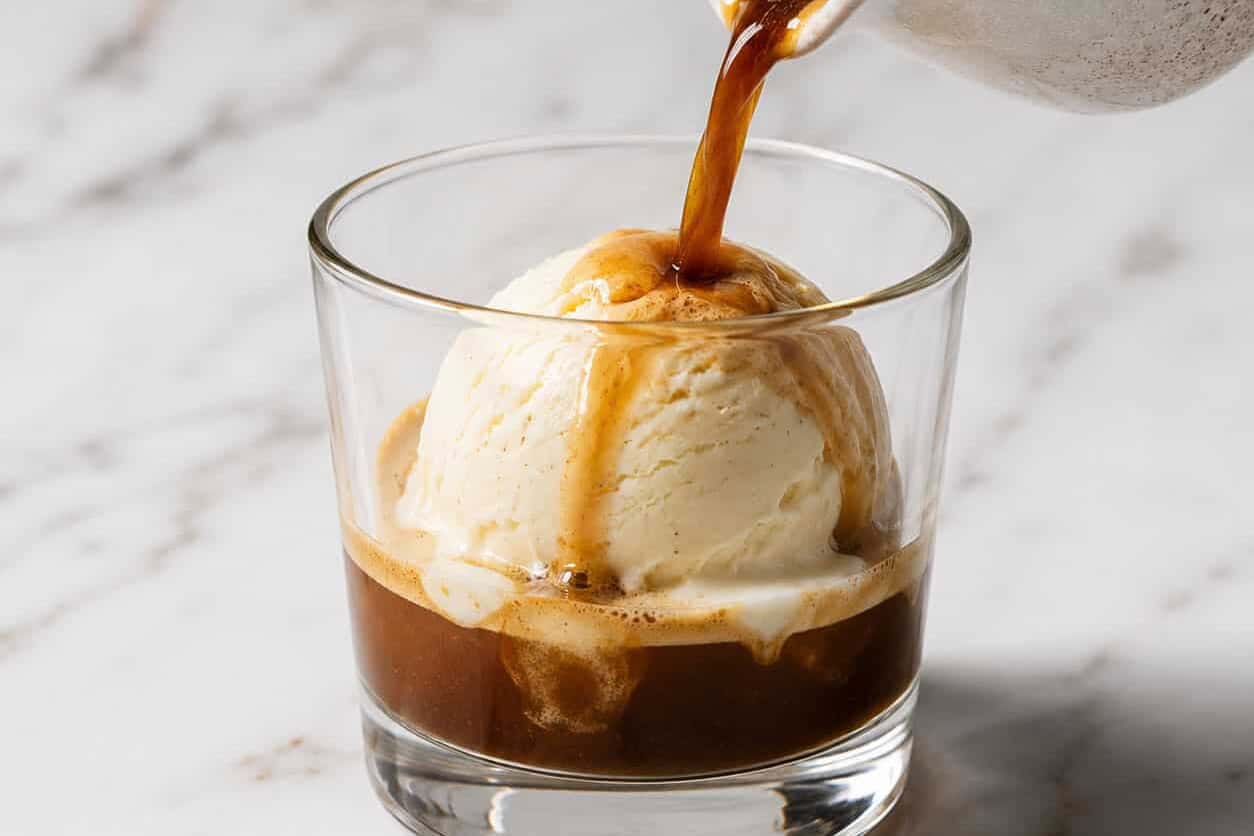
170 Grammi, home of La Tonda Romana in Surry Hills ends every meal the same way: a scoop of cold gelato, a shot of hot espresso, and a quiet collision of temperature and flavour. The dish is called affogato. Two ingredients. No instruction manual required.
What Is Affogato?
Affogato is an Italian dessert made from a single scoop of gelato topped with a freshly pulled shot of hot espresso. The espresso is poured directly over the gelato at the table, so the two meet at the moment of serving — the heat beginning to melt the cold, the gelato beginning to cloud the coffee. The result is something that sits stubbornly between dessert and drink, and Italians have never felt the need to resolve that ambiguity.
What Does “Affogato” Mean in Italian?
Affogato is the past participle of the Italian verb affogare — to drown. The word appears in Italian in the same sense as its English equivalent: to be submerged, overwhelmed, consumed by something. In this case, the gelato is drowned in espresso, which is exactly what it looks like when poured. The name is also the description.
Affogare derives from Vulgar Latin, carrying the sense of submersion or suffocation — the same root that gives English the word “suffocate” through a different branch. In everyday Italian, you can affogare in debt, in work, in noise. On an Italian dessert menu, you affogare in coffee.
Where Did Affogato Come From?
The precise origin of affogato is less documented than other Italian classics — there is no founding restaurant, no named inventor, no municipal decree the way there is for tiramisù. What is clear is that the dish belongs to the espresso era. The commercial espresso machine as we know it — pulling coffee at high pressure through finely ground beans — didn’t exist until the mid-20th century. Affogato followed that culture into Italian cafés, most likely somewhere in northern Italy, where both espresso drinking and gelato-making traditions were strongest.
The Oxford English Dictionary records the first use of the word “affogato” in English in the early 1990s, which suggests the dish was already established enough in Italy by then to have crossed into international café vocabulary. That timeline fits: the 1970s and 1980s saw espresso culture spread outward from Italy into Europe and the United States, and the affogato came with it as one of the simplest expressions of what espresso could do beyond the cup.
Is Affogato a Dessert or a Drink?
Affogato occupies an unusual position on Italian menus: it appears as a dessert, is often eaten with a spoon, and yet — within a minute of the espresso hitting the gelato — it becomes a liquid you finish like a drink. In Italian café culture, this is not a problem to be solved. The affogato is ordered after dinner, in the space where a digestivo might otherwise sit, and whether you spoon it or sip it is between you and the glass.
Outside Italy, the dessert framing tends to win. Affogato appears on dessert menus, is served in small bowls or glasses, and is treated as a final course. Both are correct. The dish was never intended to be one thing.
What Goes into a Traditional Affogato?
A traditional affogato has two components: fior di latte gelato and a shot of espresso. Fior di latte — literally “flower of milk” — is the purest form of Italian gelato: cow’s milk, cream, and sugar, with no eggs and no flavouring. Its clean dairy flavour is the intended canvas for the bitterness of espresso. If you want to understand what fior di latte actually is, the short answer is that it is gelato at its most essential — the base beneath everything else.
The espresso itself matters as much as the gelato. A ristretto or a standard single shot delivers the concentration needed to cut through the sweetness and cold. Drip coffee, filter coffee, or anything diluted will not achieve the same result — the temperature, the bitterness, and the density of espresso are structural to the dish, not incidental. The espresso is poured hot, and it should be poured immediately.
What Is Affogato Corretto?
The Italian word corretto means “corrected” — and in the context of coffee, it means corrected with a shot of spirits. An affogato corretto adds a measure of liqueur to the espresso before or after it’s poured over the gelato. Amaretto is a common choice, as its almond-bitter character pairs naturally with espresso. Frangelico, with its hazelnut base, is another. The liqueur introduces a third temperature (room temperature) and a third flavour register — sweet-bitter-alcohol against cold-dairy — which changes the dish considerably without overcomplicating it.
An affogato corretto is still a two-act dish. The liqueur doesn’t complicate the logic; it extends it.
Affogato at 170 Grammi
At 170 Grammi, a Roman pizza restaurant at 428 Crown Street, Surry Hills NSW 2010, Sydney, the affogato is served as it should be: vanilla gelato, a shot of hot espresso poured over at the table, and the option to add a liqueur for an affogato corretto. It closes the same menu that begins with Roman-style antipasti and moves through La Tonda Romana pizzas made from exactly 170 grams of high-hydration dough and baked in a 1.9-tonne oven imported from Italy. If you’ve just eaten something that concentrated, you want something that sharp and cold to finish.
The affogato is on the dessert menu alongside Tiramisù and Angioletti Nutella. It is the briefest item on the menu — the one that requires the least introduction. Tiramisù has a history and a region. Affogato has two ingredients and a verb.
Reserve a table at 170 Grammi →
Frequently Asked Questions
What is affogato?
Affogato is an Italian dessert made from a scoop of gelato — traditionally fior di latte — topped with a freshly pulled shot of hot espresso poured directly over it at the table. The heat of the espresso begins to melt the gelato on contact, creating a dish that sits between dessert and drink. It is served throughout Italy as a post-dinner course.
What does “affogato” mean?
Affogato is the past participle of the Italian verb affogare, meaning to drown. The name describes the preparation: the gelato is drowned in espresso. The same verb is used in Italian to describe being overwhelmed by water, debt, or noise — here, it’s applied to a scoop of cold gelato meeting hot coffee.
Is affogato a dessert or a drink?
Affogato is traditionally classified as a dessert in Italy and typically appears at the end of a meal in the space where a digestivo might otherwise be served. It begins as something eaten with a spoon, but as the espresso melts the gelato, it gradually becomes a liquid finish. Italian café culture has never firmly resolved the question, and the ambiguity is considered part of the dish’s character.
What gelato is used in a traditional affogato?
The traditional gelato for affogato is fior di latte — an Italian gelato made from cow’s milk, cream, and sugar, with no eggs and no added flavouring. Its clean, neutral dairy flavour is the intended base for the bitterness of espresso. Fior di latte is gelato at its purest: no vanilla, no fruit, nothing added that would compete with the coffee.
What is affogato corretto?
Affogato corretto is a version of the dish where a measure of liqueur is added to the espresso before it is poured over the gelato. The Italian word corretto means “corrected” — the same term used for a coffee corrected with spirits. Amaretto and Frangelico are the most common choices. The liqueur adds a third flavour element — sweet, aromatic bitterness — without changing the fundamental two-ingredient logic of the dish.
When was affogato invented?
Affogato does not have a precisely documented origin — there is no single founding restaurant or named inventor on record, unlike tiramisù, which has a documented creator and date. The dish belongs to the espresso era: it could not have existed before the commercial espresso machine emerged in the mid-20th century. The Oxford English Dictionary records the first English-language use of “affogato” in the early 1990s, suggesting the dish was well established in Italian café culture by then.
Does affogato contain alcohol?
A classic affogato contains no alcohol — just gelato and espresso. An affogato corretto adds a measure of liqueur, typically Amaretto or Frangelico, to the espresso before it is poured. At 170 Grammi Pizzeria in Surry Hills, the option to add a liqueur is available on request. The standard affogato on the menu is non-alcoholic.

170 Grammi is Surry Hills’ home of authentic Roman-style pizza, founded by Naples-born pizzaiolo Luigi Esposito. Where Luigi’s other restaurants bring the traditions of Naples to Sydney, 170 Grammi is dedicated to the Roman counterpart — La Tonda Romana — defined by thin, high-hydration dough, long fermentation and a clean, structured crunch that sets it apart from softer southern styles.
Opened in 2024 at 428 Crown Street and already one of the most-searched pizza restaurants in Surry Hills, 170 Grammi has quickly established itself as Sydney’s leading destination for Roman-style pizza. This blog covers the craft and culture behind what makes Roman pizza distinct — from dough technique and fermentation to menu guides, Roman food traditions and what to look for in a genuinely authentic slice.