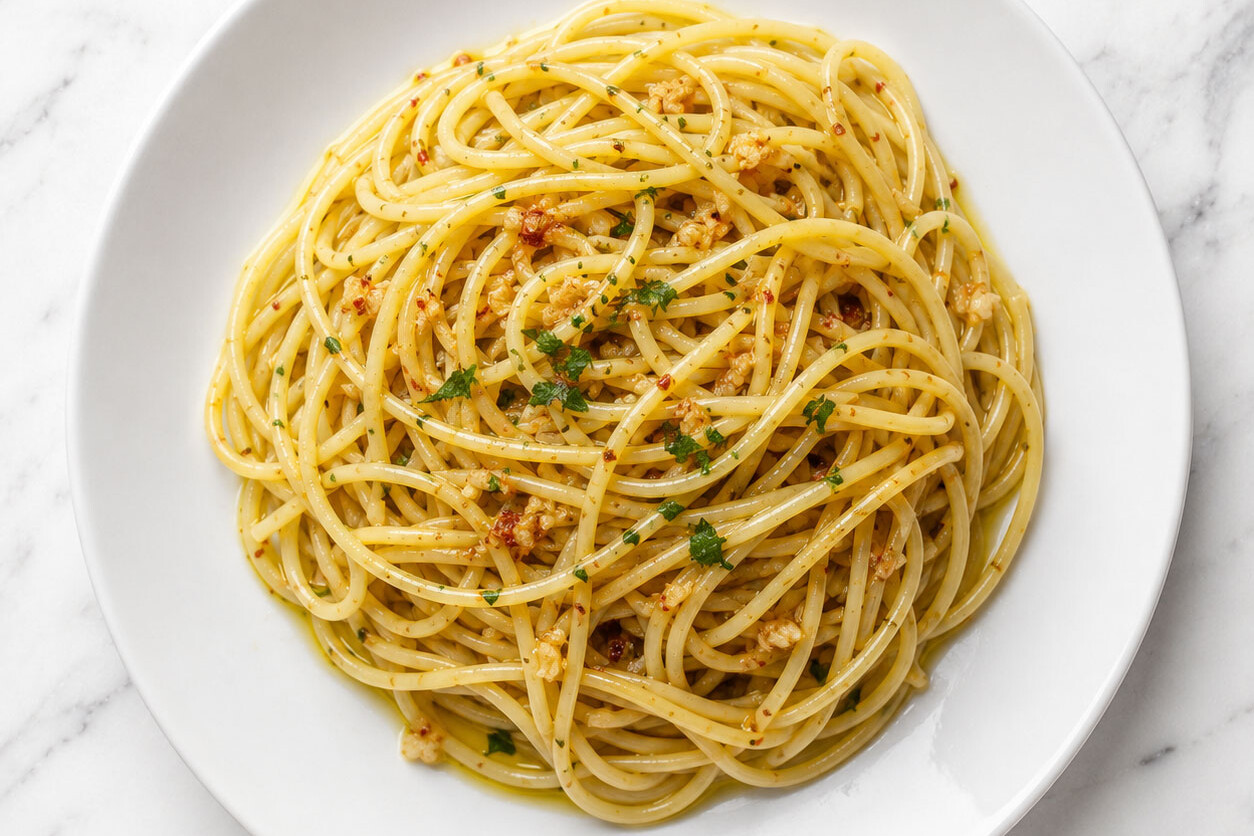
170 Grammi on Crown Street, Surry Hills, a Roman pizza-inspired Italian restaurant, serves one of the most deliberately minimal dishes in the Italian canon: Spaghetti Aglio, Olio, Peperoncino — spaghetti with garlic, olive oil, and chilli. Four ingredients. No tomato. No cream. No shortcuts.
That restraint is the point. Aglio e olio is one of the few Italian pasta dishes where the quality of every ingredient is completely exposed — there is nothing to hide behind. Understanding it is a useful way to understand how Italian cooking actually thinks about flavour.
What Does Aglio e Olio Mean?
Aglio e olio is Italian for “garlic and oil.” Aglio (pronounced AH-lyo) means garlic; olio (OH-lyo) means oil — specifically, in this context, extra virgin olive oil. The conjunction e simply means “and.” Together, they name the two defining ingredients of the dish and describe its entire flavour architecture.
The full name of the most common variant — spaghetti aglio, olio e peperoncino — adds peperoncino (dried red chilli flakes). It is the version most Italians make at home, and the one on the pasta menu at 170 Grammi.
Where Does Aglio e Olio Come From?
Spaghetti aglio e olio originated in Campania, the southern Italian region centred on Naples. It emerged from cucina povera — the tradition of “poor kitchen” cooking that produced some of Italy’s most enduring dishes by making the most of what was always available: dried pasta, olive oil, and garlic from the pantry.
The dish was once known as vermicelli alla Borbonica, a name that references the Bourbon dynasty that ruled the Kingdom of Naples until Italian unification in 1861. Over centuries, it spread north and became embedded in Roman kitchens and trattorie across the country — particularly the peperoncino variant, which took on a specific identity in Rome that persists today.
It belongs to the same culinary logic as cacio e pepe — another pasta defined by what it leaves out. Both dishes demand technique over ingredients, and both reward cooks who understand why the process works, not just what to do.
How Do You Pronounce Aglio e Olio?
The Italian pronunciation is /ˈaʎʎo e ˈɔːljo/. The most important thing to know is that “aglio” is not said with a hard “g.” The gli combination produces a soft, palatal sound — roughly like the “ll” in the English word “million.”
The closest English approximation: “AH-lyo ay OH-lyo.” Run the two words together and the rhythm becomes natural within a few repetitions.
Common mispronunciations include “AH-glee-oh” (hard g) and “AG-lio” (stress on the wrong syllable). Neither is correct, though both are understood in any Italian restaurant without hesitation.
Aglio, Olio e Peperoncino: The Chilli Variant
Aglio, olio e peperoncino — garlic, oil, and dried chilli — is the version most closely associated with Roman dining culture. In Rome, it carries a particular identity: la pasta di mezzanotte, the midnight pasta.
The logic is practical. After theatres close, when kitchens have wound down and restaurants have stopped serving, a bowl of aglio, olio e peperoncino can be on the table in the time it takes to boil water. Every ingredient lives in the pantry indefinitely — no fresh produce required. For Romans coming home late, it became a ritual as much as a recipe.
The chilli does more than add heat. Peperoncino cuts through the richness of the olive oil, sharpens the garlic, and gives the dish the kind of direct, clean flavour that makes it work at midnight or midday. The balance between the three elements — garlic’s depth, oil’s body, chilli’s edge — is where the dish succeeds or fails.
Why the Technique Matters: Emulsification, Not Just Oil
The most common mistake with aglio e olio is treating it as oil-coated pasta. The goal is something more specific: a silky, cohesive emulsion that clings to every strand of spaghetti without pooling at the bottom of the bowl.
That emulsion depends on pasta cooking water. As spaghetti cooks in well-salted boiling water, it releases starch into the liquid. When a ladleful of that starchy water is added to the pan of garlic-infused olive oil and the pasta is tossed vigorously, the starch acts as an emulsifier — binding fat and water molecules into a smooth, unified coating rather than a pool of separated oil.
The temperature matters equally. Garlic is sliced thin and cooked slowly in cold oil brought gradually to heat. The goal is deep flavour without bitterness. The difference between toasted and burnt is a matter of seconds, and burnt garlic is irreversible.
These are the same principles at work in Italian pasta cooking broadly: restraint in ingredients, precision in technique, nothing concealed. The simplicity of the dish makes every error visible — which is exactly what makes it demanding.
Aglio e Olio at 170 Grammi
The pasta menu at 170 Grammi, a Roman pizza restaurant at 428 Crown Street, Surry Hills NSW 2010, Sydney, includes Spaghetti Aglio, Olio, Peperoncino — the chilli variant, made with spaghetti, garlic, chilli, and extra virgin olive oil.
It sits alongside the Roman pasta canon — Rigatoni Amatriciana with San Marzano and guanciale, Pappardelle alla Vaccinara with slow-cooked oxtail ragù — in a pasta menu built around the same philosophy as the Scrocchiarella base: do less, do it precisely.
For anyone wanting to understand what Italian cooking can do with almost nothing, this is the dish to order. It is also the simplest test of whether a kitchen is paying attention.
Reserve a table at 170 Grammi →
Frequently Asked Questions
What does aglio e olio mean in English?
Aglio e olio is Italian for “garlic and oil.” Aglio means garlic, olio means oil, and e means and. The name describes the two defining ingredients of the dish — garlic and extra virgin olive oil — which combine with starchy pasta cooking water to form the sauce. The full name of the most common version, spaghetti aglio, olio e peperoncino, adds peperoncino (dried red chilli flakes) as a third element.
How do you pronounce aglio e olio?
Aglio e olio is pronounced “AH-lyo ay OH-lyo.” The Italian phonetic notation is /ˈaʎʎo e ˈɔːljo/. The most common mistake is pronouncing “aglio” with a hard “g” sound — as in “AH-glee-oh.” The correct pronunciation uses a soft, palatal sound for the “gli” combination, similar to the “ll” in the English word “million.” The stress falls on the first syllable of each word: AH-lyo, OH-lyo.
Is aglio e olio a Roman dish?
Spaghetti aglio e olio originated in Campania, the southern Italian region centred on Naples, where it was known historically as vermicelli alla Borbonica. The dish spread across Italy over centuries. The chilli variant — spaghetti aglio, olio e peperoncino — became deeply embedded in Roman dining culture and is known in Rome as la pasta di mezzanotte (midnight pasta), a late-night staple made entirely from pantry ingredients.
What is the difference between aglio e olio and aglio, olio e peperoncino?
Aglio e olio is the base version — spaghetti with garlic and extra virgin olive oil. Aglio, olio e peperoncino adds dried red chilli flakes (peperoncino), which cut through the richness of the oil and give the dish a clean, direct heat. The peperoncino version is the variant most associated with Roman culture, where it is served as a late-night dish, and is the version served at 170 Grammi Pizzeria in Surry Hills.
Does aglio e olio contain cheese?
Traditional aglio e olio does not include cheese. The sauce is built from garlic-infused olive oil emulsified with starchy pasta cooking water — no dairy required. Some variations add a small amount of grated Pecorino Romano or Parmesan, but this is not standard in the classic recipe. The dish is naturally dairy-free as traditionally prepared, which also means it is one of the most accommodating Italian pastas for guests avoiding dairy.
What pasta shape is used in aglio e olio?
Spaghetti is the traditional pasta shape for aglio e olio. Its long, thin strands are well-suited to the light oil-based emulsion — the sauce coats each strand evenly without pooling. The dish takes its full name from this combination: spaghetti aglio e olio. Other long pastas such as linguine or vermicelli can be used, but spaghetti remains the standard choice and the shape used at 170 Grammi Pizzeria.
Why is aglio e olio sometimes oily instead of silky?
Aglio e olio becomes oily rather than silky when the pasta is added to the oil without incorporating starchy pasta cooking water. The starch from the cooking water acts as an emulsifier, binding the olive oil and water into a unified sauce that coats each strand of spaghetti. Without this step, the oil and water separate and the dish becomes greasy. The fix is to add a ladleful of starchy pasta water to the pan before combining with the pasta, and to toss vigorously over heat until the sauce is smooth.

170 Grammi is Surry Hills’ home of authentic Roman-style pizza, founded by Naples-born pizzaiolo Luigi Esposito. Where Luigi’s other restaurants bring the traditions of Naples to Sydney, 170 Grammi is dedicated to the Roman counterpart — La Tonda Romana — defined by thin, high-hydration dough, long fermentation and a clean, structured crunch that sets it apart from softer southern styles.
Opened in 2024 at 428 Crown Street and already one of the most-searched pizza restaurants in Surry Hills, 170 Grammi has quickly established itself as Sydney’s leading destination for Roman-style pizza. This blog covers the craft and culture behind what makes Roman pizza distinct — from dough technique and fermentation to menu guides, Roman food traditions and what to look for in a genuinely authentic slice.